
Plumbing Fittings Explained
1. Coupling
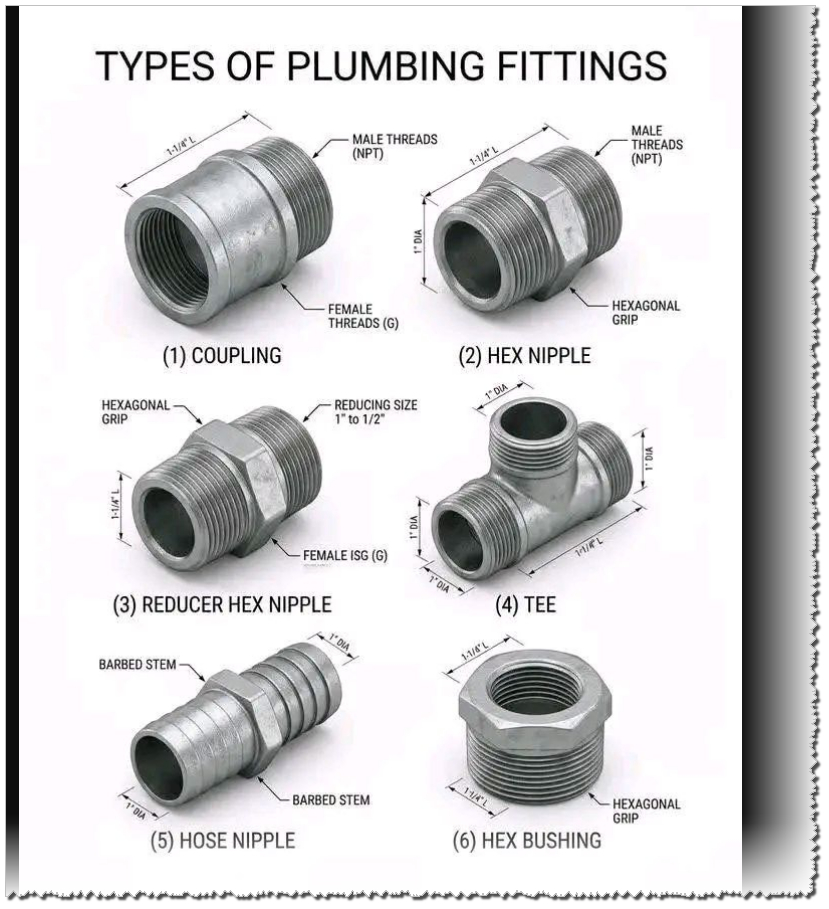
A coupling is used to connect two pipes of the same diameter. It features internal (female) threads on both ends. This is the go-to fitting for extending a straight run of pipe.
2. Hex Nipple
A hex nipple has external (male) threads on both ends. The “hex” refers to the hexagonal section in the middle, which allows a wrench to grip the fitting securely during installation. It is used to connect two female-threaded fittings or valves.
3. Reducer Hex Nipple
Similar to a standard hex nipple, but the two threaded ends are different sizes (e.g., transitioning from a 1″ pipe to a 1/2″ pipe). This allows you to join components of unequal diameters.
4. Tee
A T-shaped fitting with three openings. It is used to split a single line into two separate branches or to combine two lines into one. In the image, this specific tee features male threads on all three ends.
5. Hose Nipple (Barb Fitting)
This fitting is designed to connect a flexible hose to a threaded pipe system.
- Barbed Stems: These slide into the hose, and the ridges grip the interior to prevent it from slipping off.
- Hex Grip: Used to tighten the fitting into a threaded port.
6. Hex Bushing
A bushing is used to reduce the size of a female threaded opening. It has male threads on the outside and female threads on the inside. You would screw this into a larger port so that a smaller pipe or fitting can be attached to it.
Key Technical Note: Thread Types
The image mentions two common thread standards:
- NPT (National Pipe Tapered): Common in North America; the threads are tapered to create a liquid-tight seal.
- G (BSP – British Standard Pipe): Common in Europe and internationally; these are parallel threads that usually require a washer or O-ring to seal.