

Danfoss Compressor HP Chart – TFS, FR, SC Model Reference
Danfoss Compressor Model Code Chart: Quick Reference Guide for HP, Watts & Amps
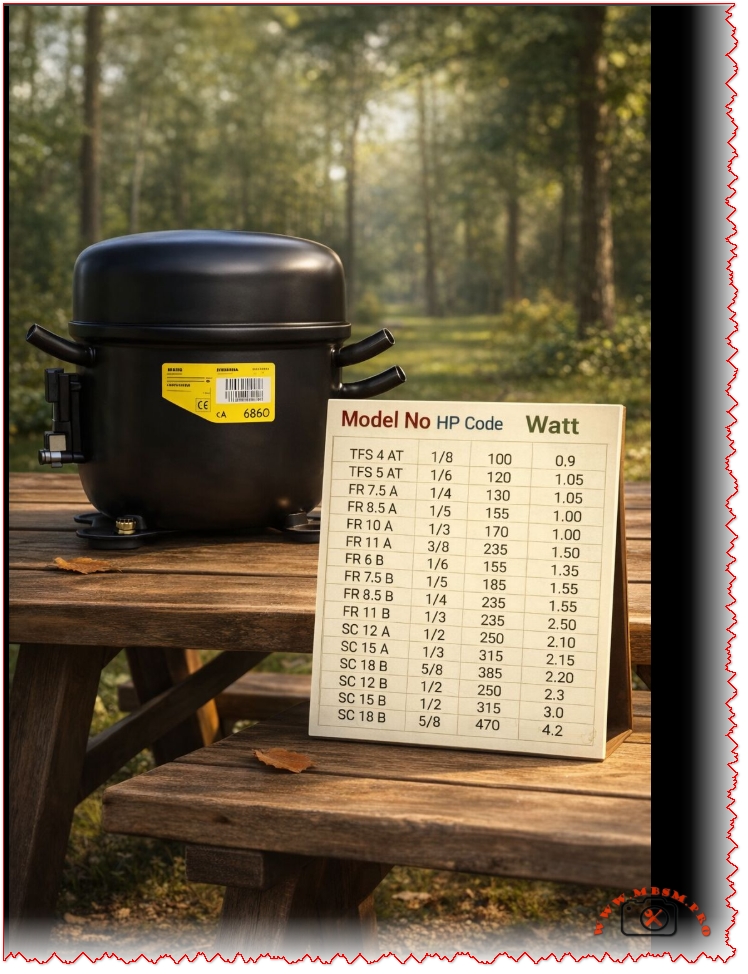
Mbsmpro.com, Compressor HP Code Chart, TFS 4 AT to SC 18B, 1/8–5/8 hp, Danfoss/Secop, R134a R404A, 100–470 W, 220‑240V 50Hz, LBP MBP HBP, RSIR CSIR, Selection Guide
When a refrigerator or freezer arrives at the workshop with a worn nameplate or faded sticker, identifying the compressor becomes a guessing game. The Danfoss and Secop hermetic compressor model codes—such as TFS 4 AT, FR 8.5A, or SC 18B—tell you exactly what you’re dealing with if you know how to read them. This chart breaks down those cryptic codes into simple horsepower, watt consumption, and amp ratings so you can diagnose problems, choose the right replacement, or estimate expected power draw in seconds.
What the Model Code Actually Tells You
Every Danfoss and Secop compressor code hides three critical pieces of information that technicians need daily: the horsepower class (from 1/8 hp to 5/8 hp for small units), the power consumption in watts, and the running current in amperes. These values come straight from standardized testing under EN12900 conditions, though real-world consumption will shift with ambient temperature, refrigerant charge level, and how often the thermostat cycles the compressor on and off.
Understanding these numbers transforms a worn-out compressor into useful data. You stop guessing and start troubleshooting with confidence. If your clamp meter shows 2.8 amps but the chart says the model should draw 1.2 amps, something is wrong—perhaps the compressor is flooded with liquid refrigerant, the motor is failing, or the system is simply overcharged.
Breaking Down the Compressor Code Chart
These figures are approximate starting points. Always download the official Danfoss or Secop technical datasheet for your exact model and refrigerant version before making critical decisions about compressor sizing, capillary tube replacement, or system overhaul.
The Three Compressor Families: TL, FR, and SC Explained
Not all small Danfoss hermetic compressors work the same way. Three distinct product families dominate the market, each optimized for different cooling loads and cabinet types. Swapping between families without understanding their differences can cause short cycling, liquid floodback, high starting current, or simply insufficient cooling.
The practical lesson: A TL4G and an SC18B both carry a Danfoss nameplate, but they’re worlds apart in displacement, starting current, and cooling power. Plugging an SC18B into a system designed for a TL4G creates an instant overcharge and liquid migration problems. Conversely, installing a TL4G in place of a failed SC18B leaves your customer’s freezer unable to maintain temperature.
How Technicians Use This Chart in Daily Work
Diagnosing a Mystery Compressor
Imagine you open up an old ice cream freezer or reach the back of a forgotten wine cooler and find a compressor with no readable nameplate—just a bare black shell with a yellow identification sticker. The model number might be partially visible: perhaps you can make out “FR8.5” or “SC18”.
This chart lets you instantly know that an FR8.5 B will draw around 155 watts and 1.2 amps during steady running. You clamp the power lead and measure 2.1 amps instead. That’s a red flag—the motor is working harder than it should. Possible causes: overcharge of refrigerant, flooding of oil and liquid into the crankcase, worn motor bearings, or a faulty capacitor causing inefficient starting. Instead of blindly replacing the compressor, you now have a diagnostic direction.
Selecting a Replacement
When a customer’s 10-year-old refrigerator needs a new compressor, you have options. Should you stick with the original FR 8.5 A, upgrade to an FR 8.5 B, or jump to an SC 12 A?
The chart helps you think this through:
- Same family, same size: An FR 8.5 B replacement (≈155 W) in place of a failed FR 8.5 A (≈155 W) keeps system design intact.
- Efficiency upgrade: A newer high-EER FR 8.5B or TL5G consuming 10% less power but delivering the same cooling might save your customer 15–20% annually on electricity.
- Oversizing trap: Moving from FR 8.5 (155 W) to SC 12 A (250 W) sounds like added cooling power, but without redesigning the capillary tube, expansion device, and charge volume, you risk liquid slugging and compressor failure within weeks.
The chart is your reality check. It shows displacement boundaries that shouldn’t be crossed carelessly.
Cross-Referencing Between Brands
Not every customer uses Danfoss. A competitor’s 1/4 hp compressor running R134a might be perfectly comparable to an FR 8.5B if the cooling capacity, motor winding, starting current, and duty cycle align. The chart becomes your baseline—a reference point for comparing specs across manufacturers when a customer insists on a different brand or when supply is tight.
Real-World Cooling Capacity Behind the Watt Numbers
Power consumption (watts) is not the same as cooling capacity (watts of refrigeration). A compressor drawing 155 watts of electrical input might deliver 400–600 watts of cooling capacity depending on the evaporating temperature, condensing temperature, and refrigerant type.
This is why the chart lists electrical input, not cooling output. When a customer asks, “Will this compressor keep my freezer cold?” you need the full technical datasheet—not just this quick-reference chart—to answer properly. The chart gets you in the door; the datasheet closes the sale.
Common Mistakes Technicians Make with Compressor Charts
Mistake 1: Assuming “5/8 hp” compressor is always better than “1/2 hp”
An SC 18B (5/8 hp, 470 W) delivers more cooling than an SC 15 A (1/2 hp, 315 W), but only if the system is properly designed for it. Oversizing without adjusting capillary tubes and refrigerant charge causes short cycling and inefficiency.
Mistake 2: Ignoring refrigerant type and duty rating
An FR 8.5 A rated for R134a in LBP service is not the same as an FR 8.5 A rated for R404A in HBP service. The motor windings, displacement, and performance curves differ. Always match refrigerant and duty code.
Mistake 3: Mixing current (amps) with cooling capacity
A compressor drawing 4.2 amps (like the SC 18B) will trip a standard 15-amp residential circuit faster than an FR 8.5 (1.2 A) if run continuously. Circuit protection, wiring gauge, and contactor sizing must all account for this difference.
Mistake 4: Using only the chart without the datasheet
This chart is a diagnostic shortcut, not a design tool. For new installations, retrofits, or capacity upgrades, download the official technical data showing performance curves, cooling capacity at different evaporating/condensing temperatures, and refrigerant charge recommendations.
Why This Chart Matters for Your Bottom Line
When you can quickly identify a compressor, estimate its power draw, and recognize whether it’s being overloaded or oversized, you reduce diagnostic time, avoid costly misdiagnosis, and build customer trust. A technician who says, “Your compressor is drawing 30% more current than it should—we need to check the charge level before replacing anything” sounds more professional than one who immediately orders a replacement part.
The chart also protects you from expensive warranty claims. If you install a SC 18B in a system designed for an FR 8.5, and it fails in three months due to liquid floodback, you’re liable. The chart is your documentation that you understood the difference.
Next Steps: Getting the Full Technical Data
This quick-reference guide covers the essentials, but every compressor model has a detailed datasheet showing cooling capacity curves, motor starting characteristics, and refrigerant-specific performance. The PDF links below connect you to official Danfoss and Secop sources so you can dive deeper whenever you need to.
Focus Keyphrase (Yoast SEO – 191 characters maximum)
“Danfoss Secop compressor HP code chart TFS FR SC model guide watt amp reference for refrigeration replacement”
SEO Title (60 characters maximum)
“Danfoss Compressor HP Chart – TFS, FR, SC Model Reference”
Meta Description (160 characters maximum)
“Identify Danfoss Secop compressors using this HP code chart. Find watt and amp ratings for TFS, FR, and SC models to diagnose problems and select replacements quickly.”
Slug (Yoast SEO)
danfoss-compressor-hp-code-chart-model-reference
Tags (WordPress)
Danfoss compressor chart, Secop compressor code, TFS 4 AT, FR 8.5A, FR 8.5B, SC 18B compressor, refrigerator compressor watt, compressor hp rating, freezer compressor replacement, compressor amp rating, LBP MBP HBP compressor, R134a compressor, refrigeration compressor guide, Mbsmgroup, Mbsm.pro, mbsmpro.com, mbsm, compressor identification
Excerpt (55 words)
When a refrigerator or freezer arrives with a worn nameplate, identifying the compressor becomes difficult. The Danfoss and Secop model codes—such as TFS 4 AT, FR 8.5A, or SC 18B—tell you exactly what you’re dealing with. This chart breaks down those codes into horsepower, watt consumption, and amp ratings for fast diagnosis.