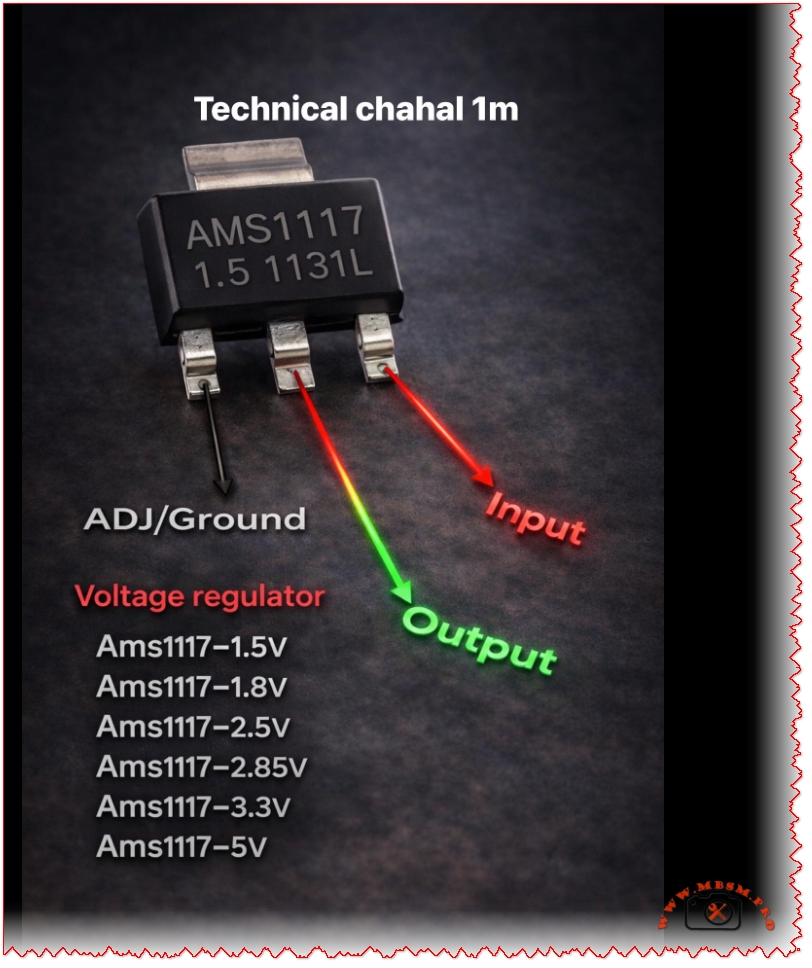
AMS1117 Voltage Regulator

 88
88AMS1117 Voltage Regulator Pinout and Versions: Complete Guide for Electronics Projects
The AMS1117 family is one of the most widely used linear regulators for stepping down DC voltages in embedded and DIY electronics projects. Its simple three‑pin layout and multiple fixed output versions make it an excellent choice for powering microcontrollers, sensors, and communication modules.
AMS1117 overview
- The AMS1117 is a low‑dropout (LDO) linear voltage regulator capable of delivering up to 1 A of continuous current, depending on heat dissipation and PCB design.
- It is available as fixed‑output regulators (1.5 V, 1.8 V, 2.5 V, 2.85 V, 3.3 V, 5 V and others) and as an adjustable version that can be set from about 1.25 V to 12 V using external resistors.
Pinout: input, output, and ground/ADJ
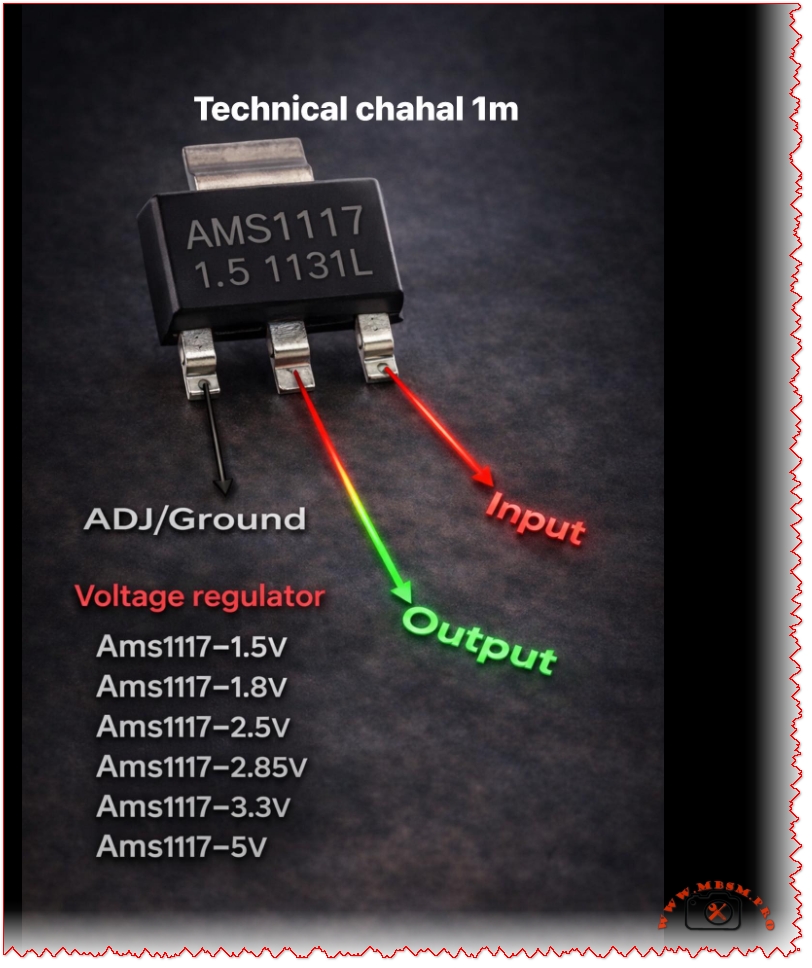
- In the common SOT‑223 package, the pins from left to right (front view, text facing you) are ADJ/GND, OUTPUT, and INPUT.
- For fixed versions (such as AMS1117‑3.3 or AMS1117‑5.0), the first pin is tied to ground, while for the adjustable version it is used as the ADJ pin to set the output voltage with a resistor divider.
Fixed output AMS1117 variants
The table below summarizes popular fixed‑voltage versions and typical use cases.
| AMS1117 version | Nominal output | Typical application example |
|---|---|---|
| AMS1117‑1.5 | 1.5 V | Low‑voltage ASICs, reference rails |
| AMS1117‑1.8 | 1.8 V | ARM cores, SDRAM, logic ICs |
| AMS1117‑2.5 | 2.5 V | Older logic families, ADC/DAC rails |
| AMS1117‑2.85 | 2.85 V | Mobile RF, modem chipsets |
| AMS1117‑3.3 | 3.3 V | MCUs, sensors, 3.3 V logic from 5 V sources |
| AMS1117‑5.0 | 5.0 V | Regulating from 7–12 V to 5 V logic or USB lines |
Electrical characteristics and design tips
- The typical input range for AMS1117 regulators is up to 12–15 V, with a dropout voltage around 1.1–1.3 V at 1 A, meaning the input must be at least about 1.3 V higher than the desired output.
- For stable operation, manufacturers recommend small bypass capacitors at both input and output (for example 10 µF electrolytic or tantalum), which help reduce noise and improve transient response in digital circuits.
Typical applications in embedded systems
- AMS1117 regulators are frequently used to derive 3.3 V from 5 V USB or 9–12 V adapter inputs in Arduino‑style development boards and sensor modules.
- Thanks to built‑in thermal shutdown and short‑circuit protection in many implementations, these regulators offer a robust solution for compact PCBs, IoT nodes, and hobby electronics where space and simplicity are critical.