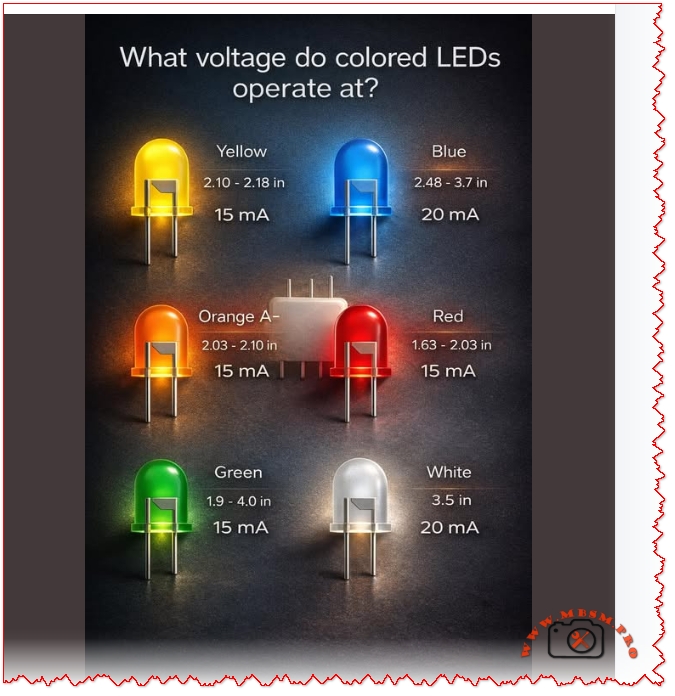
Typical forward voltages vary by LED color — red ~1.6–2.0 V, green ~1.9–4.0 V, blue/white ~2.5–3.7+ V — always size a series resistor or constant‑current driver to protect the LED.
LED Forward Voltage Guide and Practical Selection for Engineers
Why this matters Choosing the right LED and drive method prevents failures, ensures consistent brightness, and optimizes efficiency. Forward voltage (Vf) depends on semiconductor material and color; using nominal Vf from datasheets or trusted references is essential.

Typical Forward Voltages by Color
| Color | Typical Vf Range | Typical If |
|---|---|---|
| Red | 1.63 – 2.03 V | 15 mA |
| Orange | 2.03 – 2.10 V | 15 mA |
| Yellow | 2.10 – 2.18 V | 15 mA |
| Green | 1.9 – 4.0 V | 15 mA |
| Blue | 2.48 – 3.7 V | 20 mA |
| White | ~3.5 V | 20 mA |
(Values synthesized from standard LED references and calculators; always confirm with the component datasheet.)
How to Size a Series Resistor
Formula:
Example: For 12 V supply, blue LED Vf = 3.2 V, If = 20 mA →
Power on resistor:
Comparison Table LED Drive Options
| Drive Method | Pros | Cons | Best Use |
|---|---|---|---|
| Series resistor | Simple, cheap | Wasteful at high Vin–Vf; brightness varies with Vin | Indicator LEDs, low-cost boards |
| Constant current driver | Stable brightness, efficient | More complex, costlier | High-power LEDs, strings, lighting |
| PWM with resistor | Dimmable, efficient average power | Requires filtering for analog loads | LED dimming, displays |
Common Mistakes and How to Avoid Them
- Using nominal Vf without margin — always allow tolerance and temperature shift; Vf drops with temperature for some colors.
- No current limiting — leads to thermal runaway and failure; use resistor or CC driver.
- Ignoring resistor power rating — calculate and choose resistor with margin.
- Series too many LEDs without checking total Vf — ensure supply > sum(Vf) + margin.
- Assuming all green/white LEDs share same Vf — modern green/amber/white vary widely; check datasheet.
Engineering Tips and Best Practices
- Prefer constant‑current drivers for multi‑LED strings or >20 mA devices.
- Use 0.1 µF ceramic + electrolytic decoupling on driver inputs to stabilize supply.
- Thermal management: high‑power LEDs need heatsinking; junction temperature affects Vf and lifetime.
- Measure Vf under operating current when designing — bench test with regulated current source.
- For SMD LEDs, consult manufacturer SMD tables; Vf can differ from through‑hole types.
Focus Keyphrase
LED forward voltage by color typical Vf ranges resistor calculation constant current driver selection for indicators and lighting
SEO Title
Mbsmpro.com, LED Forward Voltage Chart, Red Green Blue White Yellow Orange, Vf Ranges, Resistor Calculation, Driver Selection
Meta Description
Complete LED forward voltage guide with color Vf ranges, resistor sizing formula, drive method comparison, common mistakes, and engineering tips for reliable LED designs.
Slug
led-forward-voltage-chart-resistor-calculation-driver-selection
Tags
LED, Forward Voltage, Vf, Resistor Calculation, Constant Current, Indicator LED, White LED, Blue LED, Mbsmgroup, Mbsm.pro, mbsmpro.com, mbsm
Excerpt (first 55 words)
Typical LED forward voltages vary by color: red ~1.6–2.0 V, green ~1.9–4.0 V, blue/white ~2.5–3.7+ V. This guide explains Vf ranges, resistor sizing formula, constant‑current drivers, common mistakes, and practical engineering tips to design reliable LED circuits.