 Refrigeration
Key HVAC full forms


Mbsmpro.com, HVAC Abbreviations, HVAC, AHU, FCU, CSU, PAC, BTU, PSI, TR, VAV, VRV, VRF, RPM, DC, DB, ACB
Key HVAC full forms
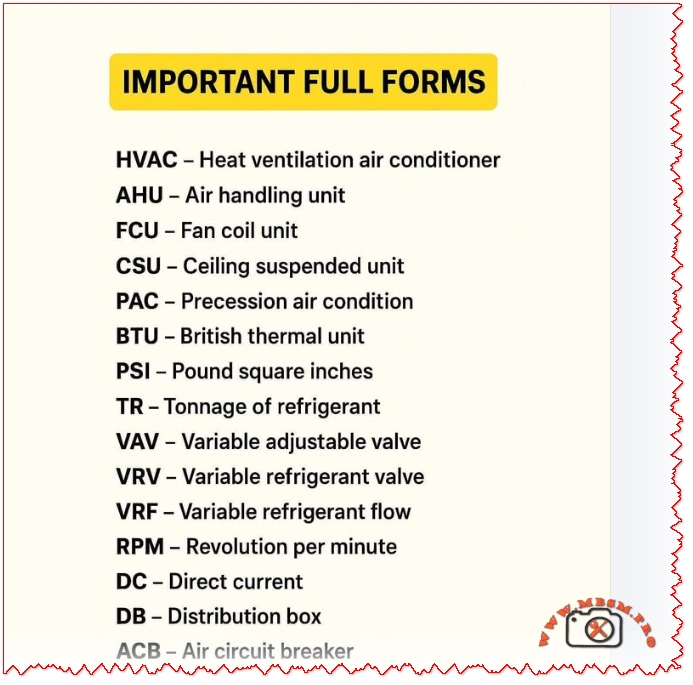
In daily HVAC practice, technicians use many abbreviations that can confuse beginners and even young engineers. Below is a corrected, standards‑based list of the most common terms and what they really mean.
| Abbreviation | Correct full form | Technical note |
|---|---|---|
| HVAC | Heating, Ventilation and Air Conditioning | General term for comfort and process air‑conditioning systems. |
| AHU | Air Handling Unit | Central unit with fan, filters and coils that conditions and distributes air through ductwork. |
| FCU | Fan Coil Unit | Small terminal unit with fan and coil, usually serving a single room or zone. |
| CSU | Ceiling Suspended Unit (often a type of fan coil or cassette) | Manufacturer term; not standardised like AHU/FCU but widely used in catalogs. |
| PAC | Precision Air Conditioner | High‑accuracy unit for data centers, labs and telecom rooms, with tight temperature and humidity control. |
| BTU | British Thermal Unit | Heat quantity needed to raise 1 lb of water by 1 °F; 1 refrigeration ton = 12 000 BTU/h. |
| PSI | Pounds per Square Inch | Pressure unit for refrigerants, water and air in piping and vessels. |
| TR / Ton | Ton of Refrigeration | Cooling capacity of 12 000 BTU/h, roughly 3.517 kW, used to size chillers and package units. |
| VAV | Variable Air Volume | Air‑distribution system that keeps supply temperature almost constant while varying airflow to each zone. |
| VRV | Variable Refrigerant Volume (Daikin trade name) | Brand name for multi‑split systems using variable refrigerant flow technology. |
| VRF | Variable Refrigerant Flow | Generic term for inverter‑driven multi‑split systems that modulate refrigerant flow to many indoor units. |
| RPM | Revolutions per Minute | Rotational speed of motors, fans and compressors. |
| DC | Direct Current | Unidirectional electric current used in ECM fan motors, inverter drives and controls. |
| DB | Dry‑Bulb (temperature) or Distribution Board (electrical) | In HVAC drawings DB usually means dry‑bulb temperature; in electrical layouts, it means distribution board. |
| ACB | Air Circuit Breaker | High‑capacity protective device used in main LV switchboards feeding large HVAC plants. |
These definitions correct several mistakes often seen on social media, such as “Heat ventilation air conditioner” for HVAC or “Pound square inches” for PSI, which are not accepted engineering terms.
How these terms work in real projects
Understanding the context of each abbreviation is essential when reading specifications or troubleshooting systems on site.
- HVAC vs PAC
- AHU, FCU and CSU in a building
- Tonnage (TR) and BTU in equipment selection
- Manufacturers still rate split and rooftop units in BTU/h for the global market, while consultants size plants in tons or kW, so technicians must convert between units quickly.
- On residential projects, 1–2 ton units dominate, while data centers or malls may require hundreds of tons on central chillers or VRF networks.
Comparing VAV, VRF and traditional systems
Many designers now face a practical choice between classic VAV ducted systems and newer VRF/VRV systems. Below is a concise comparison that can help technicians justify selections to clients.
System comparison in practice
| Feature | VAV system | VRF / VRV system | Conventional constant‑volume DX |
|---|---|---|---|
| Energy control | Varies air volume with nearly constant supply temperature. | Varies refrigerant flow using inverter compressors. | Fixed compressor and constant airflow, controlled by on/off cycling. |
| Ductwork | Requires extensive ducts, plenums, and balancing dampers. | Often ductless or with short ducts from indoor units. | Medium ductwork, usually single‑zone per unit. |
| Indoor units | VAV boxes with reheat coils or dampers at zones. | Multiple indoor fan coils (wall, cassette, ducted, ceiling suspended). | One indoor unit per outdoor condenser. |
| Best applications | Large open‑plan offices, hospitals, airports with central plant. | Mixed‑use buildings, hotels, retrofits where duct space is limited. | Small shops, houses, standalone rooms. |
From a maintenance viewpoint, VRF/VRV brings more electronic controls and refrigerant circuitry, while VAV focuses on dampers, actuators and good air‑side balancing.
Typical values and practical examples
To make these abbreviations more concrete for field technicians, the table below summarizes indicative values that are often encountered in manuals and commissioning reports.
| Parameter | Typical range / example | Where it is used |
|---|---|---|
| TR (Ton of Refrigeration) | Small split: 1–2 TR, VRF module: 8–20 TR, chiller: 50–500+ TR. | Cooling capacity on nameplates, load calculations. |
| PAC room set‑point | 22–24 °C, 45–55% RH, tolerance ±1 °C. | Data centers, telecom shelters, medical labs. |
| VAV supply air temp | About 12–14 °C constant; airflow modulates with load. | AHU discharge in variable air volume systems. |
| VRF evaporating temp | Usually −5 to +10 °C depending on mode and design. | Service data on outdoor units. |
| Fan / motor RPM | 900–1 400 RPM for large AHU fans, 2 800–3 600 RPM for small compressors. | Motor nameplates, balancing reports. |
| Common refrigerant pressures | R410A suction: 110–145 PSI, discharge: 350–450 PSI in cooling at comfort conditions (approximate). | Gauge readings when interpreting PSI in service. |
Knowing these values helps technicians quickly judge whether measured TR, PSI, RPM or temperature readings are normal or indicate faults.
Why accurate full forms matter for SEO and training
Correct terminology is not only important on drawings and control panels; it also has direct impact on SEO and on how junior technicians learn from the web. When HVAC blogs repeat wrong expansions like “Precession air condition” for PAC or “Variable refrigerant valve” for VRV, they create confusion and may even mislead search engines.
For a site such as Mbsmpro.com, using standard full forms aligned with ASHRAE‑style abbreviation lists increases topical authority and helps rank for professional queries like “HVAC abbreviations BTU PSI TR” or “difference between VRF and VAV”.
Focus keyphrase
HVAC abbreviations full forms HVAC AHU FCU CSU PAC BTU PSI TR VAV VRV VRF RPM DC DB ACB
SEO title
HVAC Abbreviations Explained: HVAC, AHU, FCU, PAC, BTU, PSI, TR, VAV, VRV, VRF, RPM, DC, DB, ACB | Mbsmpro.com
Meta description
Learn the correct full forms of key HVAC abbreviations such as HVAC, AHU, FCU, PAC, BTU, PSI, TR, VAV, VRV, VRF, RPM, DC, DB and ACB, with practical examples and system comparisons for technicians and engineers.
Slug
hvac-abbreviations-full-forms-hvac-ahu-fcu-pac-btu-psi-tr-vav-vrv-vrf-rpm-dc-db-acb
Tags for WordPress
HVAC abbreviations, HVAC full forms, HVAC, AHU, FCU, PAC, BTU, PSI, TR, VAV, VRV, VRF, RPM, Direct current, Dry bulb temperature, Air handling unit, Fan coil unit, Precision air conditioner, Variable refrigerant flow, Variable air volume, refrigeration ton, Mbsmgroup, Mbsm.pro, mbsmpro.com, mbsm
Excerpt (first 55 words)
In daily HVAC practice, technicians use many abbreviations that can confuse beginners and even young engineers. This article explains the most important HVAC abbreviations and their correct full forms, including HVAC, AHU, FCU, PAC, BTU, PSI, TR, VAV, VRV, VRF, RPM, DC, DB and ACB, with practical notes for real projects.