
8‑pin and 11‑pin relay bases are common in control panels


Mbsmpro.com, Relay Base, 8‑Pin vs 11‑Pin, Pinout, Coil Terminals, COM, NO, NC, Wiring Guide, DPDT, 3PDT, Control Panel, HVAC
8‑pin and 11‑pin relay bases are common in control panels, but miswiring coil and contact terminals can burn a load or keep a circuit from switching. This guide explains each pin function, shows practical wiring logic for NO/NC contacts, and compares 8‑pin DPDT sockets with 11‑pin 3PDT sockets for automation work in HVAC retrofits today.
Excerpt (first 55 words):
8‑pin and 11‑pin relay bases are common in control panels, but miswiring coil and contact terminals can burn a load or keep a circuit from switching. This guide explains each pin function, shows practical wiring logic for NO/NC contacts, and compares 8‑pin DPDT sockets with 11‑pin 3PDT sockets for automation work in HVAC retrofits today.
Relay base pinouts
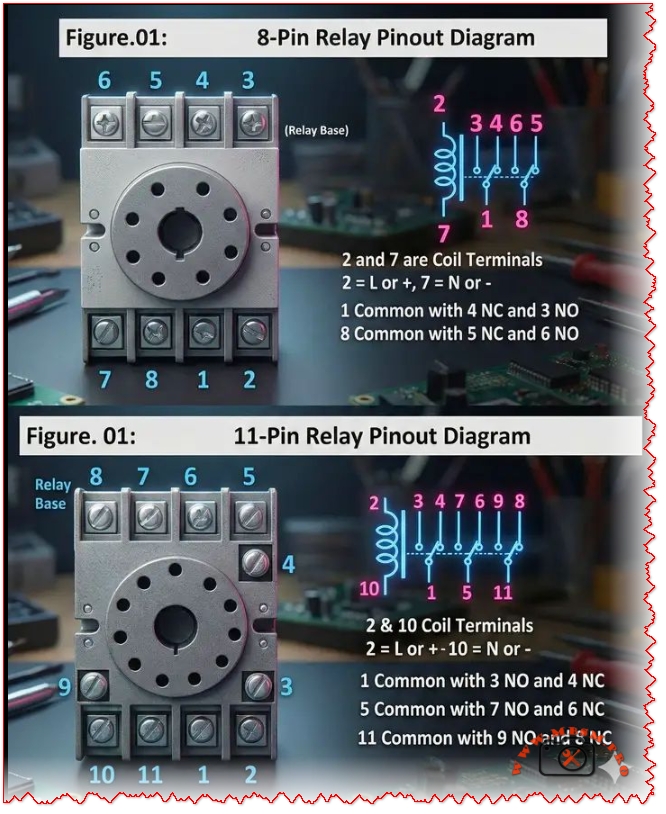
An 8‑pin “octal” relay base is typically used for a DPDT relay (two changeover contact sets), while an 11‑pin base is commonly used for a 3PDT relay (three changeover contact sets).
8‑pin relay base (DPDT) — pin functions
| Pin | Function |
|---|---|
| 2, 7 | Coil (energize the relay) |
| 1 | COM for contact set #1 |
| 4 | NC with COM=1 |
| 3 | NO with COM=1 |
| 8 | COM for contact set #2 |
| 5 | NC with COM=8 |
| 6 | NO with COM=8 |
Quick rule: when the coil is OFF, COM touches NC; when the coil is ON, COM switches to NO.
11‑pin relay base (3PDT) — pin functions
8‑pin vs 11‑pin (what changes)
Wiring scenarios
Scenario A: Holding (latching) circuit with an 8‑pin relay
A common use of an 8‑pin relay is a holding/latching circuit where one NO contact “seals in” the coil after a momentary START signal.
Copy-ready steps:
Scenario B: Interlocking with an 11‑pin relay
An 11‑pin relay’s three contact sets are often used to create electrical interlocking and holding logic (example: forward/reverse or lead/lag lockout) while keeping extra contacts for status/alarms.
Copy-ready steps:
- Power the coil on pins 2 and 10, then assign one contact set for the hold path, one for interlock permissive, and one for feedback (COM/NC/NO groups shown in the table above).
Troubleshooting
If a relay “never pulls in,” confirm the coil pins first (8‑pin: 2 & 7; 11‑pin: 2 & 10) and verify the correct control voltage is actually reaching the coil.
If outputs look “reversed,” it’s usually because COM and NO/NC were swapped; one practical reference notes that pins 2 and 7 are coil pins on an 8‑pin relay and explains which pins behave as open vs closed contacts.
When base numbering is confusing, use a multimeter continuity test: find COM, then check which terminal is continuous with COM when the coil is off (NC) and when energized (NO).
Yoast SEO package
Focus keyphrase (≤191 chars):
8 pin relay base pinout and 11 pin relay base pinout wiring (coil, COM, NO, NC)
Related keyphrases to target (search intent):
- 8 pin relay socket wiring
- octal relay base pinout
- DPDT relay base terminals 2 7
- 11 pin relay socket pin diagram
- 3PDT relay base wiring
- relay COM NO NC meaning
- relay interlocking wiring diagram
- relay holding (seal-in) circuit wiring
SEO title (Yoast):
8‑Pin vs 11‑Pin Relay Base Pinout (Coil, COM, NO, NC) | Mbsmpro
Meta description (Yoast):
Learn the 8‑pin and 11‑pin relay base pinout fast: coil terminals, COM/NO/NC contacts, DPDT vs 3PDT differences, and wiring tips for holding and interlocking control circuits.
Slug:
8-pin-vs-11-pin-relay-base-pinout
Tags (comma separated):
Mbsmgroup, Mbsm.pro, mbsmpro.com, mbsm, relay base, relay socket, 8 pin relay, 11 pin relay, octal relay, DPDT relay, 3PDT relay, COM NO NC, control panel wiring, HVAC controls, interlocking circuit, holding circuit
On-page SEO note: strong page titles improve click-through and relevance, so keep the main keyphrase near the start of the title and make it specific to the exact pinout problem being solved.