Refrigeration
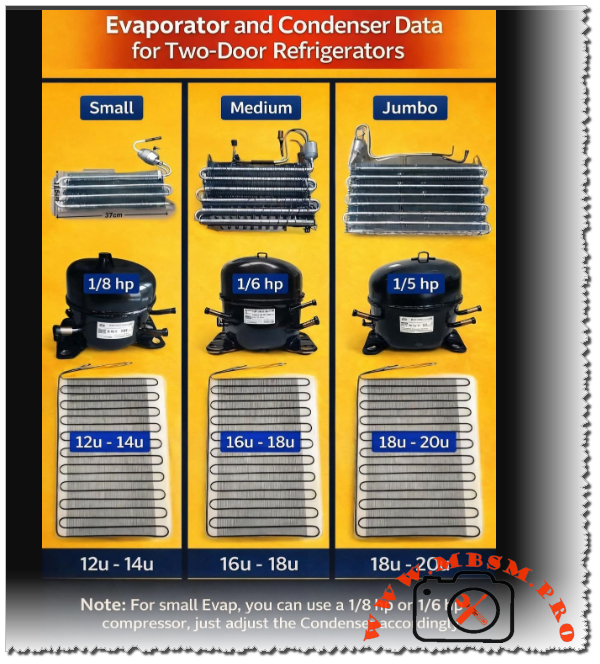
Evaporator and Condenser Data, Two-Door Refrigerators


Mbsmpro.com, Evaporator and Condenser Data, Two-Door Refrigerators, 1/8 hp, 1/6 hp, 1/5 hp, System Sizing, Static Cooling, R134a or R600a, Heat Exchange Balancing
The Engineering Art of Balancing Refrigeration Systems: Evaporators, Condensers, and Compressors
In the world of domestic refrigeration, specifically for two-door appliances, the harmony between the three primary components—the compressor, the evaporator, and the condenser—determines the longevity and efficiency of the unit. As a field expert who has spent years troubleshooting and designing cooling circuits, I can tell you that a mismatch in these components is the leading cause of premature compressor failure and poor cooling performance.
Selecting a compressor is only the first step. To achieve thermal equilibrium, the heat absorbed by the evaporator in the freezer and fridge compartments must be effectively rejected by the condenser. This article breaks down the technical standards for small, medium, and jumbo two-door systems to ensure your repairs or builds meet professional engineering benchmarks.
Technical Specifications and Component Matching
The following data provides the standard configurations for static-cooled two-door refrigerators. These values are critical for technicians performing “system upgrades” or replacing missing components.
| System Category | Compressor HP | Evaporator Type | Condenser Size (U-Bends) | Typical Capacity (Liters) |
| Small | 1/8 hp | Compact (~37cm) | 12u – 14u | 180L – 240L |
| Medium | 1/6 hp | Standard Fin | 16u – 18u | 250L – 320L |
| Jumbo | 1/5 hp | Large Surface | 18u – 20u | 330L – 450L |
Deep Dive into System Scaling
1. The Small System (1/8 hp)
Designed for compact two-door units, the 1/8 hp compressor works best with a condenser featuring 12 to 14 U-bends. This provides enough surface area to reject heat without causing excessive high-side pressure. If you find a unit struggling in high ambient temperatures (Tropical Class), increasing the condenser to 14u can significantly lower the compressor’s operating temperature.
2. The Medium Workhorse (1/6 hp)
This is the most common configuration in the market. A 1/6 hp compressor requires a robust heat rejection path, typically 16 to 18 U-bends. Using a 1/6 hp compressor with a small (12u) condenser will lead to “thermal trip” where the overload protector cuts out because the refrigerant cannot liquify fast enough, causing high head pressure.
3. The Jumbo Configuration (1/5 hp)
For large domestic refrigerators, the 1/5 hp compressor is the standard. These systems utilize jumbo evaporators to handle larger food volumes. To balance this, the condenser must be 18 to 20 U-bends. Anything less will result in poor sub-cooling and high energy consumption.
Comparative Value Analysis: Heat Rejection vs. Horsepower
Understanding the relationship between compressor power and the physical dimensions of the heat exchangers is vital.
| Feature | 1/8 hp System | 1/6 hp System | 1/5 hp System |
| Evaporator Width | ~37 cm | ~45 cm | ~52 cm+ |
| Condenser Area | Baseline | +25% | +45% |
| Refrigerant Charge | Low (80-100g) | Medium (120-150g) | High (160g+) |
| Cooling Speed | Moderate | High | Professional Grade |
Engineering Insights: The “Note” on Compressor Swapping
One of the most valuable secrets in the field involves “over-motoring” a system. If you have a refrigerator designed for a small evaporator (traditionally 1/8 hp), you can install a 1/6 hp compressor to achieve faster pull-down times.
The Engineer’s Notice:
When upgrading from 1/8 hp to 1/6 hp on a small evaporator, you must adjust the condenser accordingly. By adding two extra U-bends or ensuring the existing condenser is perfectly clean and has maximum airflow, you prevent the higher-torque motor from overheating the system. Failing to adjust the condenser during a horsepower upgrade is a recipe for a “returned” repair within six months.
Professional Advice for Field Technicians
- Cleanliness is Efficiency: A 20u condenser that is covered in dust performs worse than a clean 12u condenser. Always vacuum the condenser coils during every service call.
- Capillary Tube Matching: When changing horsepower, verify the capillary tube length. A 1/5 hp compressor requires a different flow rate than a 1/8 hp unit to avoid liquid slugging.
- The “Finger Test”: On a balanced system, the first two bends of the condenser should be hot (not burning), and the last bend should be slightly above room temperature. If the whole condenser is hot, it is undersized for the compressor.
Focus Keyphrase
Evaporator and Condenser Data for Two-Door Refrigerators 1/8 1/6 1/5 hp
SEO Title
Mbsmpro.com, Evaporator and Condenser Data, Two-Door Refrigerators, 1/8 hp, 1/6 hp, 1/5 hp, Condenser U-Bends Calculation
Meta Description
Professional engineering guide for balancing two-door refrigerators. Learn the correct condenser U-bend counts and evaporator sizes for 1/8, 1/6, and 1/5 hp compressors.
Slug
refrigerator-evaporator-condenser-hp-data-guide
Tags
Refrigeration, Compressor, Evaporator, Condenser, 1/8 hp, 1/6 hp, 1/5 hp, Two-Door Fridge, HVAC Repair, Mbsmgroup, Mbsm.pro, mbsmpro.com, mbsm
Excerpt
Achieving perfect cooling requires a precise balance between the compressor horsepower and the heat exchange surface area. Whether you are working with a small 1/8 hp unit or a jumbo 1/5 hp system, understanding the required U-bends in the condenser is the key to professional, long-lasting refrigeration repairs and system design.
Technical Resources and Downloads
- Internal Link: Mbsm.pro Compressor and Capillary Tube Sizing Chart