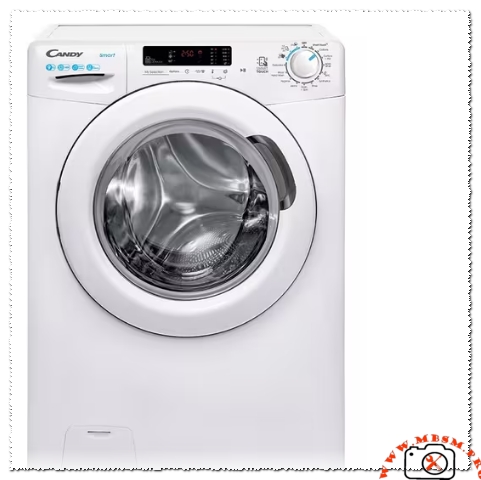
Stay away from 4 washing machines: Kiriazi, Candy, GMC, White Whale
Stay away from 4 washing machines: Kiriazi, Candy, GMC, White Whale mbsmpro


Mbsmpro.com, Washing Machines, Technical Reliability, LG, Samsung, Bosch, Structural Failures, Kiryazi, Candy, GMC, White Whale

our decision to stay away from these four brands (Kriazi, Candy, GMC, White Whale) may be based on past experiences or technical advice related to the availability of spare parts, the quality of after-sales service, or the lifespan of electronic components.

In the professional appliance sector, choosing a washing machine is an engineering audit, not a simple shopping trip. As a field expert who has dismantled thousands of units and performed rigorous stress tests on drive systems, I look beyond the digital displays to the mechanical heart of the machine: the drum bearings, the motor windings, and the electrolytic capacitors on the control board.

Technical data from the field indicates a significant divergence in quality. While some brands focus on high-turnover consumer goods, others invest in Structural Integrity. If you are being advised to “stay away” from Kiryazi, Candy, GMC, and White Whale, it is not a matter of brand bias—it is a matter of documented mechanical fatigue and specialized component scarcity.

Technical Breakdown: Identifying the Structural Bottlenecks

When an appliance fails, it is usually due to a “weakest link” in its design. Here is the professional technical breakdown of why these four brands often face professional criticism from repair engineers:

  • Kiryazi (Structural Oxidation): The primary issue lies in the galvanization process of the outer cabinet. In many models, the steel gauge is insufficient, leading to premature rust around the detergent drawer and base, which eventually compromises the machine’s balance during high-RPM cycles.
  • Candy (Electronic Volatility): Candy machines often feature highly sophisticated integrated circuits. However, the PCB (Printed Circuit Board) lacks robust thermal shielding. In environments with fluctuating voltage, the microprocessor is prone to “logic hanging” or total failure.
  • GMC (Mechanical Friction): Many GMC models rely on traditional Universal Brush Motors. These motors generate significant carbon dust and heat, leading to shorter lifespans for the drive belt and much higher decibel levels during the spin cycle.
  • White Whale (Component Inconsistency): The “Spider” assembly (the three-arm support for the drum) in these units is frequently made of a low-grade Zinc-Aluminum alloy. This material reacts chemically with liquid detergents, leading to “pitting corrosion” and eventual drum detachment.

Engineering Comparison: High-Tier vs. Standard Tier

To make an informed decision, we must compare the Material Science and Drive Systems of industry leaders against standard budget models.

Technical Component Standard Group (Avoid) LG (Direct Drive) Samsung (Inverter) Bosch (Series 6/8)
Motor Tech Universal Carbon Brush Brushless DC (BLDC) Digital Inverter EcoSilence Drive
Drive Logic Mechanical Pulley Direct Coupling Reinforced Ribbed Belt High-Torque Belt
Bearing Seal Single Lip Double-Lip / Viton High-Temp Synthetic Industrial Grade
PCB Protection Basic Varnish Resin Encapsulation Moisture Shield Thermal Management
Vibration Control Standard Springs 6-Motion AI VRT Plus (Ball Balance) AntiVibration Walls

The Inverter Logic: Electronic Schematic of Superiority

For the technician, the shift to Inverter Technology (found in LG, Samsung, and Bosch) is the greatest leap in reliability. Unlike the simple “On/Off” relay logic of older GMC or Kiryazi units, modern systems utilize a Variable Frequency Drive (VFD) logic path:

  1. Rectification Stage: Incoming AC is converted to stable DC power.
  2. IGBT Switching: (Insulated Gate Bipolar Transistors) pulse the power to the motor windings.
  3. Frequency Modulation: By changing the electrical frequency, the machine controls torque and speed with extreme precision, without mechanical stress.
  4. Result: This eliminates the Carbon Brushes, which are the primary wear-and-tear component in traditional washing machines.

Field Values: Performance Comparison Metrics

Performance Feature Budget Brands (Kiryazi/GMC) Premium Engineering (LG/Bosch)
Spin Decibels 76 dB – 82 dB 48 dB – 54 dB
Thermal Cut-out Frequent (friction-based heat) Rare (active cooling logic)
Drum Balance Passive (Weight-based) Active (Sensor-based)
Parts Availability Fragmented / Generic Serialized / Global

Professional Councils and Maintenance Protocols

  • Advice on Installation: Never place a washing machine on a wooden floor or an unlevel surface. For Bosch and LG units, precision leveling is required to allow the internal accelerometers to calibrate the “Zero-Point” vibration correctly.
  • Notice on Detergent: Excessive use of “Soap Powder” causes a buildup known as “Scrud.” In White Whale and Candy models, this acidic sludge accelerates the decay of the drum seal.
  • The Benefit of Direct Drive: By removing the belt, LG has eliminated a major friction point, significantly reducing energy loss and increasing the motor’s life expectancy to over a decade.

Final Technical Verdict

The recommendation to avoid Kiryazi, Candy, GMC, and White Whale is based on the Mean Time Between Failures (MTBF) observed in the field. As an engineer, I recommend prioritizing brands that utilize Resin-Encapsulated Electronics and Brushless Motors. LG, Samsung, and Bosch provide the necessary Mechanical Tolerance to handle the stresses of modern laundry requirements.


Focus keyphrase: Technical engineering review of washing machine brands explaining why LG Samsung and Bosch are superior to Kiryazi Candy GMC and White Whale for long-term durability.

SEO title: Mbsmpro.com, Washing Machines, Technical Reliability Review, LG, Samsung, Bosch

Meta description: Expert engineering analysis on washing machine durability. Discover why technicians recommend LG, Samsung, and Bosch over Kiryazi, Candy, GMC, and White Whale for long-term use.

Slug: washing-machine-technical-reliability-lg-samsung-bosch

Tags: Mbsmgroup, Mbsm.pro, mbsmpro.com, mbsm, Washing Machine Repair, LG Direct Drive, Bosch EcoSilence, Samsung Inverter, Appliance Engineering, Inverter Motor Schematic, Drum Bearing Failure.

Excerpt: A washing machine is a long-term engineering investment. From a field technician’s perspective, choosing the right brand depends on mechanical durability and electronic stability. While brands like Kiryazi, Candy, GMC, and White Whale are popular, they often face structural oxidation and PCB failures. This article analyzes why LG, Samsung, and Bosch are technically superior.
Stay away from 4 washing machines: Kiriazi, Candy, GMC, White Whale mbsmpro


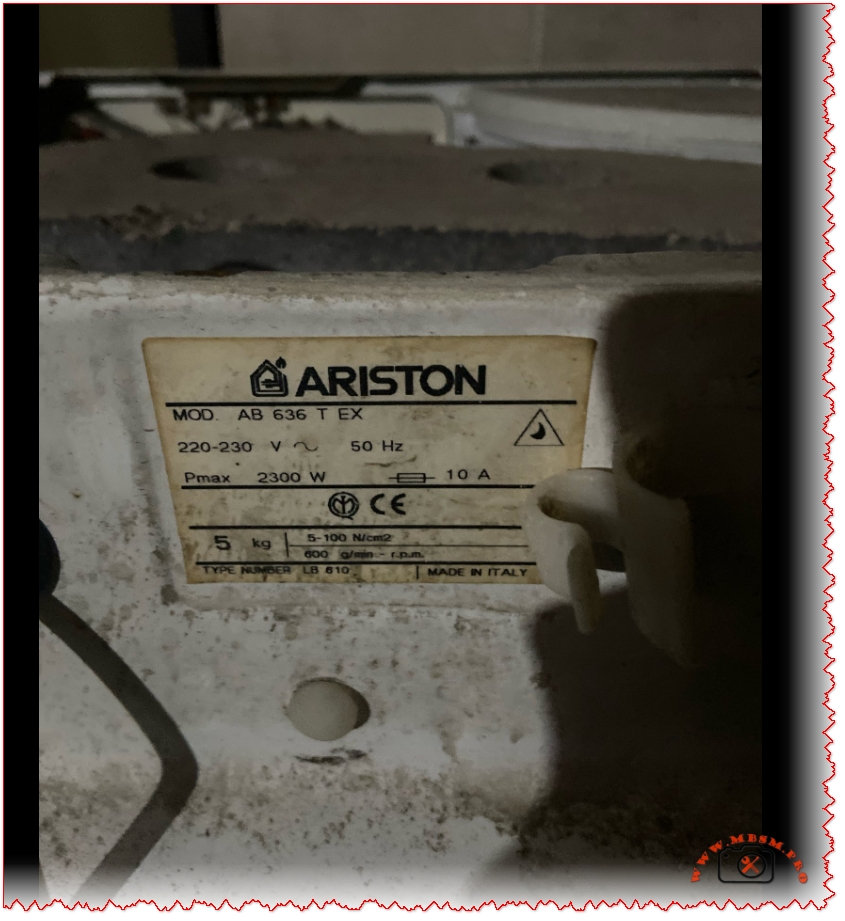
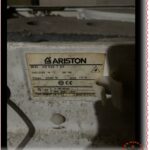
Ariston AB 636 T EX

Ariston AB 636 T EX mbsmpro

Ariston AB 636 T EX: Technical Identification Plate Guide for Repair and Maintenance

Overview of the Ariston AB 636 T EX Plate

The image shows the rating plate of an Ariston AB 636 T EX front‑loading washing machine, a classic European model widely sold in the late 1990s and early 2000s. This metal label concentrates the essential electrical and mechanical data needed for correct installation, troubleshooting, and ordering spare parts.

Decoding the Electrical Specifications

The plate confirms that the machine operates on 220–230 V, 50 Hz single‑phase power, drawing a maximum power of 2300 W and a nominal current of 10 A. These values indicate that the washer is designed for typical European domestic circuits and must be connected to a properly grounded outlet protected by a 10–16 A breaker.

Technicians use the Pmax 2300 W figure to size wiring, check energy consumption, and verify heater and motor performance during diagnostics. Overheating, tripped breakers, or burned connectors often result from ignoring these limits during installation or repair.

Mechanical Data and Pressure Switch Range

On the lower part of the label, the plate lists maximum load 5 kg and a spin speed of about 600 rpm, which class the AB 636 T EX as an entry‑level to mid‑range washer by today’s standards. This moderate spin speed explains why these machines often require longer drying times compared with newer 1000–1400 rpm units.

The marking 5–100 N/cm² refers to the water pressure range for the pressure switch and hydraulic system, compatible with standard domestic water supplies. Maintaining this range is crucial for correct filling, level detection, and safe operation of the heating element.

Why the Rating Plate Matters for Technicians

For repair professionals and advanced DIY users, the rating plate is the identity card of the washing machine. It provides the exact model (AB 636 T EX) and type number LB 610, data that spare‑parts catalogues and service manuals use to match compatible components. Without these references, ordering parts like bearings (6203‑2Z), pressure switches, or door locks risks costly mistakes.

The “Made in Italy” indication helps trace manufacturing standards and sometimes the availability of regional variants sharing similar mechanical parts but different decorative panels or program boards.

Key Technical Data Table

Parameter Value on Plate Practical Use in Service
Supply voltage 220–230 V, 50 Hz Verifies compatibility with local mains and UPS/inverter use.
Maximum power (Pmax) 2300 W Used to size wiring, breakers, and estimate energy draw.
Nominal current 10 A Confirms circuit protection rating and plug type.
Maximum load washing machine 5 kg Helps avoid overloading and drum/bearing damage.
Spin speed Approx. 600 rpm Indicates residual moisture and cycle performance.
Water‑pressure range 5–100 N/cm² (pressure switch) Guides diagnostics for fill and level faults.
Type / code AB 636 T EX – Type LB 610 Essential for parts catalogues and service documentation.

Useful Resources: Images and Documentation

Several specialised websites still provide visual references and spare‑parts diagrams for the AB 636 T EX. High‑resolution product photos and exploded views can help confirm component positions before disassembly. These resources are particularly useful when documenting repairs or creating training content on platforms such as Mbsmgroup and Mbsm.pro.

For deeper technical information, technicians can consult multi‑page PDF manuals and parts lists for the Ariston AB 636 T family, which cover installation, wiring diagrams, and troubleshooting charts. Such documents detail bearing codes, seal dimensions, and pressure‑switch compatibility for AB 636 T EX and its derivatives.


Samsung front‑load tub front half assembly: dimensions, components and replacement guide

Samsung front‑load tub front half assembly: dimensions, components and replacement guide

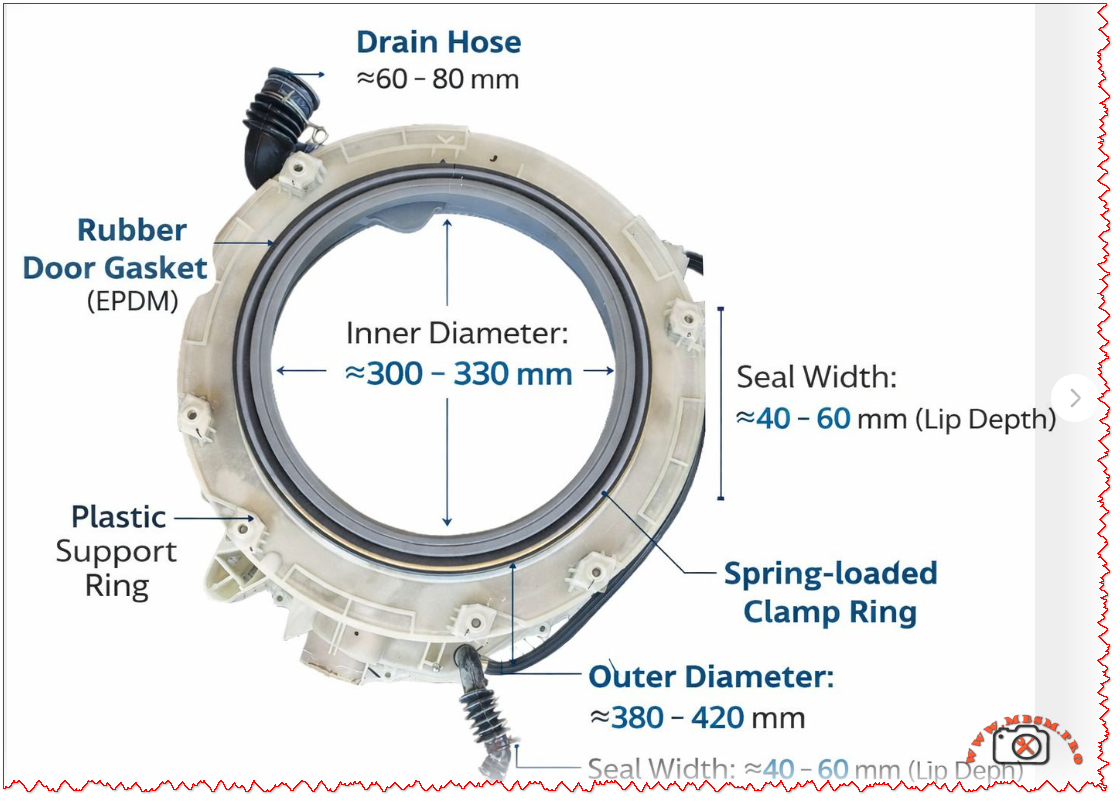
The tub front half assembly on Samsung front‑load washing machines combines the plastic support ring, EPDM rubber door gasket, drain hose and spring‑loaded clamp into one critical sealing unit between the drum and the cabinet front. It defines the loading opening (≈300–330 mm inner diameter) and overall front tub size (≈380–420 mm outer diameter), while controlling water drainage and leak‑free operation during high‑speed spin cycles.


Main components

  • Plastic support ring (semi tub front)
    The plastic semi tub front forms the rigid structure of the assembly and bolts to the rear half of the outer tub, typically listed in Samsung parts lists as “ASSY SEMI TUB FRONT”. It carries mounting points for the hinge area, latch, front panel screws and hose connections that surround the loading opening.
  • Rubber door gasket (EPDM)
    The grey EPDM door gasket works as a flexible diaphragm between the rotating stainless drum and the fixed plastic tub, absorbing vibration and preventing splashes through the door opening. Its lip depth or seal width is typically about 40–60 mm, providing a deep channel that guides water back into the tub instead of toward the door glass.​
  • Spring‑loaded clamp rings
    Two metal clamps are usually used: an inner clamp secures the gasket to the plastic tub, and an outer spring clamp band fixes it to the cabinet front panel. The outer band relies on a strong tension spring so that the elastomer lip remains compressed even under drum imbalance and door vibration at high spin speeds.
  • Drain hose connection
    A molded drain hose stub integrated into the front tub section channels residual water away from the gasket area and lower sump, typically matching Samsung’s EPDM drain hoses specified in spare‑parts diagrams. Hose internal diameters in this class of machines are commonly within 60–80 mm at the large bellows connection shown in the image, ensuring rapid evacuation and reducing standing water that could cause odors.​

Key dimensions from the assembly

The illustration corresponds to a common size range used on 7–9 kg Samsung front‑loaders, and the measurements help technicians and spare‑parts sellers match non‑OEM or compatible tubs and door boots.

Parameter Typical range (mm) Technical role
Inner opening diameter ≈300–330 Defines usable drum access and must match door glass and hinge geometry.
Outer tub front diameter ≈380–420 Matches cabinet cut‑out and rear tub half for correct bolt alignment.
Seal width / lip depth ≈40–60 Controls how deeply the gasket overlaps the drum rim and door glass to avoid leaks.​​
Drain‑hose connector length ≈60–80 Provides sufficient fall for water to clear the boot and flow to the pump housing.

Such dimensional ranges also influence replacement choices when original part numbers are no longer available, allowing cross‑referencing by diameter and seal width.


Typical failure modes and maintenance

  • Leakage and gasket damage
    Front leaks usually come from cuts, hardening or mold damage on the EPDM gasket lip, especially around the lower section where coins or sharp objects scrape during spin. Early signs include water tracks on the front panel, standing water in the door boot and musty odors after a cycle.​
  • Clamp loosening or mis‑seating
    If the spring clamp is not seated evenly in its groove after service, the boot can pull away from the cabinet, producing intermittent leaks only on high‑load or high‑speed programs. Corroded or stretched bands should always be replaced with genuine door‑seal clamp kits to maintain uniform radial pressure.​
  • Blocked drain hose connection
    Lint, detergent residue and small objects can partially block the drain hose stub shown at the bottom of the assembly, increasing water retention inside the boot and generating mold growth. Routine cleaning of the filter housing and periodic inspection of the lower hose path reduces these problems and extends component life.​

Replacement and selection tips

  • Identifying the correct part
    The fastest method is to read the full model code from the washer rating label and search for the matching “ASSY SEMI TUB FRONT” or “door boot / diaphragm” in Samsung’s illustrated parts lists or reputable spare‑parts catalogues. Where the exact code is unavailable, technicians can use the inner and outer diameters plus seal width shown in the image to select compatible universal boots within the 300–330 mm and 380–420 mm ranges.
  • Installation considerations
    When replacing the tub front half or door boot, manufacturers recommend removing the front panel, control panel and door lock assembly and carefully transferring hoses and wiring harness clips to the new ring. The gasket must be aligned to witness marks on the tub, with the drain holes positioned at the lowest point and both inner and outer clamps tightened uniformly to prevent wrinkles.​
  • Professional vs DIY service
    Although many guides and videos demonstrate door‑boot replacement as a do‑it‑yourself repair, full tub front‑half replacement involves heavy lifting and more extensive disassembly and is better performed by experienced technicians or advanced DIY users with proper support stands. For machines still under manufacturer warranty or covered by extended service contracts, any tub replacement should follow Samsung’s official service procedures and part numbers to maintain coverage.