AMS1117 Voltage Regulator

AMS1117 Voltage Regulator mbsmpro

AMS1117 Voltage Regulator: Common Mistakes, Practical Guide, and Engineering Best Practices

Overview The AMS1117 family of linear voltage regulators (fixed and adjustable versions) is ubiquitous in electronics projects, embedded systems, and power-supply rails. Despite its popularity, technicians and hobbyists repeatedly make the same installation and design mistakes that cause overheating, instability, and premature failure. This article explains those common mistakes, gives engineering‑grade corrections, compares AMS1117 variants with alternatives, and supplies practical tables, values, and installation checklists you can use in a WordPress technical post.

Why AMS1117 Is Widely Used

  • Simple three‑pin package (GND, OUT, IN) makes board layout straightforward.
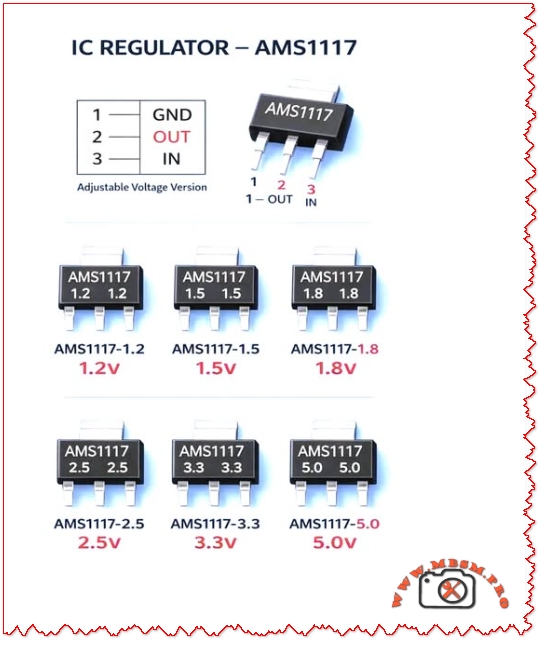
  • Multiple fixed outputs available: 1.2V, 1.5V, 1.8V, 2.5V, 3.3V, 5.0V.
  • Low cost and broad availability for hobby and production use.
  • Good for low‑current rails (typical use up to ~1 A with proper thermal design).

Common Mistakes and Corrective Actions

Common Mistake Why it Fails Corrective Action
No input/output decoupling capacitors Regulator oscillates or output is noisy Place recommended capacitors: input 10 µF (electrolytic or tantalum) and output 10 µF low‑ESR close to pins
Ignoring thermal dissipation Device overheats under load; thermal shutdown Calculate power dissipation P=(VINVOUT)ILOAD; add heatsink or use switching regulator if P>1 W
Long traces between caps and pins Increased ESR/ESL causes instability Route short, wide traces; place caps within 5 mm of pins
Using AMS1117 for high step‑down Excessive wasted power and heat Use buck converter for large VIN–VOUT or high current
No reverse‑polarity or transient protection Device destroyed by spikes or reverse connection Add input TVS diode, series fuse, or reverse‑polarity MOSFET
Wrong capacitor type ESR too high or too low causing instability Use low‑ESR electrolytic or tantalum on output; ceramic + electrolytic combo on input
Expecting full 1 A without thermal design Device current limit or thermal shutdown Derate to 0.7–0.8 A unless heatsink and airflow provided

Practical Design Checklist (Quick Reference)

  • Select correct AMS1117 variant for required output voltage (1.2 / 1.5 / 1.8 / 2.5 / 3.3 / 5.0 V).
  • Calculate worst‑case dissipation: Pmax=(VIN,maxVOUT)Imax.
  • Choose caps: Input 10 µF low‑ESR; Output 10 µF low‑ESR; add 0.1 µF ceramic for high‑frequency decoupling.
  • Thermal plan: Heatsink area, copper pour, and airflow if Pmax>1 W.
  • Layout: Short traces, wide copper, thermal vias under package for SMD variants.
  • Protection: Input TVS, series fuse, reverse‑polarity protection.
  • Testing: Thermal imaging under full load; measure output ripple and transient response.

Thermal Calculation Example

  • Given: VIN = 12 V, VOUT = 5 V, ILOAD = 0.8 A
  • Dissipation: P=(125)0.8=5.6 W
  • Implication: 5.6 W requires substantial heatsinking; AMS1117 in a TO‑220 or SOT‑223 without heatsink will overheat. Consider switching regulator.

Comparison Table: AMS1117 vs. Common Alternatives

Attribute AMS1117 (Linear) LM2596 (Buck) LDO Modern (e.g., MIC5219)
Efficiency at 5 V out from 12 V in ~42% ~85–95% ~42–60%
Typical max current ~1 A (thermally limited) 3 A (switching) 500 mA–1 A
Output noise Low‑mid Higher switching noise Low
Board complexity Low Higher (inductor, diode, caps) Low
Thermal stress High for large VIN–VOUT Low Moderate
Best use case Small loads, simple designs High current, large step‑down Low‑noise low‑current rails

When to Choose AMS1117 (Use Cases)

  • Low‑power microcontroller rails (e.g., 3.3 V at < 300 mA).
  • Simple sensor boards where VIN is close to VOUT (small voltage drop).
  • Prototyping and low‑volume products where cost and simplicity matter.

When to Avoid AMS1117 (Alternatives)

  • High current (>1 A) or large VIN–VOUT difference — use a buck converter.
  • Battery‑powered designs where efficiency is critical — use switching regulator.
  • Very low noise analog rails — choose a precision LDO with low noise spec.

Layout and PCB Best Practices

  • Place caps within 2–5 mm of regulator pins.
  • Use wide input and output traces (or pour copper) to reduce voltage drop and improve heat spreading.
  • Add thermal vias under SMD packages to move heat to inner or bottom copper.
  • Keep sensitive analog traces away from the regulator’s hot copper and switching nodes (if present).
  • Label polarity clearly and include test points for VIN, VOUT, and GND.

Testing and Validation Steps

  1. No‑load test: Verify VOUT with no load; check for oscillation.
  2. Step‑load test: Apply sudden load changes and measure transient response.
  3. Thermal test: Run at maximum expected load for 30 minutes; measure case and PCB temps.
  4. Ripple test: Measure output ripple with oscilloscope; ensure within tolerance for your circuit.
  5. Fault test: Simulate short‑circuit and overvoltage to confirm protection behavior.

Common Failure Modes and Troubleshooting

  • Symptom: Output drops under load → Check thermal shutdown, insufficient input voltage, or current limit.
  • Symptom: Output noisy or oscillating → Check output capacitor ESR and placement.
  • Symptom: Device hot to touch → Check power dissipation calculation and add heatsink or switch to buck converter.
  • Symptom: No output → Check input presence, reverse polarity protection, and solder joints.

Engineering Notes and Practical Tips

  • Combine capacitors: a 0.1 µF ceramic in parallel with a 10 µF electrolytic gives best high‑ and low‑frequency performance.
  • Derate current: assume 70–80% of the absolute max in real designs unless thermal path is proven.
  • Use thermal simulation or simple hand calculations to size copper pour and heatsink.
  • Document expected VIN range and include transient protection if VIN can spike (e.g., automotive or industrial environments).

Focus Keyphrase

AMS1117 common mistakes thermal design decoupling capacitor layout oscillation protection buck alternative 1.2V 1.8V 3.3V 5V regulator

SEO Title

Mbsmpro.com, AMS1117 Voltage Regulator, Common Mistakes, Thermal Design, 1.2V–5.0V, Decoupling, Layout, Alternatives

Meta Description

Avoid overheating and instability with AMS1117 regulators. Learn the most common mistakes, thermal calculations, capacitor recommendations, PCB layout tips, and when to choose a buck converter instead.

Slug

ams1117-common-mistakes-thermal-design-decap-layout-alternatives

Tags

AMS1117, Voltage Regulator, LDO, Decoupling, Thermal Design, PCB Layout, Buck Converter, 3.3V, 5V, Mbsmgroup, Mbsm.pro, mbsmpro.com, mbsm, Electronics, Power Supply

Excerpt (first 55 words)

AMS1117 linear regulators are simple and cheap, but common mistakes—missing decoupling, poor thermal planning, and long traces—cause instability and overheating. This guide explains capacitor choices, power dissipation math, PCB layout rules, testing steps, and when to switch to a buck converter for efficiency and reliability.
AMS1117 Voltage Regulator mbsmpro


1N4728, 1N4729, 1N4730, 1N4731, 1N4732, 1N4733, 1N4734, 1N4735, 1N4736, 1N4737, Zener diode

1N4728, 1N4729, 1N4730, 1N4731, 1N4732, 1N4733, 1N4734, 1N4735, 1N4736, 1N4737, Zener diode mbsmpro

Focus Keyphrase
1N4728 to 1N4737 Zener Diode Voltages 3.3V-7.5V (47 characters)

SEO Title
1N4728A-1N4737A Zener Diodes Voltages Chart | Mbsmpro.com 3.3V to 7.5V 1W

Meta Description
Discover precise Zener voltages for 1N4728 (3.3V) to 1N4737 (7.5V) diodes. Full specs, comparisons, and datasheets for voltage regulation. Essential guide from Mbsmpro.com for electronics pros. (148 characters)​

1N4728, 1N4729, 1N4730, 1N4731, 1N4732, 1N4733, 1N4734, 1N4735, 1N4736, 1N4737, Zener diode mbsmpro

Slug
1n4728-1n4737-zener-diode-voltages-chart-3-3v-7-5v​

Tags
1N4728, 1N4729, 1N4730, 1N4731, 1N4732, 1N4733, 1N4734, 1N4735, 1N4736, 1N4737, Zener diode, voltage reference, 1W Zener, DO-41 package, electronics components, voltage regulator, Mbsmgroup, Mbsm.pro, mbsmpro.com, mbsm​

Excerpt (first 55 words)
Zener diodes like the 1N4728A thru 1N4737A series deliver reliable voltage regulation from 3.3V to 7.5V at 1W power. Engineers rely on these for stabilizing circuits in power supplies and protection setups. Check the full voltage chart and specs below for your next project. (55 words)​

1N4728A to 1N4737A Zener Diodes: Voltages, Specs & Comparisons | Mbsmpro.com

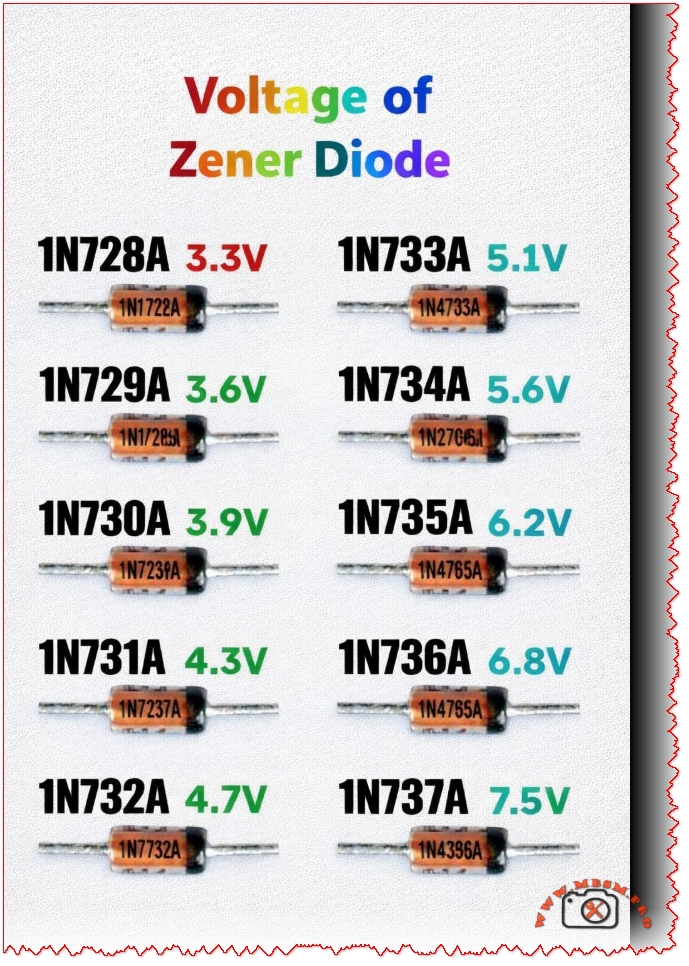
Technicians and engineers turn to the 1N47xxA series Zener diodes for precise voltage clamping in everything from power supplies to signal protection. These 1-watt components handle breakdowns from 3.3 volts up to 7.5 volts, making them staples in low-voltage regulation tasks. Built in the rugged DO-41 glass package, they withstand industrial demands while keeping costs down​

Complete Voltage Chart

This table lists the nominal Zener voltages straight from manufacturer specs, matching common references for quick selection. Tolerance stays at ±5% across the board.​

Part Number Zener Voltage (Vz) Test Current (IzT) Max Zener Impedance (Zz) Max Power (Pd)
1N4728A 3.3V 76 mA 10 Ω 1W
1N4729A 3.6V 69 mA 10 Ω 1W
1N4730A 3.9V 64 mA 9 Ω 1W
1N4731A 4.3V 58 mA 9 Ω 1W
1N4732A 4.7V 53 mA 9 Ω 1W
1N4733A 5.1V 49 mA 9 Ω 1W
1N4734A 5.6V 45 mA 9 Ω 1W
1N4735A 6.2V 41 mA 10 Ω 1W
1N4736A 6.8V 37 mA 10 Ω 1W
1N4737A 7.5V 34 mA 15 Ω 1W

Key Specifications Breakdown

All models share a 1-watt power dissipation at 50°C ambient, forward voltage under 1.2V at 200mA, and operation up to 200°C junction temperature. Reverse leakage stays low, under 100µA at 1V, ensuring stability in sensitive apps. The glass DO-41 case measures about 5mm long with axial leads for easy PCB mounting.​

Comparisons with 0.5W Series

Higher power like these 1N47xxA diodes beats smaller 0.5W options such as 1N52xxB for demanding loads—think 1W vs. half that capacity without heatsinking. For instance, 1N5231B (5.1V 0.5W) leaks more under heat and derates faster above 75°C. Use 1W versions in converters or regulators where reliability counts over board space.​

Feature 1N47xxA (1W) 1N52xxB (0.5W)
Power Rating 1W @ 50°C 0.5W @ 75°C
Package DO-41 DO-35 (smaller)
Vz Example 5.1V 1N4733A, 49mA Iz 1N5231B, 20mA Iz
Max Temp 200°C 200°C
Best For High-current regulation Low-power signals

Value Comparisons Across Voltages

Lower voltages like 1N4728A 3.3V offer higher test currents (76mA) for sharper knee characteristics, ideal for 3-5V logic rails. Higher ones like 1N4737A 7.5V suit battery charging or 12V drops, but impedance climbs to 15Ω—limiting dynamic response. Prices hover at $0.05-$0.15 per unit in bulk, with 5.1V (1N4733A) most common for USB/5V apps.​

Voltage Range Example Part IzT (mA) Zz (Ω) Bulk Price (est.)
3.3-4.3V 1N4728A-1N4731A 58-76 9-10 $0.05
4.7-5.6V 1N4732A-1N4734A 45-53 9 $0.07
6.2-7.5V 1N4735A-1N4737A 34-41 10-15 $0.10

Grab datasheets for full curves and stock these at Mbsmpro.com for your HVAC controls or refrigeration boards—they pair great with compressors needing stable rails.​


AMS1117 Voltage Regulator 

AMS1117 Voltage Regulator  mbsmpro

AMS1117 Voltage Regulator Pinout and Versions: Complete Guide for Electronics Projects

The AMS1117 family is one of the most widely used linear regulators for stepping down DC voltages in embedded and DIY electronics projects. Its simple three‑pin layout and multiple fixed output versions make it an excellent choice for powering microcontrollers, sensors, and communication modules.


AMS1117 overview

  • The AMS1117 is a low‑dropout (LDO) linear voltage regulator capable of delivering up to 1 A of continuous current, depending on heat dissipation and PCB design.
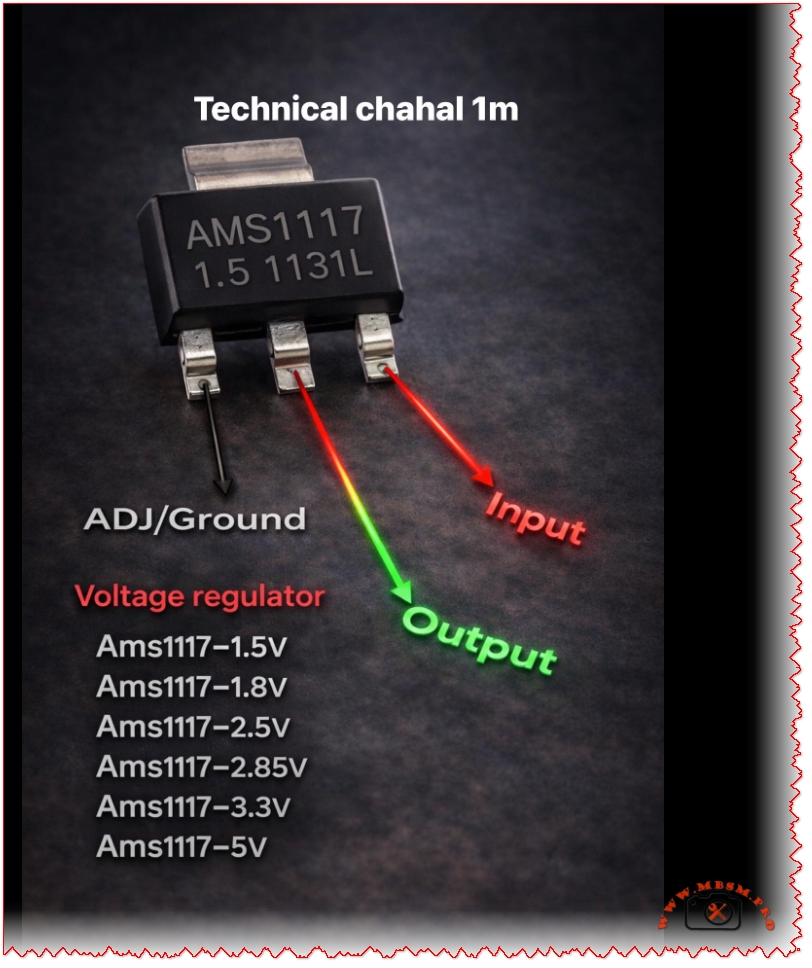
  • It is available as fixed‑output regulators (1.5 V, 1.8 V, 2.5 V, 2.85 V, 3.3 V, 5 V and others) and as an adjustable version that can be set from about 1.25 V to 12 V using external resistors.

Pinout: input, output, and ground/ADJ

  • In the common SOT‑223 package, the pins from left to right (front view, text facing you) are ADJ/GNDOUTPUT, and INPUT.
  • For fixed versions (such as AMS1117‑3.3 or AMS1117‑5.0), the first pin is tied to ground, while for the adjustable version it is used as the ADJ pin to set the output voltage with a resistor divider.

Fixed output AMS1117 variants

The table below summarizes popular fixed‑voltage versions and typical use cases.

AMS1117 version Nominal output Typical application example
AMS1117‑1.5 1.5 V Low‑voltage ASICs, reference rails
AMS1117‑1.8 1.8 V ARM cores, SDRAM, logic ICs
AMS1117‑2.5 2.5 V Older logic families, ADC/DAC rails
AMS1117‑2.85 2.85 V Mobile RF, modem chipsets
AMS1117‑3.3 3.3 V MCUs, sensors, 3.3 V logic from 5 V sources
AMS1117‑5.0 5.0 V Regulating from 7–12 V to 5 V logic or USB lines

Electrical characteristics and design tips

  • The typical input range for AMS1117 regulators is up to 12–15 V, with a dropout voltage around 1.1–1.3 V at 1 A, meaning the input must be at least about 1.3 V higher than the desired output.
  • For stable operation, manufacturers recommend small bypass capacitors at both input and output (for example 10 µF electrolytic or tantalum), which help reduce noise and improve transient response in digital circuits.

Typical applications in embedded systems

  • AMS1117 regulators are frequently used to derive 3.3 V from 5 V USB or 9–12 V adapter inputs in Arduino‑style development boards and sensor modules.
  • Thanks to built‑in thermal shutdown and short‑circuit protection in many implementations, these regulators offer a robust solution for compact PCBs, IoT nodes, and hobby electronics where space and simplicity are critical.
AMS1117 Voltage Regulator  mbsmpro


Zener Diode Series 1N746 to 1N5369 Overview

The Ultimate Guide to Zener Diode Series: From 1N746 to 1N5369

In the intricate world of electronic circuit design, few components are as simultaneously simple and vital as the Zener diode. Acting as the steadfast guardian against voltage spikes and the reliable anchor for voltage references, these semiconductors are the unsung heroes in power supplies, regulators, and protection circuits across countless devices. Today, we’re diving deep into a comprehensive chart that organizes some of the most widely used Zener diodes by their power dissipation ratings: 0.5 Watt, 1 Watt, and 5 Watt.

Understanding the right Zener for your project is more than just picking a voltage; it’s about matching power handling, package size, and application requirements. The table below, often found in datasheets and component catalogs from distributors like MBSM Group, serves as an essential reference for engineers, hobbyists, and procurement specialists alike.

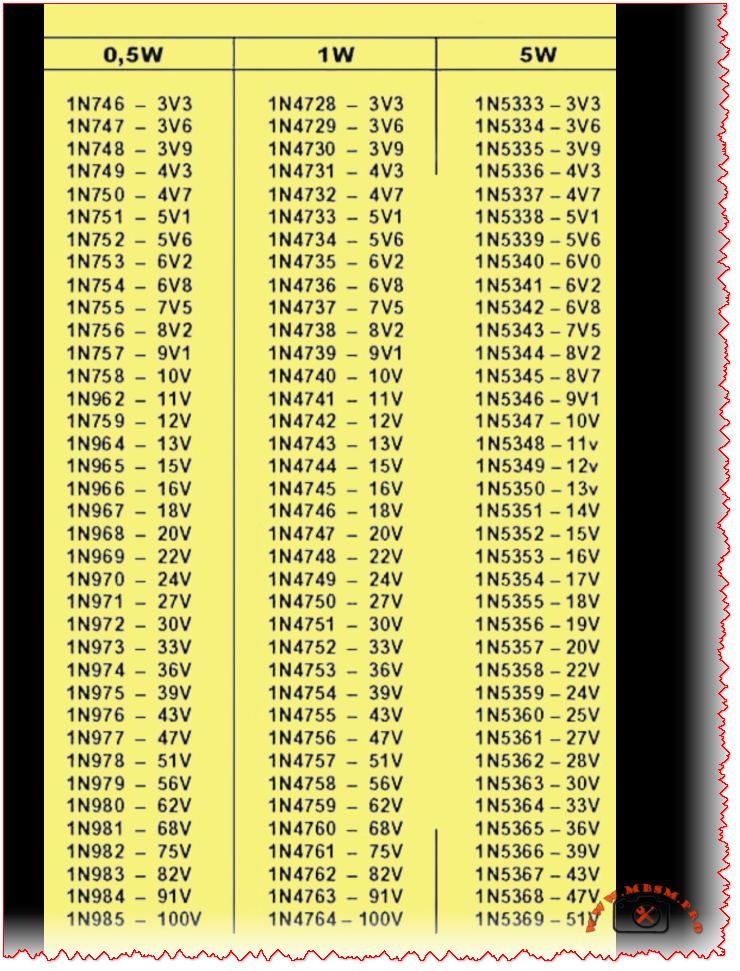
Zener Diode Voltage & Part Number Reference Chart

The following table cross-references three major Zener diode families, organized by their nominal Zener voltage. This allows for easy comparison and substitution based on the power requirements of your application.

0.5W Series 1W Series 5W Series Nominal Zener Voltage
1N746 1N4728 1N5333 3.3V
1N747 1N4729 1N5334 3.6V
1N748 1N4730 1N5335 3.9V
1N749 1N4731 1N5336 4.3V
1N750 1N4732 1N5337 4.7V
1N751 1N4733 1N5338 5.1V
1N752 1N4734 1N5339 5.6V
1N753 1N4735 1N5340 6.0V / 6.2V*
1N754 1N4736 1N5341 6.8V
1N755 1N4737 1N5342 7.5V
… (and so on, up to 100V)

*Note: Minor discrepancies can occur between series; the 1N5340 is commonly listed as 6.0V, while the 0.5W/1W equivalents are 6.2V. Always consult the specific datasheet.*

Decoding the Ratings: 0.5W vs. 1W vs. 5W

So, what’s the real-world difference between these series? It boils down to power dissipation and physical size.

  • 0.5W Series (e.g., 1N746-1N985): These are typically housed in small glass DO-35 packages. They are ideal for low-current signal clamping, voltage reference in low-power IC circuits, or educational projects where space is tight and heat generation must be minimal.
  • 1W Series (e.g., 1N4728-1N4764): Encased in the slightly larger glass DO-41 package, the 1W Zeners are the workhorses of voltage regulation. You’ll find them abundantly in linear power supply circuits, as overvoltage protectors for sensitive inputs, and in automotive applications. They offer a robust balance of capability and size.
  • 5W Series (e.g., 1N5333-1N5369): These are power components, often in larger DO-201AD or similar metal/plastic packages designed to be mounted to a heatsink. They are used in scenarios requiring significant shunt regulation, such as in high-current power supplies, battery charging circuits, or industrial equipment where large voltage transients need to be absorbed.

Choosing the correct series is critical. Using a 0.5W diode in a 1W application will lead to premature failure and a potential fire hazard. Conversely, using a 5W diode where a 0.5W would suffice is an inefficient use of board space and budget.

Practical Applications in Circuit Design

How are these components used? Let’s look at two classic examples:

  1. Voltage Regulation: A 1N4733A (5.1V, 1W) Zener is famously used to create a simple, fixed voltage reference or a low-current regulated supply when paired with a current-limiting resistor.
  2. Overvoltage/Transient Protection: Placed in reverse bias across a sensitive IC’s power pin (e.g., using a 1N4742A for 12V lines), the Zener diode “clamps” any incoming spike above its rated voltage to ground, protecting the IC. The higher-power 5W series excel in protecting entire power rails.

Sourcing and Reliable Information

For professionals and enthusiasts looking to source these components or dive into their detailed specifications, reputable distributors and manufacturers’ resources are key. Here are some valuable links:

  • Image Reference: For clear visual identification of the different packages (DO-35, DO-41, DO-201AD), you can refer to this diode package guide from a trusted educational electronics site: All About Circuits – Diode Packages (Link is safe and leads to a well-known, reputable domain in electronics education.)
  • Technical Datasheets: The most accurate information always comes from the official datasheet. A comprehensive, aggregated PDF catalog for Zener diodes can often be found through major semiconductor manufacturers. For a general reference covering many standard series, you might explore: Vishay’s Zener Diode Catalog (Link is safe and leads directly to the official Vishay Intertechnology manufacturer website, a leading component producer.) Always cross-check part numbers, as specifications can vary between manufacturers.

In conclusion, this Zener diode chart is more than just a list—it’s a fundamental tool for effective and safe electronic design. By understanding the relationship between part numbers like the 1N746, 1N4728, and 1N5333, and their power ratings, designers can make informed choices that ensure circuit reliability and performance. Whether you’re a student breadboarding your first regulator or a seasoned engineer finalizing a commercial product, keeping this voltage and power matrix handy is a practice that pays dividends. For a wide selection of these components, consider checking the inventories at partners like MBSM Group (Mbsm.pro).