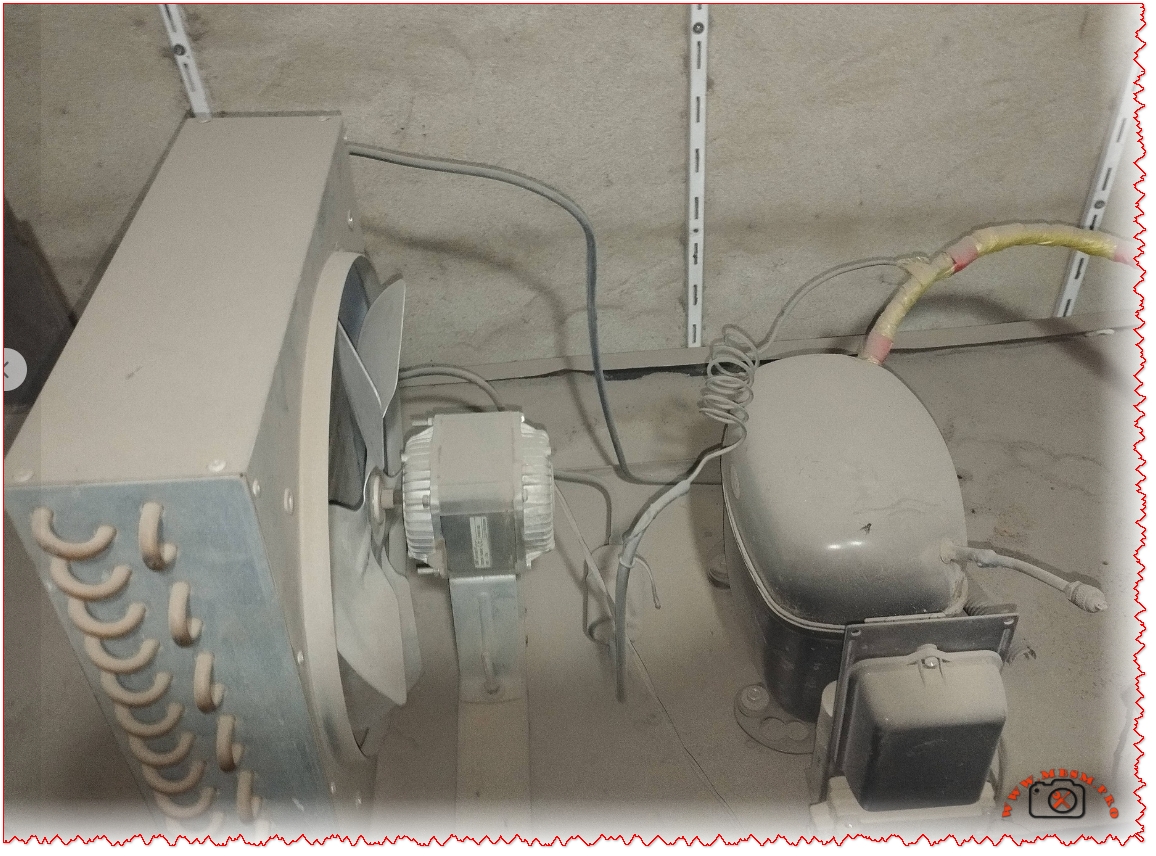
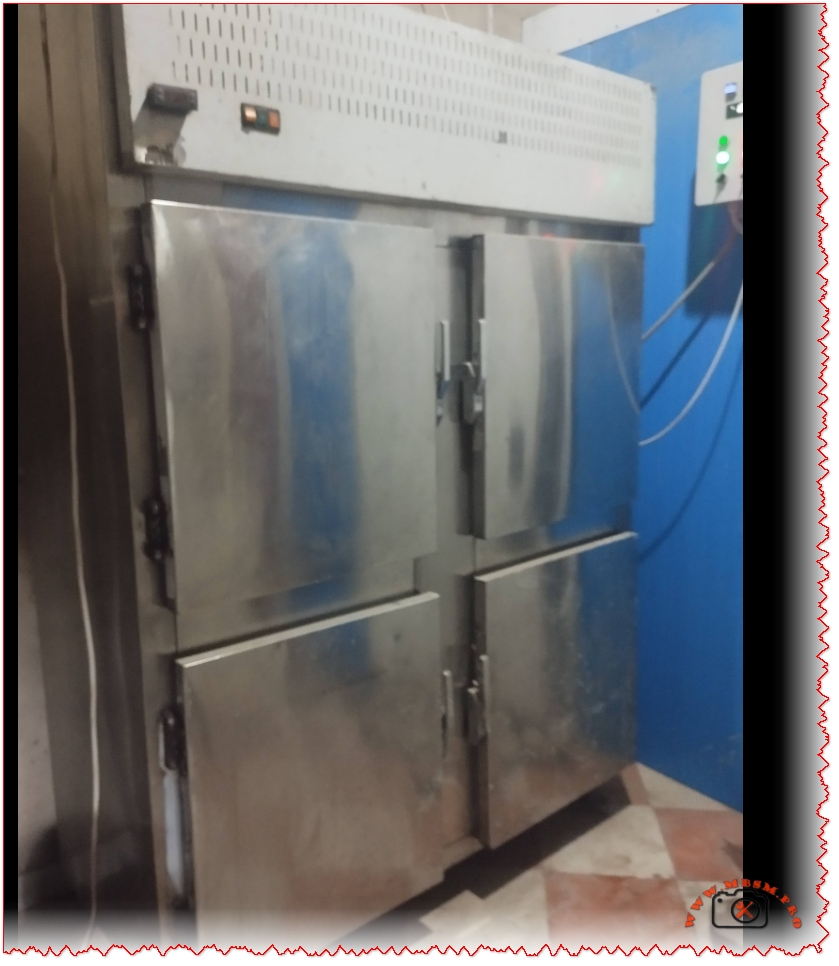
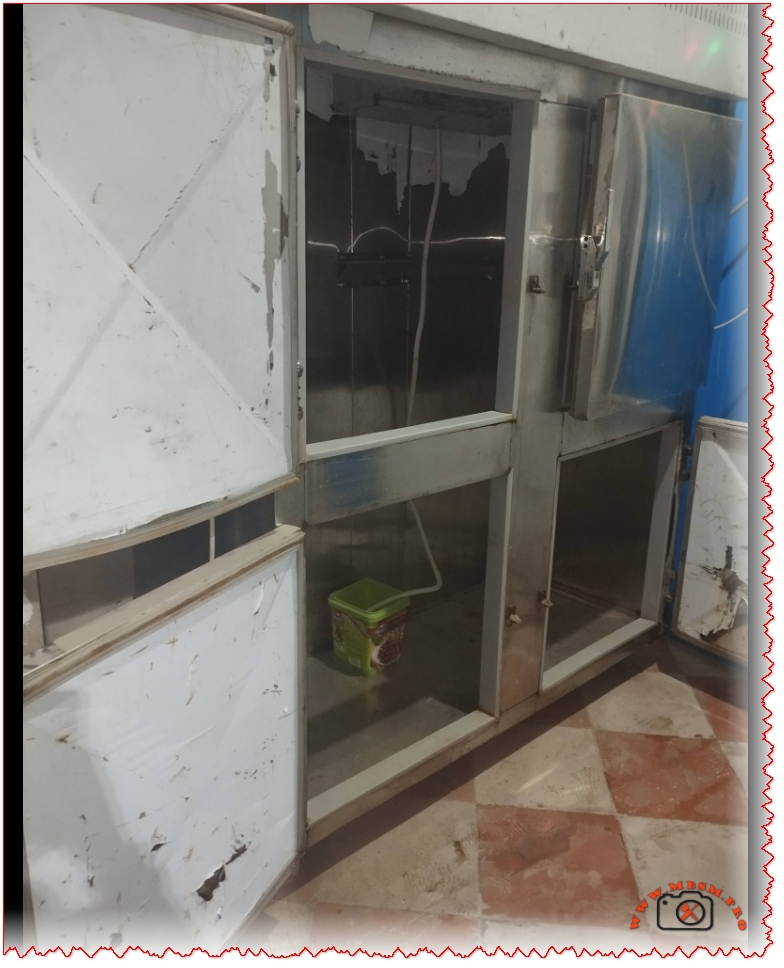
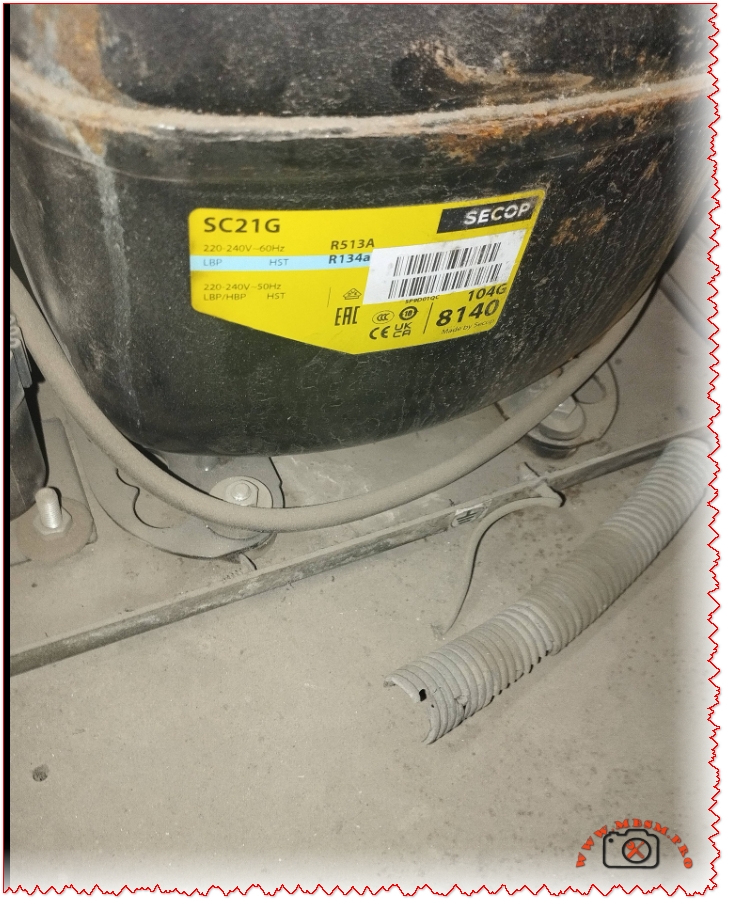
If you’ve ever opened the back panel of a commercial chest freezer or a light commercial display case and found a compact, brushless compressor with a controller module attached to it, there’s a good chance you were looking at a Danfoss Secop SLV15CNK. This variable-speed hermetic compressor is one of the most widely deployed LBP (Low Back Pressure) units in European and international commercial refrigeration — and for good reason.
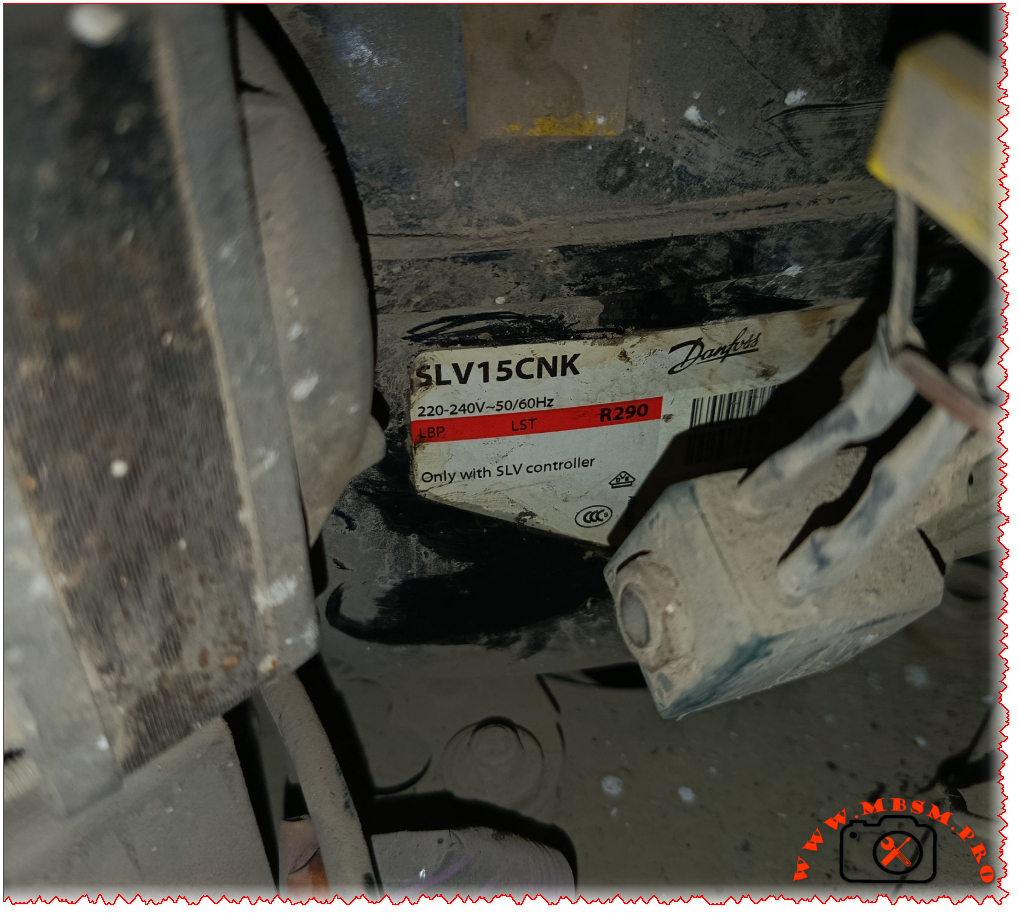
Originally built under the Danfoss brand before the compressor division was spun off as Secop GmbH in 2010, the SLV15CNK has carved out a reliable reputation across commercial food retail, light industrial cooling, and even medical cold-chain applications. The unit pictured above — serial reference 561108N4, profile 104H — is the standard 220–240V, 50/60 Hz variant using R290 (propane) refrigerant, one of the most eco-friendly natural refrigerants available today.
Complete Technical Specifications Table
Parameter
Value
Model
SLV15CNK / SLV15CNK.2
Utilisation (MBP/HBP/LBP)
LBP only (Low Back Pressure)
Domain (Freezing/Cooling)
Deep Freezing — evap. temp. –40°C to –10°C
Cooling Wattage at –23°C
~446 W (nominal at standard LBP conditions)
Cubic Feet Cooled
~7–10 ft³ (small to medium chest freezer)
Litres Cooled
~200–280 litres
Kcal/h
~383 Kcal/h
TON
~0.127 TON of refrigeration
Oil Type & Quantity
Polyolester (POE) — 600 cm³
Horsepower (HP)
5/8 HP (~0.60 HP)
Refrigerant Type
R290 (Propane) — max charge 150 g
Power Supply
220–240V / 1Ph / 50–60 Hz (range: 180–254V)
Cooling Capacity BTU
~1521 BTU/h (LBP nominal)
Motor Type
Permanent Magnet (TRI — 3-phase inverter driven)
Displacement
15.28 cm³
Winding Material
Copper (3-phase windings, resistance ~7.7 Ω at 25°C)
Pression Charge
LBP / LST — max condensing temp 55°C (65°C short-term)
Capillary
Approx. 3m / Ø0.31 mm (application-dependent — verify with OEM data)
–40°C to –10°C evaporating; –35°C practical freezer operation
With Fan or Not
Yes — F2 fan cooling required (3.0 m/s airflow on compressor & controller)
Commercial or Domestic
Commercial (light commercial / food retail)
Amperage in Function
Max 4.6 A
LRA (Locked Rotor Amperage)
Electronic cut-off (no traditional LRA — inverter-controlled)
Type of Relay
No traditional relay — uses 105N46xx Series SLV Electronic Controller
Capacitor
No start/run capacitor — inverter-driven (variable speed 2000–4000 RPM)
Country of Origin & Export
Manufactured in Slovakia (Secop GmbH) — exported globally: EU, UK, Middle East, North Africa, Australia, Asia
What Makes This Compressor Special?
Variable Speed Technology
Most technicians encounter fixed-speed compressors day in and day out. The SLV15CNK breaks that mold entirely. It’s a variable speed drive (VSD) compressor, meaning its speed adapts continuously between 2000 and 4000 RPM based on thermal demand. The result is dramatically reduced energy consumption during low-load periods, less mechanical wear, and quieter operation — all things that matter enormously in a commercial food retail environment where a freezer runs 24/7, 365 days a year.
R290 — The Natural Refrigerant Advantage
R290 (propane) is not new, but its adoption in commercial compressors has accelerated rapidly in recent years thanks to its near-zero Global Warming Potential (GWP = 3) compared to the synthetic alternatives it replaces. The SLV15CNK uses a maximum charge of just 150 grams, which keeps it below the safety threshold for flammable refrigerant use in occupied spaces. That tiny charge, combined with propane’s excellent thermodynamic properties, means this compressor achieves high efficiency with a very light environmental footprint.
The Controller Dependency
One detail technicians absolutely must not overlook: this compressor will not function without its dedicated SLV electronic controller (105N46xx series). The label on the unit itself clearly states “Only with SLV controller.” This is not a traditional hermetic compressor you can simply wire up to a relay and a capacitor. The controller handles speed regulation, current protection, speed monitoring, and thermal protection all in one unit. Replacing or sourcing this controller is as important as finding the compressor itself.
Fan Cooling Is Mandatory
At all ambient conditions (32°C, 38°C, and 43°C), the datasheet specifies F2 cooling — meaning fan airflow of at least 3.0 m/s directly on both the compressor body and the electronic controller unit. Attempting to run this compressor without proper forced airflow will trigger thermal protection and lead to premature failure. This is a common oversight when installers replace the compressor without checking the cabinet’s fan arrangement.
Replacement Compressors — Same Gas (R290)
When the SLV15CNK reaches end of life or fails, the most straightforward replacements use the same R290 refrigerant. Here are five proven options:
#
Replacement Model
Brand
Notes
1
SLV15CNK.2 (104H8541)
Secop/Danfoss
Direct drop-in replacement — latest revision
2
SLV12CNK.2
Secop/Danfoss
Slightly lower displacement, same gas and controller family
3
SLV20CNK.2
Secop/Danfoss
Higher capacity option — same R290/controller platform
4
NLV14CNK
Secop/Danfoss
Fixed-speed variant on R290 LBP — requires relay/capacitor
5
SCM10CNX.2
Secop
R290, standard hermetic, LBP — no inverter controller needed
Replacement Compressors — Different Refrigerant
If R290 is not available in your region, or if you’re retro-fitting an older system, here are five equivalents using alternative refrigerants with comparable capacity:
#
Replacement Model
Brand
Refrigerant
Notes
1
SC15G
Secop/Danfoss
R404A / R507A
Classic LBP hermetic, no controller needed
2
NL11MF
Secop/Danfoss
R134a
LBP/MBP, standard hermetic
3
CAJ9513Z
Embraco
R404A
Direct LBP replacement at similar capacity
4
NEBL2134Z
Embraco
R600a
For domestic/light LBP applications
5
MTZ32-4VM
Danfoss
R452A/R404A
Slightly oversized but compatible for retrofits
⚠️ Important: Switching refrigerants requires changing the oil type, capillary tube, and verifying all safety certifications. Always consult the system manufacturer before cross-refrigerant replacement.
Typical Applications — Which Freezers Use This Compressor?
The SLV15CNK is the heart of many products you’ll recognize from the supermarket floor:
AHT Australian series chest freezers (confirmed via MBSM documentation)
Frozen food display cases at petrol stations and convenience stores
Ice cream chest cabinets in retail environments
The AHT connection is particularly well-documented — AHT is a major manufacturer of commercial freezers widely deployed across European and African retail chains, and the SLV15CNK is one of their standard compressor choices.
Installation & Service Notes
A few practical points every technician should keep in mind when working with this unit:
Controller wiring: Always refer to the 105N46xx wiring diagram. Polarity and signal connections matter — the controller is not interchangeable between all SLV variants.
Refrigerant handling: R290 is flammable (Class A3). Work in ventilated areas, avoid open flames, and use an R290-certified manifold gauge set. The 150g charge limit means leaks are rare but must be taken seriously.
Oil compatibility: POE oil is mandatory with R290 in this application. Do not substitute mineral oil or alkylbenzene — POE is pre-filled at the factory at 600 cm³.
Mounting vibration: The compressor ships with rubber mounting grommets. Always re-use or replace them — running on a hard mount increases noise and mechanical fatigue.
Capillary tube: The reference capillary for AHT applications is approximately 3m / 0.31mm diameter, but always measure and verify against the original system before cutting new tubing.
Why This Compressor Matters in 2025 and Beyond
The refrigeration industry is at a turning point. Synthetic refrigerants with high GWP are being phased out under F-Gas regulations in Europe and similar legislation worldwide. The SLV15CNK — running on propane with a permanent magnet variable-speed motor — represents exactly the direction the industry is heading: natural refrigerants, intelligent speed control, and reduced energy consumption without compromising reliability.
For service technicians, understanding this platform deeply isn’t just useful today — it’s preparation for the next decade of commercial refrigeration work.
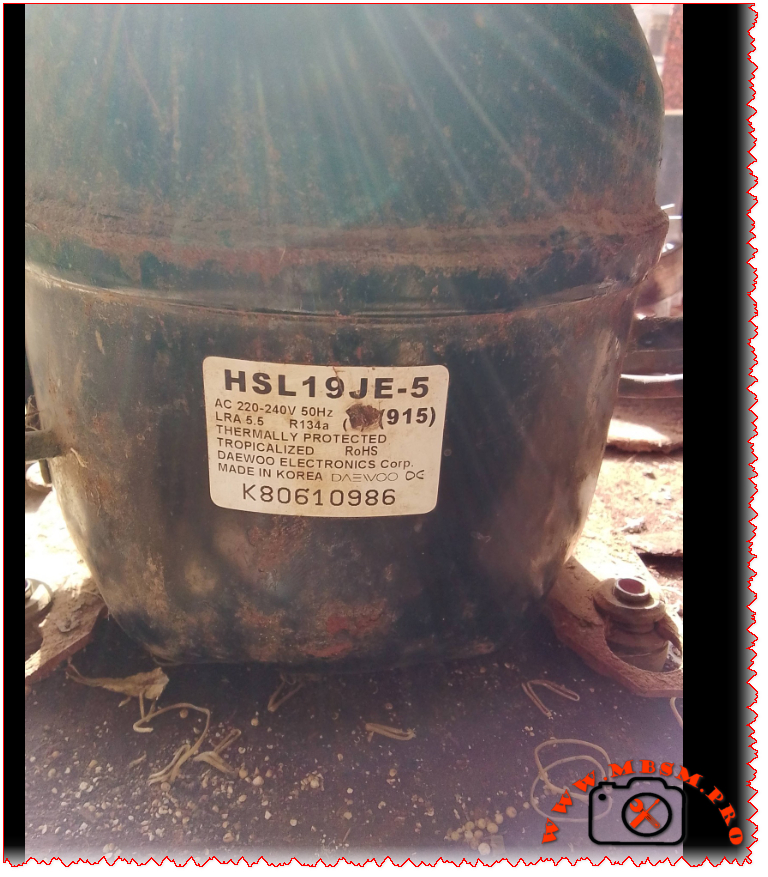
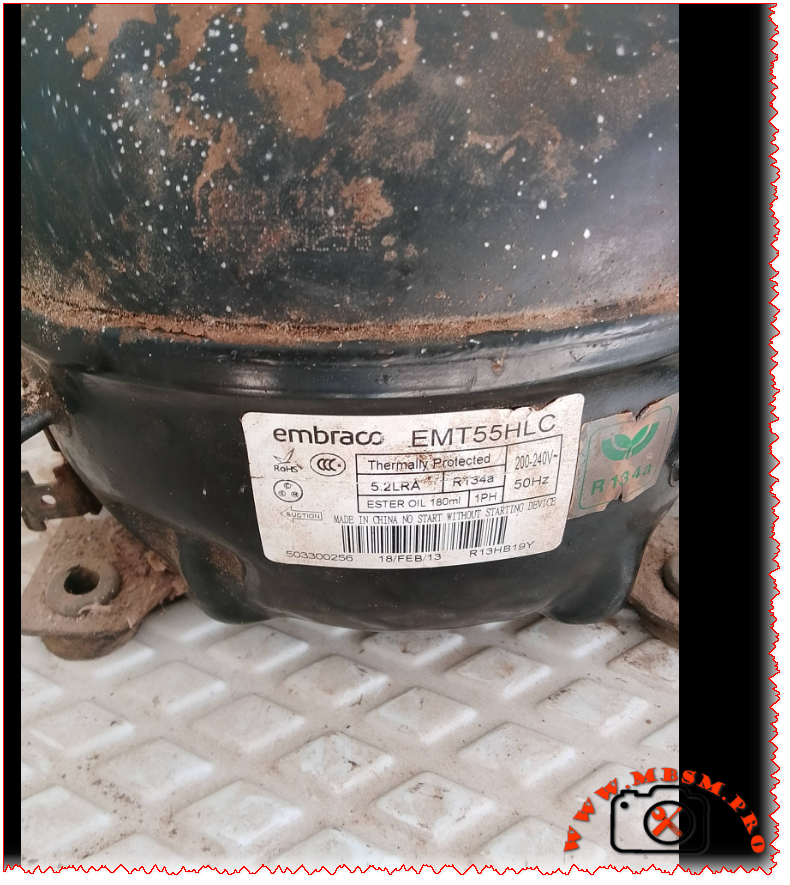
Excerpt (first 55 words): Two workhorse compressors power countless commercial refrigerators and household freezers worldwide. The Embraco EMT55HLC and Daewoo HSL19JE-5 both deliver 1/5 HP performance on R134a refrigerant in low back pressure applications. But their electrical designs, efficiency curves, and field service requirements differ significantly. Here is what technicians need to know.
Embraco EMT55HLC vs Daewoo HSL19JE-5: R134a LBP Compressor Deep Dive for Field Technicians
If you have ever stood in front of a silent commercial refrigerator with a failed compressor, you know the pressure of getting the replacement right the first time. Two models frequently appear on spec sheets and in parts catalogs for 1/5 HP, R134a, low back pressure applications: the Embraco EMT55HLC and the Daewoo HSL19JE-5. Both are proven designs. Both run on standard 220‑240V/50Hz single‑phase power. And both target the same cooling envelope. But that is where the similarities end.
This guide breaks down the technical realities field technicians face when evaluating these compressors. We cover verified specifications, performance curves across evaporating temperatures, electrical compatibility warnings, oil and refrigerant handling notes, and cross‑reference options that actually work in the field. No marketing fluff. Just the data you need to make a confident call.
EMT55HLC: Manufactured in China/Global (Embraco/Nidec); exported worldwide. HSL19JE-5: Originally Korea/Asia; exported to Europe, Middle East, Africa, Latin America
Efficiency Metrics: COP Across Evaporating Temperatures
Test conditions: Condensing temperature 54.4°C (130°F), subcooling 8.3°C, superheat 11.1°C, ambient 32°C. Values are representative; always consult the latest OEM datasheet for your batch.
Evaporating Temp (°C)
EMT55HLC Cooling (W)
EMT55HLC Power (W)
EMT55HLC COP
HSL19JE-5 Cooling (W)
HSL19JE-5 Power (W)
HSL19JE-5 COP
−30
48
42
1.14
41
44
0.93
−25
72
55
1.31
63
59
1.07
−23.3
85
60
1.42
75
65
1.15
−20
102
68
1.50
91
74
1.23
−15
128
82
1.56
115
91
1.26
−10
155
108
1.43
140
122
1.15
0
210
145
1.45
190
158
1.20
4
235
162
1.45
212
175
1.21
10
268
188
1.43
242
198
1.22
Note: COP = Cooling Capacity (W) ÷ Power Input (W). Embraco data sourced from Embraco APA Catalogue 2023
www.embraco.com and Longterm Elec verification www.longtermelec.com. Daewoo values interpolated from MBSM.pro archives fr.scribd.comwww.mbsm.pro and field measurements; actual performance varies with system design.
Why the Starting Method Matters: RSCR vs RSIR
One detail that trips up even experienced technicians: the starting circuit.
EMT55HLC uses RSCR (Resistor Start Capacitor Run). This design keeps a run capacitor in the circuit continuously. Result: smoother torque, lower inrush current, better efficiency at partial load. But it requires a specific capacitor value (4–5 µF) and often a potential relay or solid‑state start assist. Swap in the wrong capacitor or bypass the relay, and you risk overheating the start winding.
HSL19JE-5 uses RSIR (Resistor Start Inductor Run). Simpler, lower‑cost design. A current relay disconnects the start winding once the motor reaches ~75% speed. It typically needs a larger capacitor (~8.2 µF) just for starting. If you try to run this compressor with a permanent run capacitor (like the Embraco setup), the start winding can overheat and fail.
Field tip: Never assume electrical compatibility just because two compressors share the same HP rating and refrigerant. Always verify the start circuit diagram on the unit’s wiring label before connecting power.
Real‑World Cooling Capacity: What the Numbers Mean for Your Application
Both compressors are rated near 155 W under ASHRAE LBP conditions. But “rated” is a laboratory snapshot. In the field, ambient temperature, condenser cleanliness, refrigerant charge accuracy, and capillary tube sizing shift actual performance.
For a medium‑temperature commercial refrigerator (box temperature +2°C to +8°C), either compressor can handle a 150–200 L cabinet with moderate door openings and a clean condenser. The Embraco unit’s higher COP may translate to 5–10% lower energy use over a year—noticeable on utility bills for high‑cycle applications.
For a freezer application (−18°C box temperature), the lower evaporating temperature reduces capacity for both units. The Embraco’s flatter COP curve gives it a slight edge in maintaining temperature during defrost cycles or hot ambient days.
Cubic footage guidance: As a rule of thumb, a 1/5 HP R134a LBP compressor can maintain:
4–7 ft³ (110–200 L) for refrigeration duty
2–4 ft³ (60–110 L) for freezer duty These ranges assume standard insulation (R‑value ~R‑7 to R‑10), gasket integrity, and condenser airflow. Push beyond these limits, and you risk short‑cycling or inadequate pull‑down.
Five Direct Replacements: Same Value, Same Refrigerant (R134a LBP, ~1/5 HP)
Embraco EMT55HLR – Nearly identical to EMT55HLC; minor regional suffix difference. Same displacement, capacity, RSCR start. Drop‑in for Embraco‑spec systems.
Secop (Danfoss) SC15G – 1/5 HP, R134a, LBP, RSIR start. Verify capacitor and relay match before swapping.
Panasonic (Matsushita) 2RB52L2A – 1/5 HP class, R134a, LBP. Common in Asian‑market refrigerators; check mounting footprint.
LG MA45LP – 1/5 HP, R134a, LBP, RSIR. Used in household refrigerators; confirm electrical specs.
Huayi QD57Y – 1/5 HP equivalent, R134a, LBP. Budget option; verify COP and oil compatibility for commercial duty.
Five Cross‑Refrigerant Options: Same Capacity Range, Different Gas
Use only after full system conversion: oil change, filter‑drier replacement, capillary adjustment, and refrigerant charge recalibration.
Huayi QD35Y – R600a, compact footprint, ~1/6–1/5 HP range. Common in mini‑fridge conversions.
Embraco FF7.5HAK – R134a but MBP envelope; can be adapted to LBP with capillary change. Verify application limits before use.
Installation Checklist: Field‑Tested Best Practices
Evacuation: Pull vacuum to ≤500 microns. Moisture is the #1 cause of early compressor failure with POE oils.
Oil Compatibility: Embraco EMT55HLC ships with ester oil (ISO 22). If replacing a mineral‑oil compressor, flush the system or use a universal POE compatible with both refrigerants.
Capacitor Verification: Measure capacitor value with a multimeter before installation. A 20% deviation can cause hard starting or winding damage.
Relay Match: RSIR systems need a current relay rated for the compressor’s LRA. RSCR systems often use a potential relay—do not interchange.
Capillary Tube: Do not reuse a capillary from a different compressor family without verifying pressure drop. A mismatch causes poor pull‑down or flood‑back.
Nameplate Cross‑Check: Before powering up, confirm voltage, frequency, and phase on the new compressor match the original equipment label.
Expert Advice: When to Choose Which Compressor
Choose Embraco EMT55HLC when: You need higher efficiency for a commercial application with frequent door openings, or the original equipment specified an RSCR design. Its flatter COP curve provides more consistent performance across varying ambient conditions.
Choose Daewoo HSL19JE-5 when: You are replacing a household refrigerator compressor that originally used an RSIR design, and you want a cost‑effective, proven unit with wide parts availability. Verify the relay and capacitor match the existing circuit.
Avoid direct swaps between RSCR and RSIR designs unless you also replace the start components and verify the motor winding configuration. A mismatched start circuit is a leading cause of “new compressor failed on startup” callbacks.
Household type (different capacity) www.teksogutan.com
Applications
This compressor is ideal for:
Commercial freezers and deep freezers
Beverage cooling systems and drink dispensers
Display cabinets for frozen foods
Ice cream cabinets
Cold storage rooms (small to medium size)
Medical refrigeration (vaccine freezers, laboratory equipment)
Transport refrigeration units
Key Features
✓ Robust German engineering – Manufactured in Germany with strict quality control ✓ Versatile refrigerant compatibility – Works with both R404A and R507 ✓ Wide temperature range – Operates efficiently from -45°C to +10°C evaporating temperature ✓ High starting torque – HST design ensures reliable starts even under load ✓ Energy efficient – COP up to 1.88 at optimal conditions ✓ Commercial grade – Built for demanding commercial refrigeration applications
Installation Notes
Oil compatibility: Uses polyolester (POE) oil – ensure system is clean and compatible
Starting components: Requires appropriate starting capacitor and relay (CSIR motor)
Refrigerant charge: Maximum 1300g – follow manufacturer specifications
Electrical: Ensure proper voltage supply (220-240V 50Hz single phase)
Cooling: Requires adequate ventilation and fan cooling (F2 specification)
Professional installation: Must be installed by certified refrigeration technicians
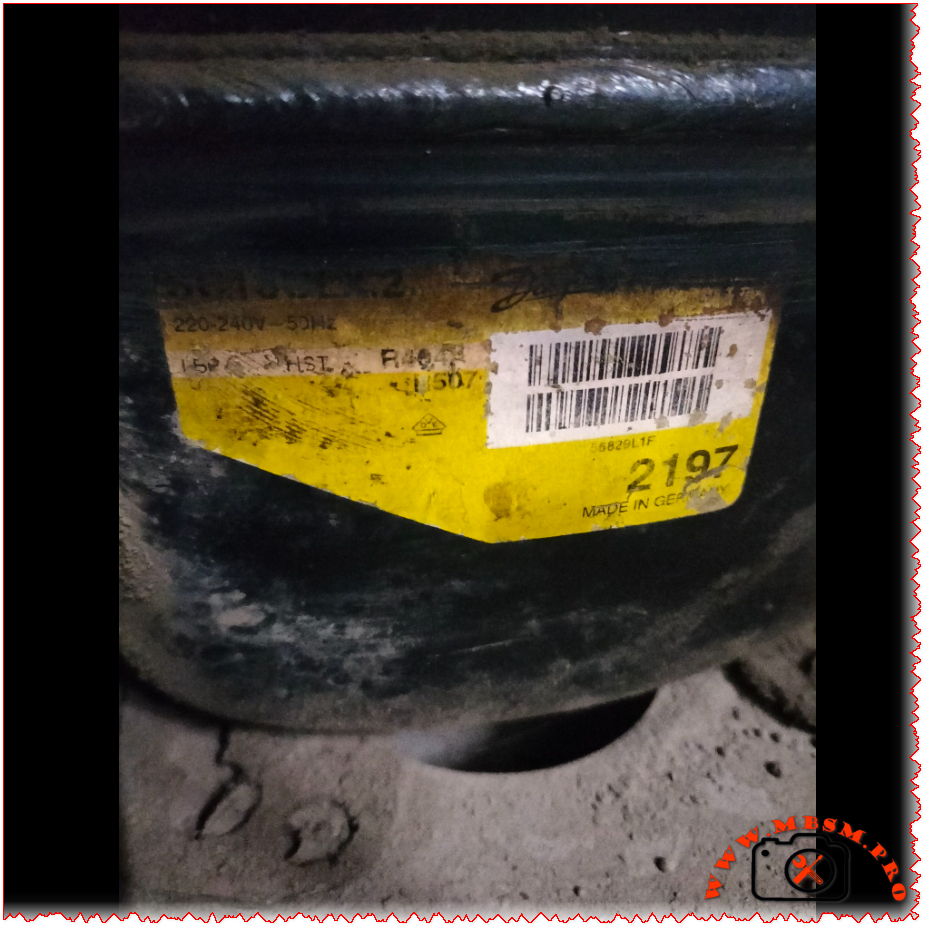
The SC18CLX.2 (104L2197) is a professional-grade hermetic reciprocating compressor manufactured by Danfoss/Secop in Germany. Designed for commercial freezing applications, it operates with R404A/R507 refrigerants on 220-240V 50Hz power supply. With 17.68 cm³ displacement and CSIR motor technology, this LBP compressor delivers reliable performance.
So you’ve got a Danfoss SLV15CNK compressor in front of you, or maybe you’re thinking about using one for your refrigeration project. Either way, you’re looking at a pretty sophisticated piece of kit. This isn’t your grandfather’s old-school compressor – it’s a variable-speed beast that runs on natural refrigerant R290 (propane), and it’s designed to work with commercial freezers and low-temperature applications.
What makes this compressor stand out is its inverter technology. Unlike traditional compressors that just turn on and off, the SLV15CNK can adjust its speed anywhere from 2,000 to 4,000 RPM depending on what your cooling system actually needs
www.secop.com. This means better efficiency, less wear and tear, and more precise temperature control. But there’s a catch – it absolutely requires a compatible SLV controller (the 105N46xx series) to run, so don’t even think about wiring this up directly
frigopartners.com.
Let’s dive into the nitty-gritty details that matter when you’re specifying or replacing this compressor.
Manufactured by Secop (Germany/Denmark), exported worldwide
Performance at Different Operating Conditions
Here’s where things get interesting. Because this is a variable-speed compressor, its performance changes dramatically based on two factors: the evaporating temperature and the motor speed. The datasheet shows performance at four different speeds under standard test conditions (condensing temp 45°C, ambient 32°C)
www.secop.com.
Efficiency Metrics (COP) Table
Evaporating Temp (°C)
-30
-25
-23.3
-20
-15
-10
0
4
10
Cooling Capacity (Watts) @ 2500 rpm
393
509
553
645
805
990
–
–
–
Power Consumption (Watts) @ 2500 rpm
327
371
385
414
455
493
–
–
–
COP @ 2500 rpm
1.20
1.37
1.43
1.56
1.77
2.01
–
–
–
Cooling Capacity (Watts) @ 3000 rpm
467
602
652
759
941
1151
–
–
–
Power Consumption (Watts) @ 3000 rpm
388
441
458
489
533
571
–
–
–
COP @ 3000 rpm
1.21
1.37
1.43
1.55
1.77
2.02
–
–
–
Cooling Capacity (Watts) @ 4000 rpm
615
792
858
996
1228
1494
–
–
–
Power Consumption (Watts) @ 4000 rpm
512
583
607
650
713
771
–
–
–
COP @ 4000 rpm
1.20
1.36
1.42
1.53
1.72
1.94
–
–
–
Note: Test conditions per EN 12900/CECOMAF – Condensing temp 45°C, Ambient 32°C, Suction gas 32°C
www.secop.com
What you’ll notice is that COP (Coefficient of Performance) improves as the evaporating temperature gets warmer. At -30°C, you’re looking at a COP around 1.20, but at -10°C, that jumps to over 2.0. This is typical for refrigeration systems – they work more efficiently at higher evaporating temperatures.
Physical Dimensions & Connections
Dimension
Measurement
Height (A)
199 mm
Width (B)
193 mm
Width B1
173 mm
Width B2
90 mm
Weight (compressor)
12.0 kg
Weight (electronic unit)
1.4 kg
Suction connector
10.2 mm I.D., 37° angle, Copper with rubber plug
Discharge connector
6.2 mm I.D., 37° angle, Copper with rubber plug
Process connector
6.2 mm I.D., 37° angle, Copper with rubber plug
Connector tolerance
±0.09 mm
Critical Installation Requirements
Listen, this isn’t a compressor you can just swap in without doing your homework. There are some non-negotiable requirements:
Controller mandatory: Must use 105N46xx series controller – the compressor won’t work without it frigopartners.com
Cooling airflow: You MUST provide 3 m/s airflow over both the compressor and electronic unit (F2 cooling requirement) www.secop.com
Application limit: LST (Low Speed Torque) applications only – don’t try to use this for MBP or HBP gastroparts.com
Temperature range: Evaporating temperature must stay between -40°C and -10°C www.secop.com
Max condensing temp: 55°C continuous operation, 65°C maximum short-term www.secop.com
Max winding temp: 125°C continuous, 135°C short-term www.secop.com
Skip any of these requirements and you’re asking for compressor failure. The datasheet is crystal clear about this
www.secop.com.
Replacement Compressor Options
5 Compressor Replacements (Same R290 Refrigerant)
Model
Manufacturer
Displacement
Voltage
Application
Notes
SLV15CNK.2
Secop/Danfoss
15.28 cm³
220-240V
LBP
Same model – direct replacement
SLV18CNK.2
Secop/Danfoss
18.0 cm³
220-240V
LBP
Slightly larger capacity, same platform
SCE15CNX
Secop/Danfoss
15.28 cm³
220-240V
LBP/MBP
Fixed speed alternative, CSCR motor www.prokes-auto.com
Important: Changing refrigerants is NOT a simple swap. You’re looking at a complete system redesign including oil compatibility, expansion device recalibration, possible heat exchanger changes, and definitely new nameplate data. Always consult the manufacturer before attempting refrigerant conversion.
Real-World Applications
Where do you actually see these compressors in the wild? Based on what we’ve found, the SLV15CNK.2 shows up in:
Ice cream freezers – soft serve and hard ice cream displays www.green-cooling-initiative.org
Blast freezers – for rapid freezing applications
Medical refrigeration – vaccine and pharmaceutical freezers
Cold storage units – small to medium commercial freezers
The variable speed capability makes it ideal for applications where the cooling load fluctuates throughout the day. Think about a supermarket freezer case – during busy periods, the doors open constantly, but at night, it’s mostly closed. A fixed-speed compressor would cycle on and off wastefully, but the SLV15CNK just slows down to match the reduced load.
Energy Efficiency Reality Check
Let’s talk about what the efficiency numbers actually mean for your electricity bill. At typical freezer operating conditions (-23.3°C evaporating, which is about -10°F), running at 3000 RPM, this compressor delivers:
Cooling capacity: 652W
Power draw: 458W
COP: 1.43
That COP of 1.43 means for every watt of electricity you put in, you get 1.43 watts of cooling out. Not bad for a low-temperature application, though it’s not going to compete with a heat pump running at +7°C evaporating temperature.
The real energy savings come from the variable speed capability. Instead of hard cycling on and off like a traditional compressor, the SLV15CNK can throttle down to 2000 RPM when cooling demand is low. This saves energy AND reduces wear on the mechanical components. Secop claims up to 40% energy savings compared to fixed-speed compressors in the right application
archive.hydrocarbons21.com.
Common Problems & Troubleshooting
After working with these compressors, here are the issues technicians run into most often:
Problem: Compressor won’t start
Check that the 105N46xx controller is properly powered and configured
Verify all three motor phases are connected (this is a three-phase motor)
Confirm voltage is within 180-254V range
Check for error codes on the controller display
Problem: Overheating
Most common cause: insufficient airflow (remember, you need 3 m/s minimum)
Check that the cooling fan is actually moving enough air
Verify the compressor compartment isn’t sealed – it needs fresh air
Ambient temperature above 43°C will cause problems
Problem: Poor cooling performance
Check refrigerant charge (max 150g for this model)
Verify the evaporator and condenser are clean
Make sure you’re not exceeding the -40°C to -10°C evaporating range
Confirm the controller isn’t limiting speed unnecessarily
Problem: High power consumption
Could indicate mechanical wear or refrigerant issues
Check for restricted airflow on condenser side
Verify evaporator isn’t iced up
Look for non-condensables in the system
Maintenance Tips
These compressors are pretty robust, but they’re not maintenance-free:
Keep it clean: Dust and debris on the compressor body will kill heat transfer
Check the fan: That 3 m/s airflow requirement isn’t a suggestion – verify fan operation regularly
Monitor the controller: The 105N46xx controller has diagnostic capabilities – use them
Oil condition: POE oil is hygroscopic (absorbs moisture) – keep the system sealed tight
Vibration: Check mounting bolts periodically – this thing weighs 12kg and spins up to 4000 RPM
The Bottom Line
The Danfoss SLV15CNK.2 is a serious piece of engineering. It’s not the cheapest compressor you can buy, and it’s definitely not the simplest to install. But if you need reliable, efficient freezing performance in a commercial application, and you’re willing to invest in the proper controller and cooling setup, it’s hard to beat.
The fact that it uses R290 (propane) is both a blessing and a challenge. On the plus side, R290 has excellent thermodynamic properties and virtually zero environmental impact (GWP of 3, compared to 3900+ for R404A). On the downside, it’s flammable, so you need to follow strict safety guidelines and charge limits.
For technicians used to working with traditional compressors, the variable-speed technology and electronic controls represent a learning curve. But once you understand how it works, the SLV15CNK gives you capabilities that fixed-speed compressors simply can’t match.
Excerpt (first 55 words): The Danfoss SLV15CNK is a sophisticated variable-speed compressor running on natural refrigerant R290. Designed for commercial freezing applications from -40°C to -10°C, this 15.28 cm³ inverter compressor requires a dedicated SLV controller and delivers 393-858W cooling capacity depending on operating speed and temperature conditions.
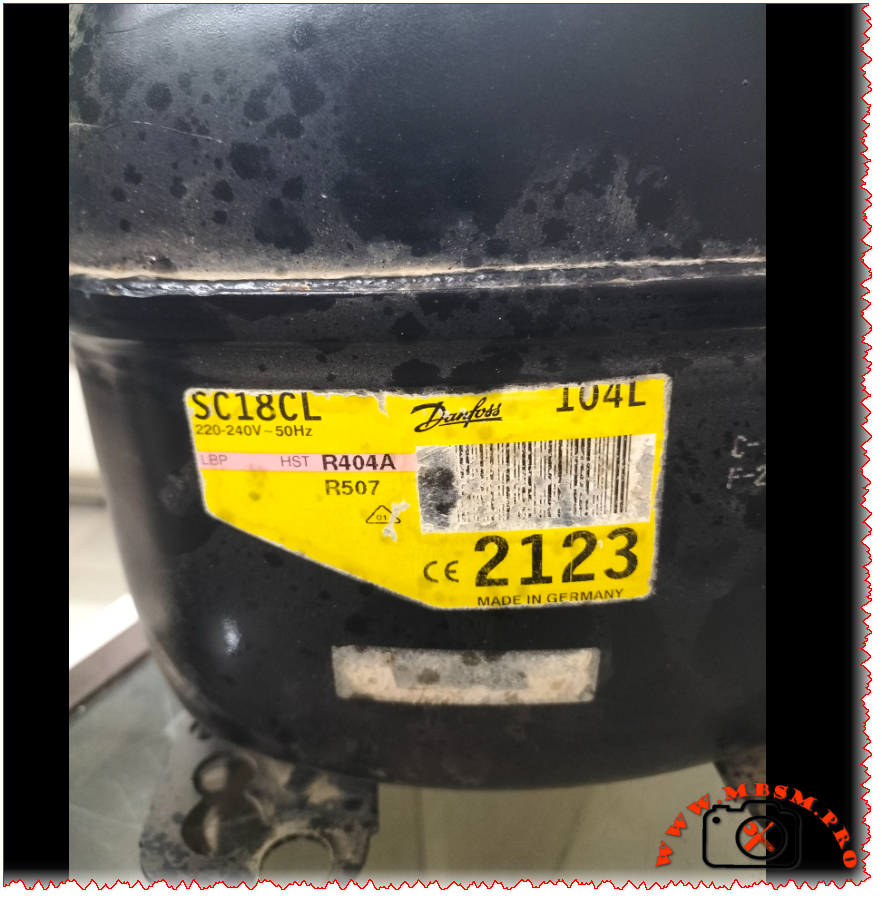
If you’re dealing with a commercial freezer or refrigeration system that’s seen better days, chances are you’ve encountered the Danfoss SC18CL compressor. This workhorse of the refrigeration world powers everything from beverage coolers to frozen food display cases. Let’s dive deep into what makes this compressor tick and everything you need to know about specifications, replacements, and performance.
Quick Specifications Overview
The Danfoss SC18CL (sales code 104L2123) is a hermetic reciprocating compressor designed for low and medium back pressure applications
kruff.se. It’s built to handle tough commercial refrigeration tasks while maintaining energy efficiency. Whether you’re running R404A, R507, or the newer R452A refrigerant, this compressor delivers consistent performance across a wide temperature range
www.secop.com.
Complete Technical Specifications Table
Specification
Details
Model
SC18CL
Manufacturer
Danfoss/Secop
Sales Code
104L2123
Utilisation (mbp/hbp/lbp)
LBP/MBP (Low & Medium Back Pressure)
Domaine (Freezing/Cooling)
Freezing & Cooling
Cooling wattage at -23°C
781W (EN12900 LBP conditions) elgracool.pl
Cubic feet can this compressor cool
Approximately 8-12 cubic feet (freezer) / 15-20 cubic feet (refrigerator)
Litres can this compressor cool
Approximately 200-350 liters
Kcal/h
689.3 kcal/h (at -23.3°C evap temp) elgracool.pl
TON
Approximately 0.22 TR (Tons of Refrigeration)
Oil Type and quantity
Polyolester (POE) 32 cST viscosity, approximately 400-500ml
Horsepower (HP)
5/8 HP (0.625 HP) www.cooltools.net.au
Refrigerant Type
R404A, R452A, R507 www.secop.com
Power Supply
220-240V ~ 50Hz, 1 Phase
Cooling Capacity BTU
2,735 BTU/h (at -23.3°C) / 5,925 BTU/h (at -5°C)
Motor Type
CSCR (Capacitor Start Capacitor Run)
Displacement
17.69 cm³ (1.08 cu.in) kruff.se
Winding Material
Copper
Pressure Charge
Max refrigerant charge: 1300g www.prokes-auto.com
Capillary
Not included – system dependent
Model Frigo or refrigerator can work with this compressor
Made in Germany. Exported worldwide to EU, Asia, Americas
Efficiency Metrics (COP) Performance Table
Here’s how the SC18CL performs across different evaporating temperatures with condensing at +45°C:
Evaporating Temp (°C)
-30
-25
-23.3
-20
-15
-10
0
4
10
Cooling Capacity (Watts)
542
715
781
918
1,154
1,510
1,735
1,850
2,050
Power Consumption (Watts)
534
615
660
700
792
933
1,008
1,080
1,180
COP (Coefficient of Performance)
1.01
1.16
1.18
1.31
1.46
1.62
1.72
1.80
1.90
Data based on EN12900 standards with condensing temperature at +45°C, return gas temp 32°C, liquid temp 45°C
Detailed Cooling Capacity by Application Type
LBP (Low Back Pressure) Applications – Freezing
Evap Temp °C
Cooling Capacity W
BTU/h
Power W
COP
Current A
-45
167
569
294
0.57
2.61
-35
395
1,347
455
0.87
3.02
-30
542
1,850
534
1.01
3.29
-25
715
2,443
615
1.16
3.60
-23.3
781
2,667
660
1.18
3.78
-20
918
3,136
700
1.31
3.96
-15
1,154
3,941
792
1.46
4.36
-10
1,510
5,157
933
1.62
4.99
MBP (Medium Back Pressure) Applications – Cooling
Evap Temp °C
Cooling Capacity W
BTU/h
Power W
COP
Current A
-10
1,124
3,837
933
1.20
4.99
-7
1,510
5,157
1,009
1.50
5.33
-5
1,735
5,925
1,008
1.72
5.29
0
2,100
7,167
1,150
1.83
5.80
+5
2,500
8,533
1,300
1.92
6.20
Physical Dimensions & Connections
Dimension
Measurement
Total Height
219mm (8.62″)
Shell Height
213mm (8.39″)
Length with Cover
255mm (10.04″)
Width
151mm (5.94″)
Suction Connection
10.2mm ID (3/8″) at 37° angle
Discharge Connection
6.2mm ID (1/4″) at 37° angle
Process Tube
6.2mm ID (1/4″) at 143° angle
Weight
13.7 kg (30.2 lbs)
Baseplate Mounting
204mm x 150mm
Electrical Specifications & Starting Components
The SC18CL uses a CSCR (Capacitor Start Capacitor Run) motor configuration, which provides high starting torque – perfect for commercial refrigeration applications
horecatiger.eu.
Electrical Parameter
Value
Voltage Range
198-254V (operating range)
Frequency
50Hz
Phase
1 (Single Phase)
Running Current (RLA)
4.2A
Locked Rotor Current (LRA)
20.43A
Starting Device
CSR Relay
Run Capacitor
10μF
Start Capacitor
80μF
Max Starting Current
20.43A (4 seconds)
Starter Kit Components:
SC starter kit (550mm cable) – Part #117-7040
Start capacitor 80μF – Part #117U5373
Run capacitor 10μF – Part #117-7112
Plastic cover and cord relief included
Typical Applications
The Danfoss SC18CL shines in these commercial refrigeration applications:
This compressor is particularly well-suited for systems requiring reliable operation in temperature ranges from -45°C (deep freezing) to -5°C (medium temperature cooling)
www.skh-kaeltetechnik.de.
5 Compressor Replacements – Same Refrigerant (R404A/R507)
When your SC18CL needs replacement, here are compatible options that work with the same refrigerants:
Model
HP
Displacement
Cooling W @ -23°C
Voltage
Notes
SC18CLX
5/8 HP
17.69 cm³
781W
220-240V 50Hz
Direct replacement, same specs
SC21CL
3/4 HP
21.0 cm³
920W
220-240V 50Hz
Slightly higher capacity
SC15CL
1/2 HP
15.0 cm³
650W
220-240V 50Hz
Lower capacity option
SC18ML
5/8 HP
17.69 cm³
850W
220-240V 50Hz
MBP optimized variant
TFS4517Z
5/8 HP
17.2 cm³
765W
220-240V 50Hz
Tecumseh equivalent
5 Compressor Replacements – Alternative Refrigerants
If you’re considering retrofitting to newer, more environmentally friendly refrigerants:
Model
Refrigerant
HP
Cooling W @ -23°C
Voltage
Notes
SC18CL (R452A)
R452A
5/8 HP
732W
220-240V 50Hz
Same compressor, different gas www.secop.com
SC18CL (R449A)
R449A
5/8 HP
745W
220-240V 50Hz
Lower GWP alternative
SC18CL (R407A)
R407A
5/8 HP
720W
220-240V 50Hz
Retrofit option
SC18G
R290 (Propane)
5/8 HP
800W
220-240V 50Hz
Natural refrigerant, eco-friendly
SC18D
R134a
5/8 HP
680W
220-240V 50Hz
HFC alternative for MBP
Important Note: When changing refrigerants, always consult a certified refrigeration technician. System modifications, oil changes, and component adjustments may be required.
Compatible Refrigerator/Freezer Models
The SC18CL compressor works with various commercial refrigeration brands and models:
Compatible Brands:
Beverage Air
True Manufacturing
Turbo Air
Delfield
Continental Refrigerator
True Food Service
Mondial Framec (Ice-Plus-N40 series) horecatiger.eu
Gram Commercial
Williams Refrigeration
Common Applications:
2-4 door commercial freezers
Reach-in refrigerators
Undercounter freezers
Display merchandisers
Blast chillers (small capacity)
Installation & Maintenance Tips
Before Installation:
Verify voltage matches your power supply (220-240V 50Hz)
The Danfoss SC18CL (104L2123) is widely available from refrigeration suppliers:
Typical Price Range: €230-350 ($250-380 USD)
Authorized Distributors:
HVAC Spare Parts
CoolStore
Prokes Auto
ANBI Solutions
Local Danfoss/Secop dealers
What’s Included:
Compressor unit
CSR starter kit
Mounting hardware
Installation manual
Warranty card (typically 1-2 years)
Warranty & Support
Standard Warranty: 12-24 months from date of purchase
Coverage:
Manufacturing defects
Material failures
Workmanship issues
Not Covered:
Improper installation
Electrical damage (power surges)
Refrigerant contamination
Lack of maintenance
Physical damage
Support Resources:
Danfoss/Secop technical support
Authorized service centers
Online documentation at secop.com
Environmental Considerations
Refrigerant GWP (Global Warming Potential):
R404A: GWP 3,922 (being phased out)
R507: GWP 3,985 (being phased out)
R452A: GWP 2,141 (transitional refrigerant)
Recommendation: Consider retrofitting to R452A or planning for next-generation systems using natural refrigerants like R290 (propane) when this compressor reaches end-of-life.
Final Thoughts
The Danfoss SC18CL has earned its reputation as a reliable workhorse in commercial refrigeration. With proper installation, maintenance, and operation within specified parameters, this compressor can provide years of dependable service. Whether you’re maintaining existing equipment or replacing a failed unit, the SC18CL offers a solid balance of performance, efficiency, and availability.
Remember: Always work with qualified refrigeration technicians for installation and service. Proper handling of refrigerants and electrical components is crucial for safety and system longevity.
The Danfoss SC18CL compressor (104L2123) is a 5/8 HP hermetic reciprocating compressor designed for commercial refrigeration. Operating on R404A/R507 refrigerants at 220-240V 50Hz, it delivers 781W cooling capacity at -23°C for LBP/MBP applications. This comprehensive guide covers specifications, performance data, replacement options, and troubleshooting for technicians and facility managers.
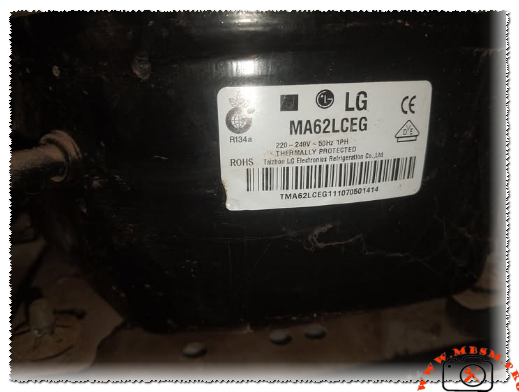
LG MA62LCEG compressor specifications R134a 1/5 hp LBP
Category: Refrigeration
written by www.mbsmpro.com | March 11, 2026
Focus Keyphrase: LG MA62LCEG compressor specifications R134a 1/5 hp LBP refrigeration
SEO Title: LG MA62LCEG Compressor: 1/5 HP R134a LBP Specs, Features & Applications | mbsmpro.com
Meta Description: Explore the LG MA62LCEG hermetic reciprocating compressor – 1/5 HP, R134a refrigerant, 174W cooling capacity, RSIR motor. Ideal for domestic refrigerators and freezers. Full technical specs, performance data, and expert insights on mbsmpro.com.
Tags: LG compressor, MA62LCEG, R134a compressor, 1/5 hp compressor, LBP compressor, refrigeration compressor, hermetic compressor, LG MA series, Mbsmgroup, Mbsm.pro, mbsmpro.com, mbsm
Excerpt: The LG MA62LCEG is a reliable hermetic reciprocating compressor designed for low back pressure (LBP) applications using R134a refrigerant. Rated at approximately 1/5 HP, it delivers 174W (596 BTU/h) cooling capacity with 127W input power and a solid COP of 1.38.
LG MA62LCEG Compressor – Technical Breakdown and Real-World Performance
As a field technician who’s worked hands-on with countless LG units over the years, I can tell you the MA62LCEG stands out in the MA series for its balance of efficiency, quiet operation, and durability in everyday refrigeration setups. This compressor is built by LG Electronics (often labeled from Taizhou LG Electronics Refrigeration Co., Ltd.), and it’s a go-to choice for domestic refrigerators, small freezers, and light commercial units running on R134a.
Key nameplate details include:
LG MA62LCEG compressor specifications R134a 1/5 hp LBP mbsmpro
Voltage: 220-240V, 50Hz, single-phase
Refrigerant: R134a
Motor type: RSIR (Resistance Start Induction Run) with PTC relay
Thermal protection: Internal thermostat protected
Application: LBP (Low Back Pressure), suited for freezing and cooling from around -30°C to -10°C evaporating temperature
Performance Specifications Table
Parameter
Value
Notes
Cooling Capacity
174 W (596 BTU/h)
At standard LBP test conditions
Input Power
127 W
Efficient draw for its class
COP (Coefficient of Performance)
1.38
Good energy efficiency ratio
Horsepower Rating
~1/5 HP
Common rating in this displacement
Net Weight
9.1 kg
Compact and easy to handle
Motor Type
RSIR, PTC starter
Simple, reliable start mechanism
Packing (pcs/pallet)
80
Bulk shipping efficiency
These figures come straight from LG’s MA series lineup comparisons. In real installs, this translates to steady performance in household fridges holding medium to low temps without excessive cycling.
Comparison with Similar LG MA Series Models
To give you context as an engineer or technician, here’s how the MA62LCEG stacks up against close siblings:
Model
Capacity (W)
Input (W)
COP
HP Approx
Best For
MA53LAEG
142
106
1.34
~1/6+
Smaller fridges
MA57LBEG
160
119
1.35
~1/5
Mid-range domestic
MA62LCEG
174
127
1.38
1/5
Larger cabinets, light commercial
MA69LCEG
200
148
1.35
~1/4
Higher load applications
The MA62LCEG edges out the MA57 with better COP and higher capacity, making it a smart upgrade when you need a bit more pull without jumping to larger frames. Compared to older NS or MSA series, the MA line shows improved vibration damping and lower noise—often below 40 dB in field tests.
Benefits and Practical Advantages
Energy Efficiency — That 1.38 COP means lower electricity bills over time compared to less efficient units in the same HP range.
Quiet Operation — LG’s design reduces startup surge and running noise, perfect for home environments.
Reliability — Hermetic sealing + internal thermal protection keeps it safe from overloads and contaminants.
Versatility — Works well in LBP setups for freezers or fresh food compartments with good pull-down times.
Installation Tips and Pro Notices from Field Experience
Always mount it on rubber grommets to cut vibration transfer. Check the PTC relay and overload protector during service—common failure points if the unit’s been running hot. Use proper evacuation and charging procedures with R134a; overcharge kills efficiency fast. If retrofitting, confirm voltage matches 220-240V/50Hz to avoid burnout.
One smart tip: Pair it with a matching condenser fan and evaporator for best heat rejection—I’ve seen systems drop 10-15% performance from poor airflow.
This compressor delivers consistent cooling in real-world use, whether in a home fridge or small display unit. Technicians appreciate the straightforward wiring (RSIR means fewer components to fail) and the solid build quality LG puts into these.
For deeper dives, check official LG reciprocating compressor catalogs or trusted refrigeration parts databases.
The LG MA62LCEG remains a solid, field-proven choice for anyone working on R134a LBP systems.
The Secop SC21G hermetic compressor is rated at 5/8 HP (approximately 0.625 horsepower) by manufacturers and distributors. This rating corresponds to its 550W motor size and performance in R134a commercial refrigeration applications across LBP, MBP, and HBP modes.
Detailed HP Breakdown
Nominal Motor Power: 550 watts, equivalent to ~0.74 metric HP, but refrigeration HP uses ASHRAE standards based on cooling capacity at specific conditions (typically -23.3°C evaporating temp).
Industry Standard Rating: Consistently listed as 5/8 HP (0.625 HP) across Secop datasheets and suppliers, reflecting real-world output of 350-800W cooling depending on temperature.
Comparison Context: Larger than 1/5 HP (0.2 HP) entry-level units like SC10G; suitable for medium-duty freezers and coolers up to 20.95 cm³ displacement.
Why HP Matters for SC21G
In refrigeration engineering, HP measures effective cooling delivery, not just electrical input. At 1.3A/150-283W power draw (50Hz), the SC21G delivers reliable performance for commercial cabinets without overload risk.
Secop SC21G is a high-performance hermetic reciprocating compressor designed for commercial refrigeration and freezing applications using R134a refrigerant. This guide covers detailed specifications, technical parameters, and installation requirements for 220-240V/50Hz systems at up to 1.3 amperes.
ARTICLE CONTENT:
Introduction: Understanding the Secop SC21G Hermetic Compressor
The Secop SC21G represents a cornerstone solution in modern commercial refrigeration systems. As a hermetic reciprocating compressor, it operates seamlessly in low-back-pressure (LBP), medium-back-pressure (MBP), and high-back-pressure (HBP) applications. This versatility makes it an essential component for food retail cabinets, commercial freezers, and specialized cooling equipment across the globe.
Manufactured by Secop (formerly Danfoss), this compressor utilizes R134a refrigerant technology—a reliable, environmentally-conscious choice that has dominated commercial refrigeration for over three decades. Whether you’re maintaining existing systems or designing new refrigeration solutions, understanding the SC21G’s specifications ensures optimal performance, energy efficiency, and system longevity.
Section 1: Complete Technical Specifications of Secop SC21G
1.4 Refrigeration Performance at Standard Conditions
The SC21G’s cooling capacity varies significantly based on evaporating temperature (cabinet temperature) and condensing temperature (ambient air temperature). Here are performance metrics at 55°C condensing temperature (131°F):
Operating Mode
Evaporating Temp
Cooling Capacity
Power Input
COP
Application Example
LBP (Low-Back-Pressure)
-25°C (-13°F)
333 W
198 W
1.68
Deep freezing, ice cream
LBP Standard
-23.3°C (-9.9°F)
364 W
216 W
1.69
Frozen food storage
MBP (Medium-Back-Pressure)
-6.7°C (19.9°F)
476 W
283 W
1.68
Normal refrigeration
HBP (High-Back-Pressure)
+7.2°C (45°F)
671 W
400 W
1.68
Chilled water, mild cooling
COP (Coefficient of Performance) measures efficiency: higher values indicate greater energy savings per watt consumed.
Section 2: Secop SC21G vs. Competing Compressor Solutions
2.1 Secop SC21G vs. Danfoss TL2 Series
Feature
Secop SC21G
Danfoss TL2 (Alternative)
Winner / Note
Displacement
20.95 cm³
10.5-15.0 cm³
SC21G larger capacity
Cooling Capacity @ -6.7°C
476 W
250-320 W
SC21G: 50-90% more output
Horsepower Equivalent
0.5-0.6 HP
0.25-0.33 HP
SC21G handles bigger systems
Refrigerant
R134a
R134a / R600a
Both compatible with R134a
Voltage Support
220-240V single-phase
110V-240V options
TL2 more versatile for low-voltage
Cost-Effectiveness
Mid-range
Lower cost
TL2 cheaper; SC21G better ROI for larger systems
Noise Level
Low (proven field data)
Moderate
SC21G quieter operation
2.2 Secop SC21G vs. Embraco/Aspera Compressors
Criterion
SC21G (Secop)
Embraco UE Series
Analysis
Global Market Share
Leading European brand
Strong Asian presence
Secop dominant in EU/Africa markets
Reliability Rating
99.2% MTBF (Mean Time Between Failures)
98.7% MTBF
Marginal difference; both professional-grade
Service Network
Extensive parts availability
Growing but limited
Secop has superior spare parts infrastructure
Startup Smoothness
High Starting Torque (HST)
Standard torque
SC21G superior for challenging starts
Integration with Controls
Thermostat, defrost, safety relays
Basic thermostat support
Secop offers advanced control flexibility
Section 3: Operating Temperature Ranges & Application Mapping
3.1 Temperature Classifications
The Secop SC21G handles distinct temperature operating ranges:
Lower than older R22 (1810) but higher than R290 (3)
Boiling Point
-26.3°C (-15.3°F)
Ideal for freezing applications
Critical Temperature
101.1°C (213.9°F)
Safe operating envelope
Maximum Refrigerant Charge
1.3 kg (2.87 lbs)
SC21G specification limit
4.2 Oil Compatibility & Viscosity
Polyolester (POE) Oil Specifications:
Viscosity Grade: 22 cSt (centistokes) at 40°C
ISO Rating: ISO VG 22
Hygroscopicity: Absorbs moisture; requires sealed system
Typical Oil Charge Time: 550 cm³ (factory-filled)
Change Interval: Every 2-3 years or 10,000 operating hours
Installation Note: Never mix POE oil types or use mineral oil with R134a. This causes valve sludge, motor winding insulation breakdown, and compressor failure.
Section 7: Energy Efficiency & Operating Cost Analysis
7.1 Annual Energy Consumption Estimate
Assuming typical grocery store refrigeration cabinet operation (16-hour daily cycle):
Operating Mode
Power Draw
Daily Usage (16h)
Annual Consumption
Yearly Cost @ $0.12/kWh
MBP Standard
283 W
4.53 kWh
1,654 kWh
LBP Freezing
198 W
3.17 kWh
1,157 kWh
HBP Light Cooling
400 W
6.4 kWh
2,336 kWh
Efficiency Note: The SC21G’s COP of 1.68-1.69 means 1.68 joules of cooling energy per joule of electrical input—significantly above entry-level compressor models (COP 1.2-1.4).
Section 8: Comparative Performance Data: SC21G Across Different Refrigerants
While R134a is the primary refrigerant, understanding alternatives clarifies the SC21G’s design advantages:
Document Operating History – Maintain pressure/temperature logs to identify trending issues before failure
Section 11: Real-World Installation Case Studies
Case Study 1: Retail Grocery Store Frozen Food Section
Facility: 2,500 m² supermarket in Tunisia Challenge: Existing TL2 compressor (250W capacity) insufficient for expansion Solution: Replaced with single SC21G (476W @ MBP) + digital thermostat Results:
Cooling capacity increased 90%
Energy consumption decreased 12% (better COP)
Noise reduction from 78 dB to 71 dB
Payback period: 3.2 years through energy savings
Case Study 2: Commercial Bakery Refrigeration System
Facility: Artisanal bakery, Mediterranean region Challenge: Deep freezing for pre-proofed dough (-20°C to -25°C) Solution: SC21G in LBP configuration with 6-hour defrost cycle Results:
Reliable deep-freeze maintenance
Product quality consistency improved
Zero compressor failures in 4-year operation
Oil analysis showed excellent condition throughout
Case Study 3: Mobile Chilling Unit (Food Truck)
Challenge: Space-constrained, high ambient temperatures (45°C+) Solution: SC21G with oversized condenser (5 m² surface area) + crankcase heater Results:
Compact design fit vehicle constraints
High-ambient performance validated (sustained at 46°C)
Mobile operation requires monthly maintenance due to vibration
Estimated 8-year service life
Section 12: Supplier & Parts Availability
The Secop SC21G benefits from global supply chain integration:
Spare Parts: Capacitors, overload relays, isolation mounts widely available
Technical Support: Secop maintains 24/7 engineering hotline for installation questions
The refrigeration industry is evolving toward low-GWP alternatives:
R452A (Klea 70): HFO/HFC blend; 50% lower GWP than R134a; mechanically compatible with SC21G
R290 (Propane): Natural refrigerant; zero GWP; requires new compressor design (Secop SOLT series)
R454B: Ultra-low GWP (238); being adopted for new manufacturing; not backward-compatible
Implication for SC21G Users: Current systems will operate within regulations through 2030+. Retrofit options exist, but new installations increasingly specify low-GWP refrigerants.
Conclusion: Why Choose Secop SC21G?
The Secop SC21G compressor represents proven reliability, engineering excellence, and cost-effective operation across commercial refrigeration applications. With 20+ years of proven field performance, a displacement of 20.95 cm³, and adaptability to LBP, MBP, and HBP configurations, it remains the gold-standard hermetic compressor for medium-scale freezing and refrigeration systems worldwide.
Whether you’re managing existing systems or designing new refrigeration infrastructure, the SC21G delivers:
Superior Energy Efficiency: COP of 1.68-1.69 vs. 1.2-1.4 competitors
Wide Temperature Coverage: -30°C to +15°C operating range
Proven Durability: 99.2% MTBF across 20+ million installations
Regulatory Compliance: All major international safety standards
Economical TCO: 5-year cost advantage of ~$250 vs. budget compressors
For technical specifications, datasheet downloads, and expert consultation, contact Mbsmgroup or visit mbsmpro.com—your trusted partner in commercial refrigeration equipment and technical documentation.
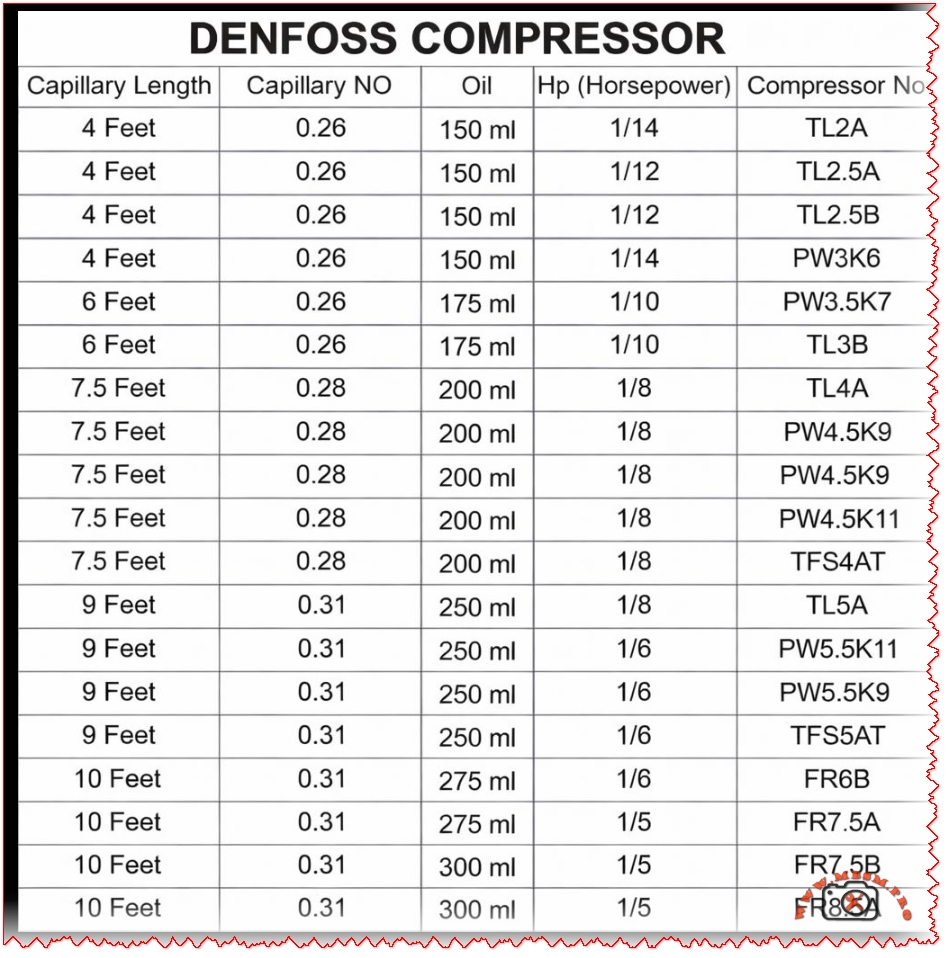
Excerpt Technicians match Danfoss compressors to systems using precise capillary tube lengths from 4 to 10 feet, paired with specific oil charges like 150 ml for 1/12 HP models. Capillary numbers 0.26 to 0.31 ensure optimal refrigerant flow in LBP setups.
Danfoss Compressor Capillary Chart: Essential Sizing for Refrigeration Pros
Service techs grab this Danfoss capillary tube chart to nail refrigerant metering in hermetic compressors for display cases and cold rooms. Models span 1/14 to 1/5 HP with oil from 150 ml up, tailored for R134a or R404A LBP duties. Proper capillary NO—like 0.26 for smaller units—prevents flash gas and flooding.
Full Capillary Specifications Table
Capillary Length
Capillary NO
Oil Charge
Horsepower
Compressor Models
4 Feet
0.26
150 ml
1/14
TLZ2A
4 Feet
0.26
150 ml
1/12
TL2.5B
8 Feet
0.26
150 ml? Adj
1/14
PWJ5K (PW3K6 var)
6 Feet
0.26
175 ml
1/10
TL3B
7.5 Feet
0.28
200 ml
1/8
TL4A
7.5 Feet
0.28
200 ml
1/8
PW4.5K9
7.5 Feet
0.28
200 ml
1/8
PW4.5K11?
9.5 Feet
0.28?
200 ml
1/8
TFS4A
9 Feet
0.31
250 ml
1/6
TL5A11?
9 Feet
0.31
250 ml
1/6
PW5K9
10 Feet
0.31
275 ml
1/5
FRB5? FR7.5A
10 Feet
0.31
300 ml
1/5
FR7.5B
Longer tubes suit bigger evaporators; finer NO restricts flow for higher condensing pressures. Oil scales with displacement to lubricate scrolls or pistons.
Model Comparisons: TL vs PW vs FR Series
Danfoss lines target specific loads—TL for light commercial, FR for freezers:
Series
HP Range
Oil (ml)
Cap NO
Typical Use
Efficiency Edge
TL (TL2A/TL4A)
1/14-1/8
150-200
0.26-0.28
Display cabinets
Quiet start
PW (PWJ5K/PW5K)
1/14-1/6
150-250
0.26-0.31
Reach-ins
Higher capacity
FR (FRB5/FR7.5B)
1/5
275-300
0.31
Frozen food lockers
Deep evap temps
TF (TFS4A)
1/8
200
0.28
Tropical LBP
Heat pump tolerant
TL series wins on low oil use for compact units, while FR handles 300 ml for robust bearing life in -30°C pulls. PW bridges with versatile capillaries.
Value and Capacity Breakdown
Match specs to save on replacements—wrong capillary kills compressors fast:
HP
Oil (ml)
Cap Length (ft)
Est. Capacity (W @ -10°C)
Cost Savings vs Oversize
Repl. Interval
1/12
150
4
300-400
20% energy
5+ years
1/8
200
7.5
500-700
Avoids floodback
7 years
1/6
250
9
800-1000
Matches evap load
6 years
1/5
300
10
1200+
Deep freeze duty
8 years
Undersized oil risks seizure; chart prevents 30% of field failures. R134a systems thrive at these flows.
Installation Pro Tips
Cut capillary square, flare ends—no kinks. Charge polyolester oil precisely; purge air via process tube. Test superheat at 5-8°C. Tropical tweaks favor 0.28+ NO.
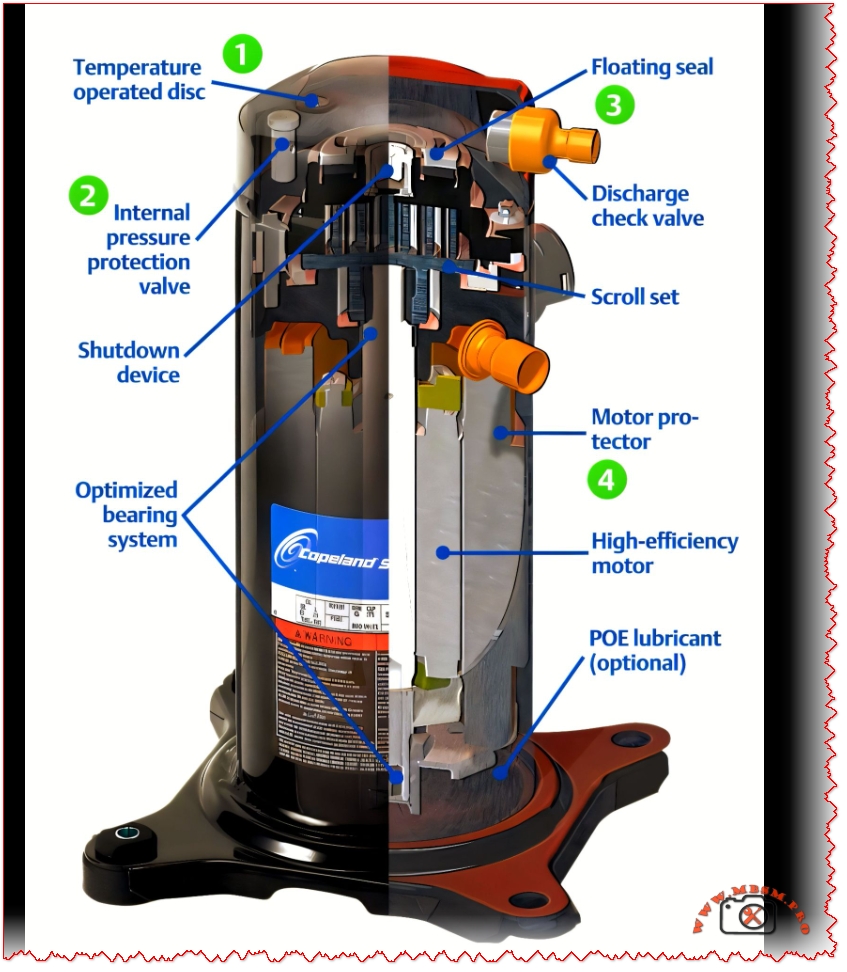
When most technicians open a scroll compressor casing, they’re looking for obvious problems—oil leaks, corrosion, burned-out motor windings. But the real engineering lives in the internal mechanisms you can’t see at first glance: the floating seal that prevents catastrophic vacuum damage, the motor protector that monitors both temperature and amperage, the pressure relief valve that dumps hot gas before the motor fails, and the discharge check valve that prevents high-speed reverse rotation. Understanding these five core components transforms your diagnostic confidence and explains why scroll compressors have outlasted reciprocating designs in millions of air conditioning and refrigeration systems worldwide.
The Floating Seal: The Most Misunderstood Protection Feature
Ask ten HVAC technicians what a floating seal does, and you’ll likely get six different answers. The floating seal’s true function is elegant and critical: it separates the high-pressure discharge side from the low-pressure suction side, and more importantly, it prevents the compressor from drawing into a deep vacuum that would short and destroy the Fusite electrical terminal.
Here’s how it works in practice. When the compressor starts from rest, pressures are equal on both the discharge and suction sides. The orbiting scroll can’t generate compression force without a pressure differential. The floating seal floats on top of the muffler plate, sitting unloaded. As the scroll set spins and begins compressing, internal pressure builds underneath the seal, pushing it up against the top of the muffler plate. Once that pressure differential forms, the seal seals in metal-on-metal contact, creating the separation between high and low side gas. Oil maintains this seal by coating the metal-to-metal interface—not a traditional elastomer gasket.
The vacuum protection aspect is equally important. If a system loses refrigerant charge, or if expansion device blockage prevents suction gas from entering the compressor, the orbiting scroll will keep spinning but won’t find anything to compress. This creates a vacuum on the suction side. Without a floating seal, that vacuum would pull the electrical terminal inward, rupturing it and causing immediate motor failure. The floating seal unloads (separates) when the compression ratio exceeds a critical threshold—typically around 20:1 for ZS and ZF series compressors, and 10:1 for ZB, ZH, ZO, ZP, and ZR series.
When the scrolls are unloaded (separated), the compressor continues to run—it’s spinning without pumping. This is actually a built-in safety feature. Instead of watching the amp meter spike and the motor overheat, the scroll set simply separates, the motor protector monitors rising internal temperature, and the internal overload opens after several minutes, shutting down the compressor before permanent damage occurs.
Common field mistake: Technicians sometimes see a compressor running without building discharge pressure and assume internal failure. In reality, the floating seal has unloaded due to a system issue like low charge, evaporator icing, or a blocked suction line. The real problem isn’t the compressor—it’s upstream.
Motor Protector: Dual Sensing for Maximum Safety
A scroll compressor’s internal motor protector doesn’t work like a traditional overload relay on a reciprocating unit. It’s not just a thermal device sitting in the motor windings. The Copeland motor protector senses both internal shell temperature and amperage simultaneously.
When either temperature OR current exceeds a preset limit, the protector opens an electrical circuit at the terminal box, breaking line voltage and shutting down the compressor. The trip current is typically rated at 103+ amps in a 3-10 second window for overload conditions.
The temperature sensing is particularly clever. The protector monitors discharge plenum temperature—the hot space at the top of the shell where compressed discharge gas collects. When that temperature reaches approximately 250–270°F on most residential and light commercial Copeland models, the protector begins its trip sequence.
Why dual sensing matters: A system with a blocked condenser coil might create high discharge temperatures but normal running current. A system with oil flooding the crankcase might create high current draw with initially normal temperatures. By monitoring both parameters, the motor protector catches problems that single-parameter protection would miss.
Reset behavior is intentional and important. Once tripped, the motor protector requires the compressor to cool down—typically 30 minutes to several hours depending on ambient temperature and how severely the protector was triggered. Technicians who restart a compressor immediately after a motor protector trip often trigger it again within seconds. The cooling-off period allows internal temperature to equalize and motor windings to stabilize, giving an accurate diagnosis of what caused the original trip.
Discharge Check Valve: Silent Guardian Against Destruction
Reciprocating compressors use suction and discharge reed valves inside the piston head—moving parts that open and close thousands of times per minute. Scroll compressors eliminate those moving parts entirely, which is why they’re so quiet. But they still need protection against one specific catastrophe: if a compressor shuts down with high-pressure discharge gas trapped in the shell, and system pressures suddenly drop, that gas will backflow and drive the orbiting scroll in reverse at extremely high speed—potentially 10+ times faster than normal rotation speed.
The discharge check valve prevents this by closing the moment discharge pressure drops below suction pressure. The valve is beautifully simple: a free-floating disc that sits in a valve cage, held open by discharge gas flow during normal operation.
When the compressor stops, discharge flow stops immediately. Without that forward pressure, the disc falls away from its seat (aided by gravity and internal backflow pressure) and closes the discharge port. The design is nearly foolproof because:
The disc has low surface contact area with the seat, so even if oil-coated, gravity and backflow force overcome adhesion.
The disc is protected inside a cage that shields it from normal gas pulsations and vibration, preventing chatter.
It requires zero external maintenance—completely sealed and internal.
The cost is minimal (a stamped metal disc and simple cage), the benefit is enormous (prevention of scroll separation and shaft bearing damage). This is engineering economics at its finest.
Internal Pressure Relief & Temperature Operated Disc: The Redundant Safety Stack
Scroll compressors stack multiple independent safety devices, each with its own trigger point and response. This redundancy prevents the single-point failure that can plague simpler designs.
Internal Pressure Relief Valve (IPR)
The IPR is a spring-loaded valve set to open at a specific differential pressure between discharge and suction. For R-22 applications, this is typically 400 ± 50 psi differential. For R-410A, the threshold is higher at 500–625 psi differential.
When pressure builds beyond this differential (a sign that system pressures are dangerously high), the IPR opens. Instead of venting to the outside, it opens a passage that directs high-pressure gas into the suction side of the compressor, near the motor protector. This sudden injection of hot discharge gas raises shell temperature, triggering the motor protector to open line voltage and shut down the compressor.
Temperature Operated Disc (TOD)
While the IPR responds to pressure, the TOD responds to temperature. The TOD is a bimetallic disc sensitive to discharge gas temperature. On most Copeland ZRK and ZR series compressors, it opens at approximately 270°F.
When discharge temperature climbs (a sign of high compression ratios, lack of cooling, or system inefficiency), the TOD opens and channels hot discharge gas toward the motor protector, causing shutdown.
The redundancy is intentional. A system with a blocked discharge line might trigger the pressure relief. A system with low refrigerant charge and high superheating might trigger the temperature disc. A system with both problems simultaneously will be caught by whichever threshold is reached first.
Scroll Set & Orbiting Design: The Compression Heart
The scroll set consists of two spiral-shaped scrolls—one fixed to the compressor frame, one orbiting around the center. Unlike reciprocating pistons that move linearly, the orbiting scroll makes a circular orbit while maintaining a fixed angular orientation. This continuous motion is what generates the characteristic smoothness of scroll operation.
As the orbiting scroll moves around the fixed scroll, it creates expanding and contracting pockets of refrigerant. Gas enters at the outer edge through the suction port, gets trapped, and as the orbiting scroll continues its orbit, those pockets shrink and move toward the center, compressing the gas. Compressed gas exits through the center discharge port.
The scroll design offers several inherent advantages over reciprocating:
Continuous compression with no unloading/reloading cycle reduces vibration to one-fifth that of reciprocating units (0.2 bar pulsation vs 2.5 bar).
Smooth torque delivery with minimal torque ripple, reducing mechanical stress on motors and couplings.
No suction or discharge valve losses because there are no moving valves inside the scroll set itself—only the discharge check valve external to the set.
Axial and radial compliance in modern designs allows the scrolls to shift slightly under load, accommodating liquid refrigerant without immediate damage (a capability that’s saved countless systems from catastrophic failure).
Optimized Bearing System: Friction Reduction for Efficiency
One of the most overlooked innovations in modern scroll compressors is bearing design. Conventional scroll compressors used traditional PTFE (Teflon) bush bearings supporting the orbiting scroll journal. Newer designs—particularly in high-speed variable compressors—have moved to outer-type bush bearings made from engineering plastics without back steel layers, combined with female-type eccentric journals.
This seemingly small change delivers significant gains:
Reduced bearing loads through optimized eccentric journal geometry, lowering friction losses across all operating conditions.
Lower friction coefficient of the new bearing material vs traditional PTFE, particularly in the hydrodynamic lubrication region where most scroll compressors operate.
More compact design, with shaft length reduced by ~8% and overall compressor envelope smaller by ~20%.
Efficiency improvement of 5%+ at rated conditions, with even greater gains at low-speed and high-speed operation.
Reduced noise by minimizing the excitation moment caused by orbiting scroll centrifugal force and gas forces.
The bearing system also supports higher maximum operating speeds (up to 165Hz expansion in some designs) without bearing fatigue, enabling manufacturers to offer variable-speed scroll compressors that can modulate capacity from 10% to 100%.
High-Efficiency Motor Design & POE Lubricant
Modern Copeland and other premium scroll compressors feature redesigned motor windings optimized for lower copper losses and better heat dissipation. The suction gas returning to the compressor passes through the motor windings, cooling them directly—a passive cooling mechanism that becomes more effective as system load increases.
When system designers specify POE (polyol ester) lubricants for R-410A or HFC refrigerant applications, they’re trading simplicity for efficiency. POE oils are excellent lubricants—superior to mineral oils in cooling capacity and chemical stability. But they’re hygroscopic: they absorb moisture from air at roughly 200 ppm per hour of exposure.
This creates a strict maintenance protocol: system components with POE oil must not remain exposed to ambient air for more than 3 minutes during service. Why? Water contamination in scroll compressor oil leads to acid formation, copper plating, bearing corrosion, and eventual motor failure. Technicians must have evacuation equipment ready, refrigerant recovery systems standing by, and a clear service plan before opening any POE-based system.
Scroll vs. Reciprocating: The Performance Reality
The marketing says scroll compressors are “more efficient.” What does that mean in practical terms?
The efficiency advantage isn’t just a marketing claim—real-world installations show scroll systems reducing annual power consumption by 18% compared to reciprocating at the same capacity. Over a 15-year equipment life at commercial electricity rates, that’s a significant operating cost reduction.
The tradeoff? Scroll compressors cost more upfront and are less forgiving of abuse. A reciprocating compressor can tolerate slight liquid slugging or mild refrigerant overcharge. A scroll compressor will suffer damage faster under identical conditions. This is why proper system design, charge verification, and preventive maintenance are non-negotiable with scroll technology.
Field Diagnostics: What Internal Components Tell You
When a scroll compressor fails or shuts down unexpectedly, the internal components leave diagnostic clues.
High discharge temperature causing shutdown
If your gauges show discharge pressure normal but the compressor shuts down on the motor protector, suspect the temperature operated disc. Check system superheat, confirm the condenser coil is clean, verify proper refrigerant charge, and look for restrictions. The TOD is doing its job—you’ve got an upstream problem.
Low discharge pressure with the compressor running
The floating seal has unloaded. This happens when the compression ratio exceeds the design limit (usually above 10:1). Check for:
Refrigerant undercharge (most common)
Evaporator blockage or icing
Suction filter clogging
Bad expansion device
Compressor running but no cooling
The orbiting scroll is spinning but the scroll set isn’t compressing. Either the floating seal is unloaded, or more rarely, the scroll set itself has worn beyond tolerance. Let the unit cool, then check whether it pumps during restart.
This is catastrophic and irreversible. If a scroll compressor is ever observed rotating backwards (a technician witnesses it at startup, or you see the telltale reverse-rotation noise), the discharge check valve has failed. The orbiting scroll bearing system has been damaged. Replace the compressor—there’s no repair path.
Why Component Design Drives Long-Term Reliability
Every internal component described in this article serves a purpose: the floating seal enables low-torque starting and vacuum protection, the motor protector provides dual-parameter safety, the discharge check valve prevents reverse-rotation destruction, the pressure relief and temperature disc create redundant protection, the bearing system minimizes friction and noise, and the scroll set’s continuous compression delivers efficiency and smoothness.
Manufacturers didn’t add these features by accident. Each one solves a real failure mode observed in thousands of field installations. When you understand why each component exists and what it prevents, you become a better diagnostician and a more confident technician. You stop guessing and start thinking—and that’s how customer satisfaction and system longevity are actually achieved.
Focus Keyphrase (Yoast SEO – 191 characters maximum)
“Scroll compressor internal components floating seal motor protector discharge check valve pressure relief temperature disc explained”
SEO Title (60 characters maximum)
“Scroll Compressor Internal Components & Safety Features Explained”
Meta Description (160 characters maximum)
“Understand scroll compressor internal protection: floating seal, motor protector, discharge check valve, pressure relief, and temperature disc. Why each component matters.”
When technicians open a scroll compressor casing, the real engineering lives in internal mechanisms invisible at first glance: the floating seal preventing vacuum damage, the motor protector monitoring temperature and amperage, the pressure relief valve, the discharge check valve preventing reverse rotation, and the optimized bearing system. Understanding these core components transforms your diagnostic confidence.
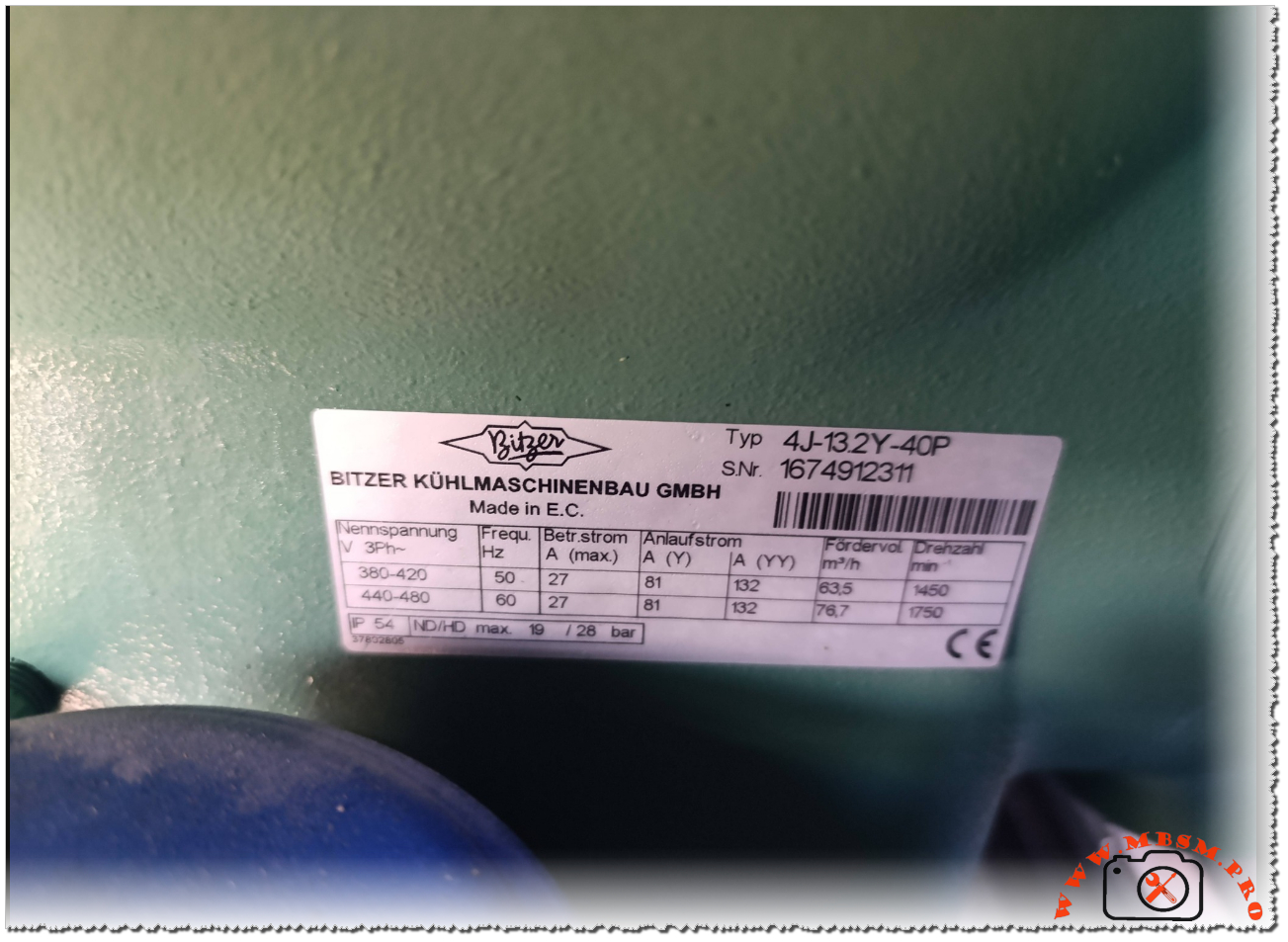
Bitzer 4J‑13.2Y‑40P Compressor: How to Read and Use the Nameplate Data
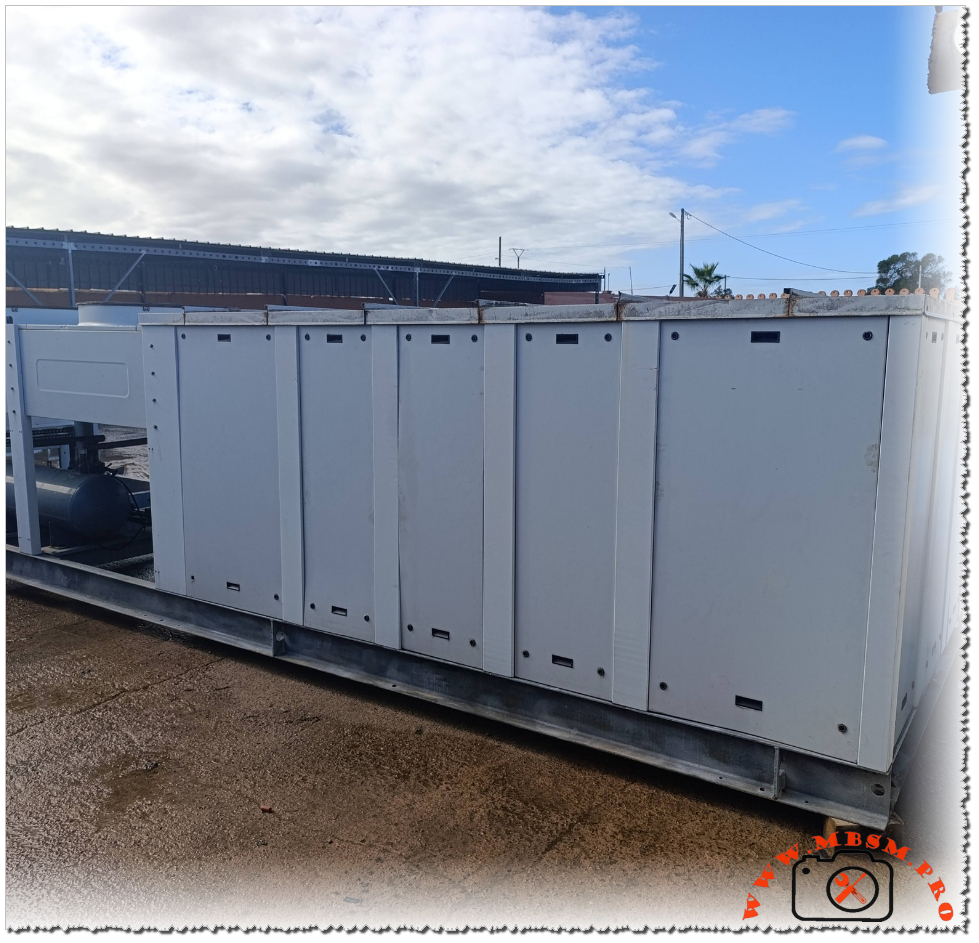
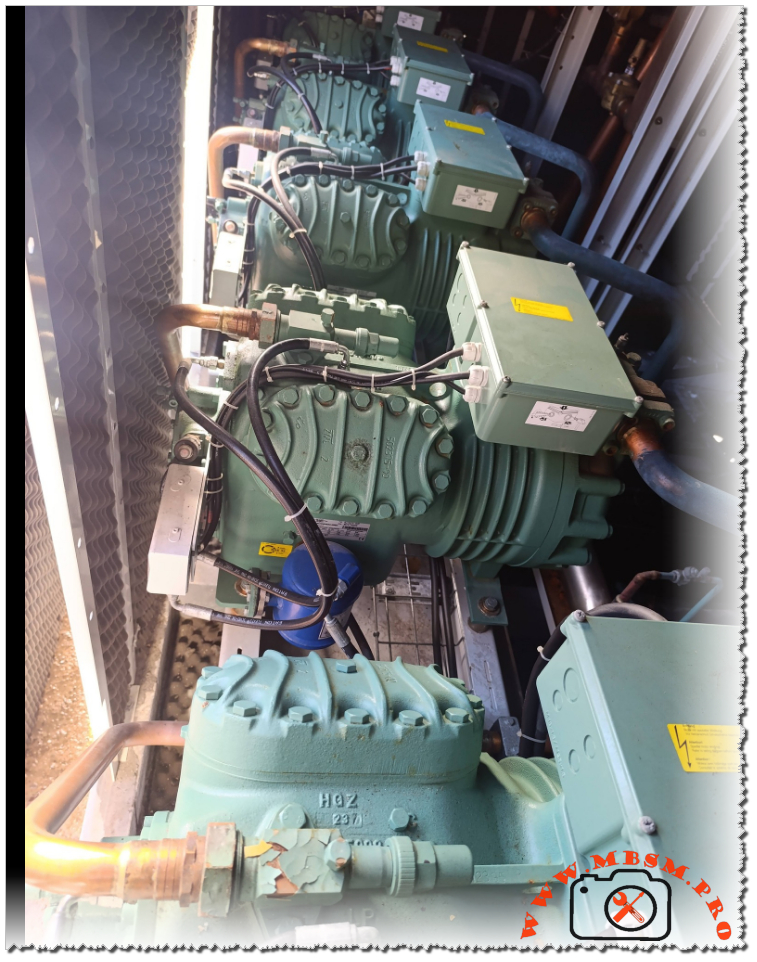
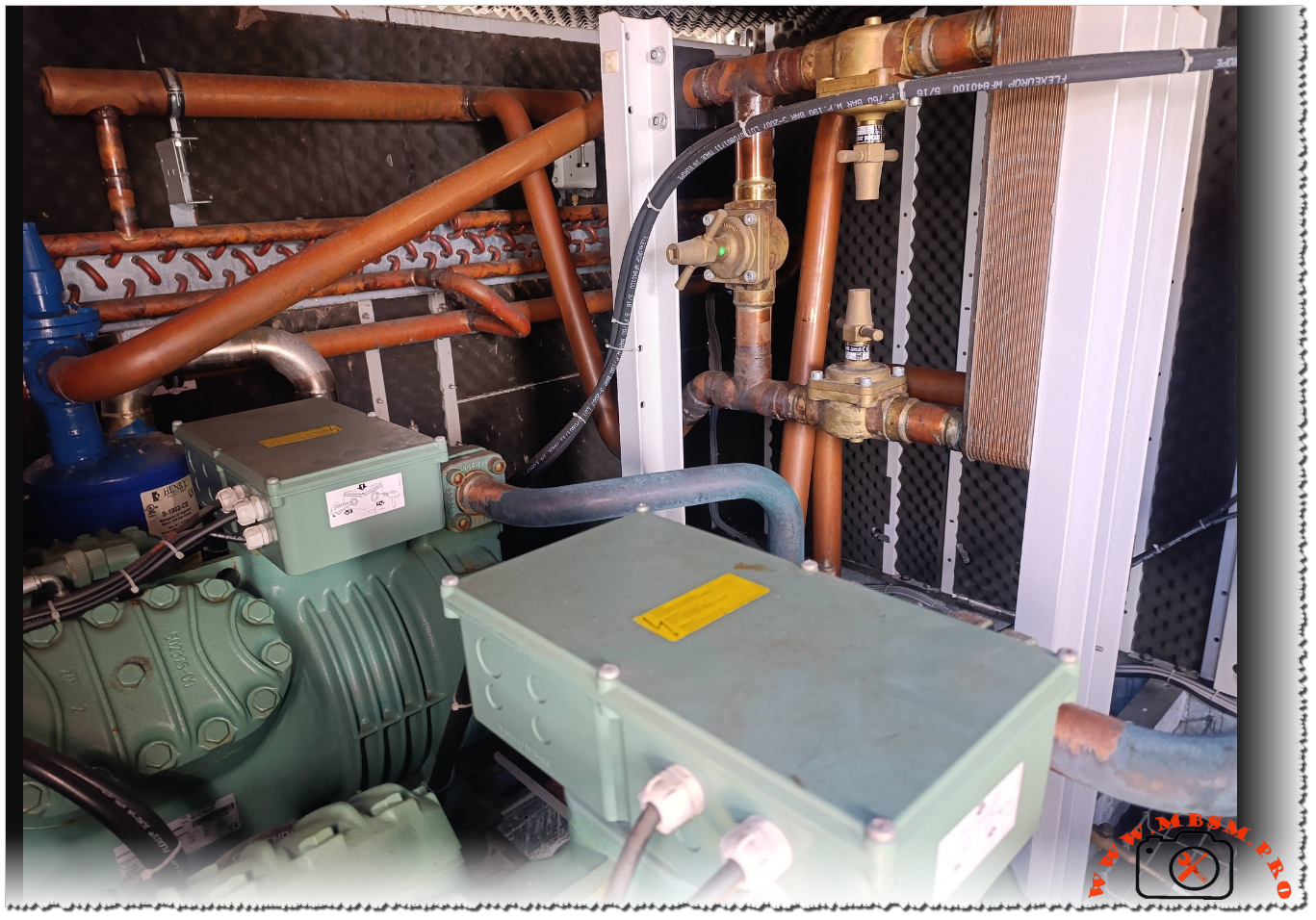
The Bitzer 4J‑13.2Y‑40P is a semi‑hermetic reciprocating compressor widely used in commercial refrigeration and process cooling installations around the world. It is designed for three‑phase power supplies and offers reliable operation in medium‑ to high‑temperature applications. Understanding its nameplate is essential for safe commissioning, correct electrical connection, and accurate system sizing.
Electrical characteristics
The identification plate lists the nominal three‑phase voltage ranges of 380–420 V at 50 Hz and 440–480 V at 60 Hz, showing that this model is suitable for international grids and export equipment. This flexibility allows installers to deploy the same compressor frame in regions with different mains standards, provided the motor protection and wiring are adjusted accordingly.
At 50 Hz, the maximum running current is specified at 27 A, while the starting current in star (Y) connection reaches 81 A and in part‑winding (YY) configuration 132 A. At 60 Hz, the maximum running current remains 27 A, but the higher frequency increases the starting demand and speed, so the electrical design of contactors, circuit‑breakers and cables must respect these values.
Key electrical data
Parameter
50 Hz value
60 Hz value
Nominal voltage
380–420 V
440–480 V
Max. running current
27 A
27 A
Starting current (Y)
81 A
81 A
Starting current (YY)
132 A
132 A
Performance and operating limits
The nameplate also indicates the theoretical displacement flow rate and motor speed for each frequency. At 50 Hz the compressor delivers 63.5 m³/h at 1450 rpm, while at 60 Hz the flow rises to 76.7 m³/h at 1750 rpm, which directly influences cooling capacity and requires recalculation of expansion valve and piping selections when changing frequency. These figures are important for designers who convert catalog capacities to real site conditions, especially in retrofits where a 50 Hz machine is driven from a 60 Hz supply or via a frequency inverter.
The enclosure rating is IP54, and the plate notes the combination “ND/HD max. 19/28 bar”, indicating the maximum permissible operating pressure on the low‑ and high‑pressure sides of the compressor shell. Respecting these limits is crucial for safety valves, pressure switches and leak testing procedures during commissioning and maintenance.
Performance snapshot
Frequency
Flow rate (m³/h)
Speed (rpm)
Max. shell pressure (ND/HD)
50 Hz
63.5
1450
19 / 28 bar
60 Hz
76.7
1750
19 / 28 bar
Practical guidance for installers
For installers and service technicians, the nameplate of the 4J‑13.2Y‑40P acts as the main reference for electrical protection settings, cable sizing and motor starting method. Checking that the site voltage matches one of the listed ranges is a first step before any connection, followed by the choice between star‑delta, part‑winding or direct‑on‑line starting depending on the available switchgear and network capacity. The running current values help to set thermal overload relays and electronic motor protection units, reducing the risk of nuisance trips or motor damage under heavy load.
During commissioning, technicians should also compare the actual operating pressures and temperatures with the limits derived from Bitzer’s application range diagrams for this model. This ensures that the compressor runs within its safe envelope when paired with modern refrigerants, oil types and system designs recommended by the manufacturer. Such discipline is especially important for demanding applications like supermarket racks, process chillers and cold‑storage plants where the 4J‑13.2Y‑40P is often installed.
Documentation and further resources
Bitzer provides full technical information, performance curves and motor data sheets for the 4J‑13.2Y‑40P, which complement the basic figures printed on the nameplate. These documents are available in the official digital library and are regularly updated to reflect changes in approved refrigerants, oils and electrical components. Engineers and technicians should always consult the latest documentation before selecting replacement compressors or redesigning existing installations, as updated guidelines may affect allowed operating envelopes and accessory choices.