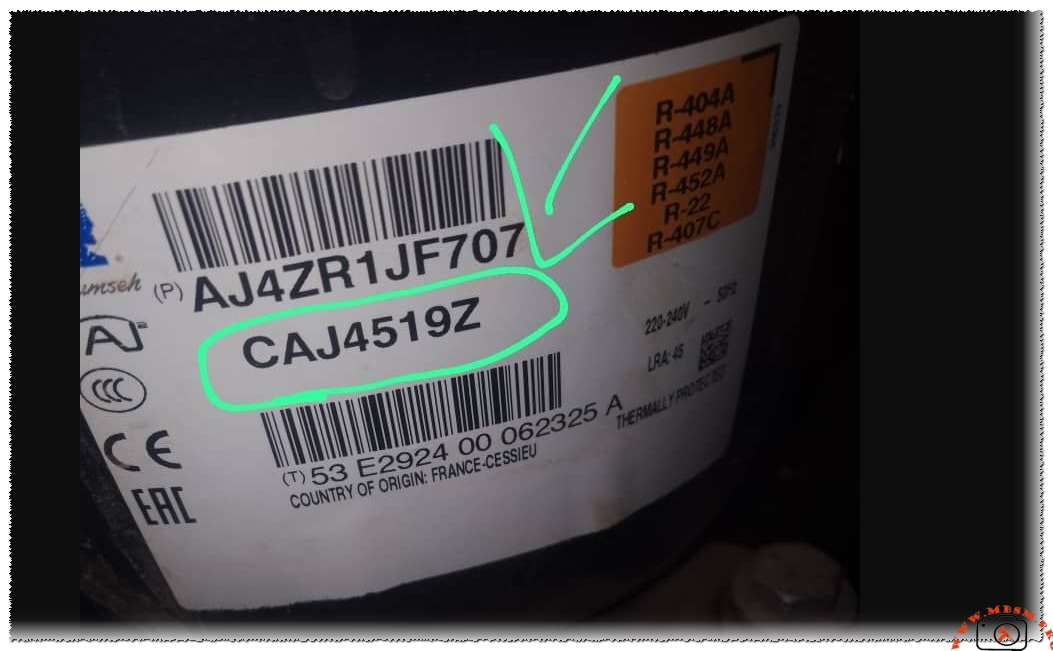
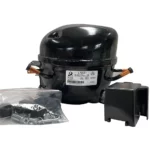
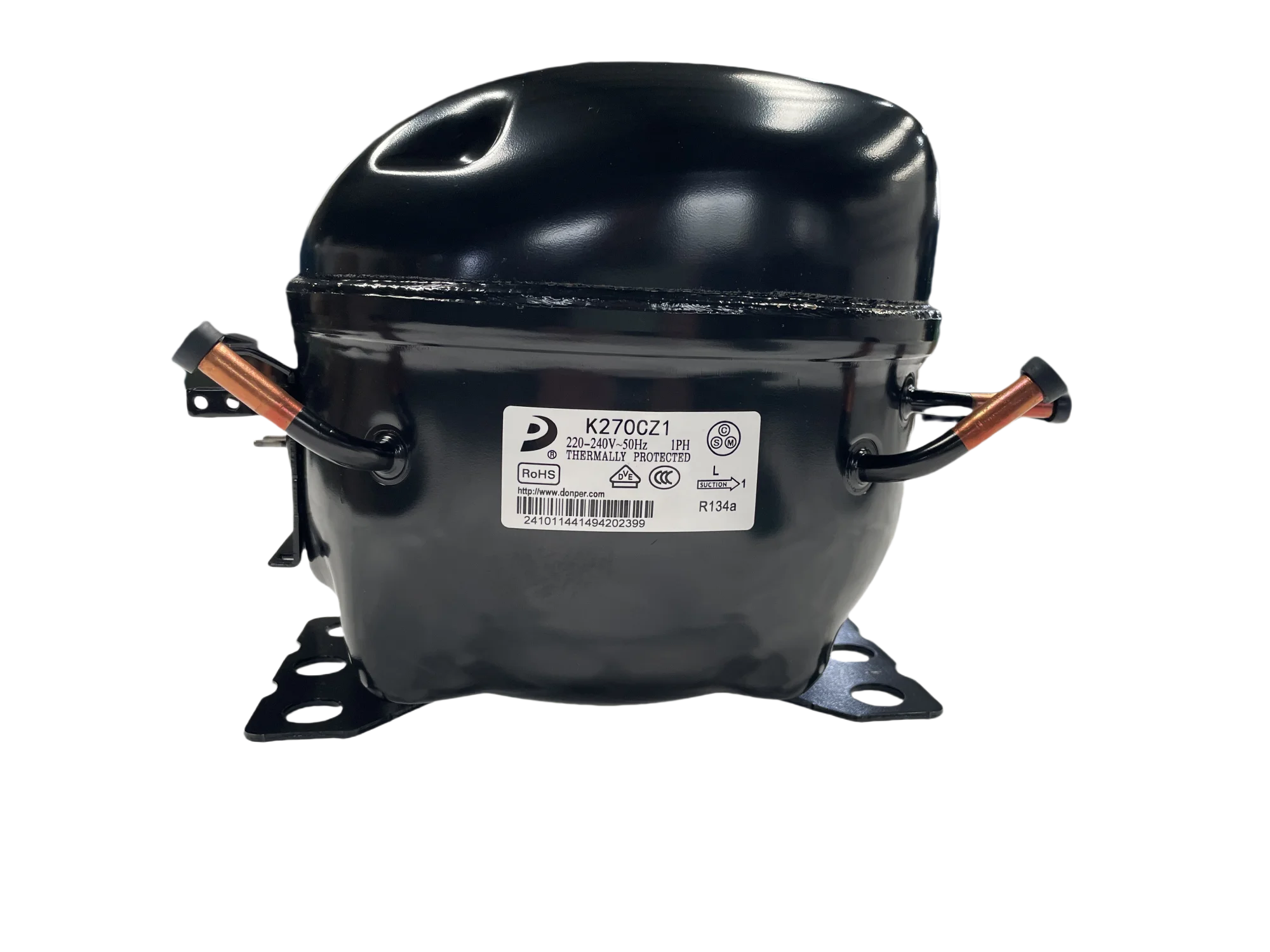
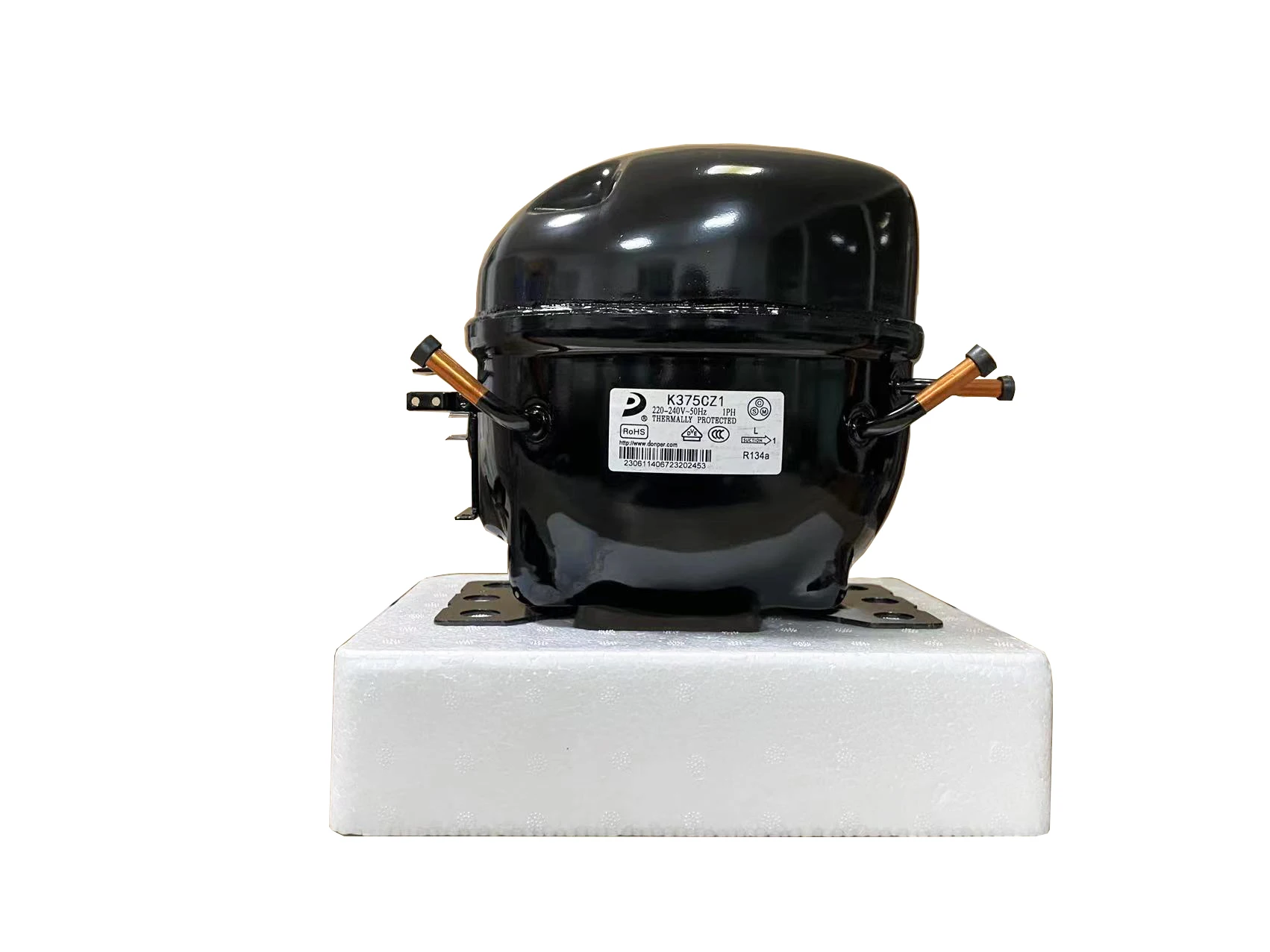
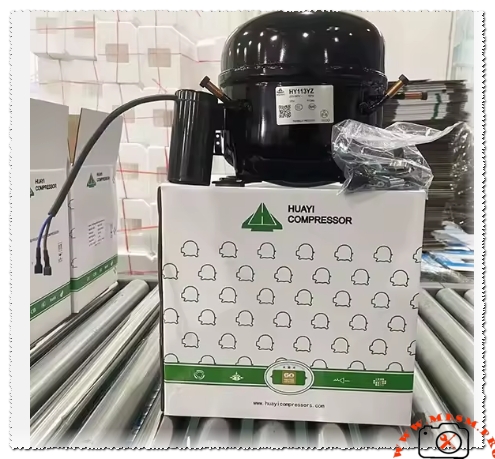
Copeland KCE444HAG hermetic compressor

Copeland KCE444HAG hermetic compressor mbsmpro

Mbsmpro.com, Compressor, KCE444HAG, 3/8 Hp, Copeland, R134a, 230V 50Hz, High / Medium temperature, Water cooler applications

Overview of the Copeland KCE444HAG compressor

The Copeland KCE444HAG is a hermetic reciprocating compressor designed for high and medium temperature commercial refrigeration using R134a refrigerant.
It is widely used in water coolers and bottle coolers where stable performance, compact size, and low noise are required.

Technical specifications and operating range

The KCE444HAG belongs to the KCE family and uses a connecting‑rod type reciprocating mechanism with a single‑phase induction motor.
Its evaporating temperature range is approximately −17.8°C to +12.8°C, covering typical high / medium temperature applications in beverage and water cooling.

Main electrical and performance data

Parameter Value Notes
Refrigerant R134a HFC, medium‑pressure.
Nominal horsepower 0.36 HP (≈3/8 HP) Depending on rating condition HBP/CBP.
Cooling capacity 1077 W (HBP), 551 W (CBP) At specified EN12900 conditions.
Power input 475 W (HBP), 339 W (CBP) Single‑phase operation.
Voltage / frequency 230 V, 50 Hz, 1‑phase Typical for water coolers 40–80 L.
Motor type 2‑pole single‑phase induction Internally thermally protected.
Application group High / Medium temperature (HBP / CBP) Not suitable for low‑temperature freezing.
Compressor cooling Fan, about 350 ft³/min Forced air cooling around shell.
Oil type / volume POE, approx. 0.31 L Pre‑charged from factory.
Approx. internal free volume 2400 cm³ (81.1 oz) Without oil.

This specification table is essential for system designers who must match condenser size, evaporator load, and expansion device selection to the compressor envelope.
Using the correct voltage, frequency, and oil type is critical to preserve warranty and avoid early motor or mechanical failure.

Application examples and exploitation in the field

In practice, the KCE444HAG is commonly installed in:

  • Water coolers between 40 and 80 liter nominal storage.
  • Bottle coolers and small commercial beverage merchandisers operating in high or medium temperature ranges.

For water coolers, the compressor offers enough capacity to chill drinking water quickly while keeping energy consumption moderate, thanks to its roughly 475 W input at high‑back‑pressure conditions.
In bottle coolers, the wide evaporating envelope from negative temperatures up to more than +10°C allows flexible control of cabinet temperature without putting the compressor outside its design limits.

Performance comparison with similar compressors

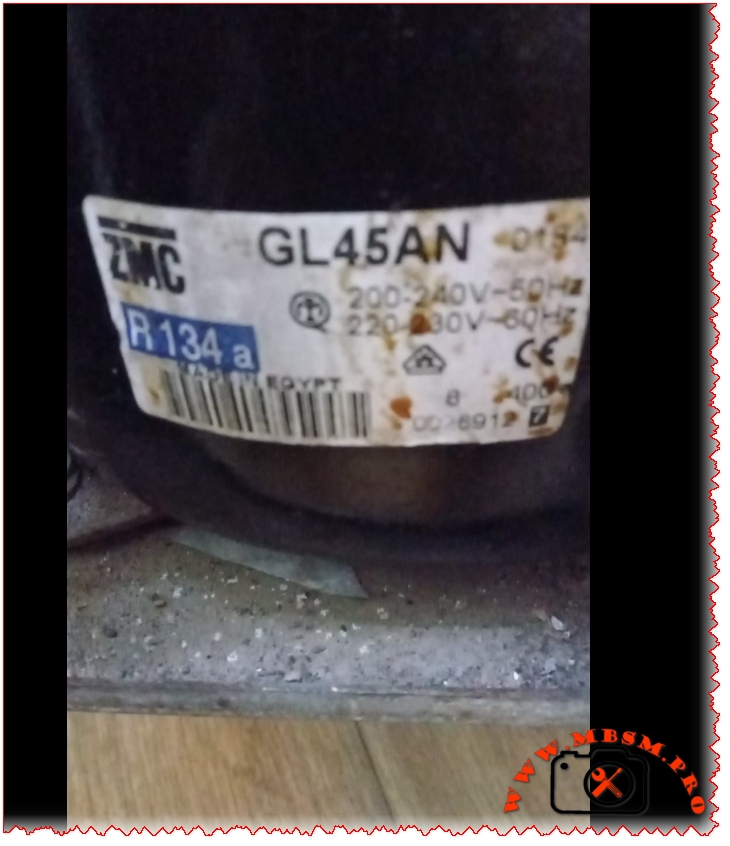
To understand the real value of the KCE444HAG, it is useful to compare it with another well‑known R134a hermetic compressor such as the GL90AA (ZMC EGL90AA) widely used in domestic and light commercial refrigeration.

Capacity and power comparison

Model Refrigerant Nominal HP Cooling capacity (approx.) Input power Typical use
KCE444HAG R134a 0.36 HP 1077 W (HBP), 551 W (CBP) 475 W (HBP) Commercial water/bottle coolers.
EGL90AA (GL90AA) R134a 0.25 HP 227 W (LBP) Domestic refrigerators, small LBP cabinets.

From this table, the KCE444HAG clearly delivers a much higher cooling capacity than the EGL90AA, which translates into faster pull‑down times and suitability for larger, more demanding systems.
However, the smaller EGL90AA consumes less power and is better suited where low‑back‑pressure, small‑load operation is required, such as household fridges and compact freezers.

Application temperature range comparison

Model Application group Evaporating temperature range
KCE444HAG HBP / CBP −17.8°C to +12.8°C.
EGL90AA LBP Around −35°C to −6.7°C in typical LBP charts.

The table shows why the KCE444HAG is chosen for positive temperature applications like water coolers, while the EGL90AA works better in freezer‑type systems requiring lower evaporating temperatures.
Selecting the wrong compressor for the required evaporating range can lead to high discharge temperatures, low efficiency, and premature failure.

Installation, reliability, and service considerations

The KCE444HAG compressor must be operated inside the condensing and evaporating temperature envelope defined by the manufacturer to guarantee long service life.
The datasheet specifies that performance values are valid only inside this envelope and also gives maximum allowable internal moisture and solid residue limits, emphasizing the need for clean, well‑evacuated systems.

Technicians should:

  • Use R134a only and charge with the correct POE oil volume if a major repair requires oil replacement.
  • Keep the mounting angle within the 5° limit and respect guidelines for handling and disposal listed in the detailed product documentation.

Good airflow around the compressor and condenser, combined with properly sized capillary or expansion valve, keeps shell temperature and discharge pressure under control, further improving reliability in continuous water‑cooler duty.

Copeland KCE444HAG hermetic compressor mbsmpro


LG BMG110NHMV Inverter Compressor

LG BMG110NHMV Inverter Compressor mbsmpro

Mbsmpro.com, Compressor, BMG110NHMV, 1/4 hp, LG inverter, Cooling & Freezing, R600a, 220‑240V 50/60Hz, LBP capacity, BLDC, −29°C to −10°C

The LG BMG110NHMV is a variable‑speed BLDC inverter compressor for R600a refrigerators and freezers, working on 220–240 V, 50/60 Hz in low‑back‑pressure applications. With a nominal rating close to 1/4 hp and a speed range from 1200 to 4500 rpm, it delivers flexible capacity and high efficiency for modern domestic appliances.


BMG110NHMV technical profile

LG’s catalog lists the BMG110NHMV in the BMG inverter R600a series, designed for high‑efficiency household refrigerators. The nameplate confirms R600a refrigerant, thermal protection and 220–240 V supply.

Main data and operating point

Parameter BMG110NHMV value
Manufacturer LG Electronics / LG Compressor & Motor 
Series BMG inverter R600a 
Model BMG110NHMV 
Refrigerant R600a (isobutane) 
Motor type BLDC inverter, variable speed 
Supply 220–240 V, 50/60 Hz (inverter‑driven, 60–225 Hz) 
Application LBP domestic refrigerator / freezer 
Speed range 1200–4500 rpm 
Test condition Evap −23.3 °C / Cond 54.4 °C / ambient 32 °C 
Nominal capacity at 4500 rpm ≈ 262 W (894 Btu/h) 
Input power at 4500 rpm ≈ 146 W 
COP at 4500 rpm ≈ 1.79 W/W (≈ 6.11 Btu/W·h) 

At lower speeds like 1500–1800 rpm, capacity drops to around 102–125 W while COP remains near 1.74–1.75, allowing the compressor to modulate for part‑load efficiency.


Capacity table across speeds

The inverter control lets the same compressor cover a wide load range without cycling, which is reflected in LG’s performance table.

Cooling capacity vs power – BMG110NHMV (R600a LBP)

Speed (rpm) Capacity (kcal/h) Capacity (W) Capacity (Btu/h) Power (W) COP (W/W) EER (Btu/W·h)
4500 225 262 894 146 1.79 6.11 
3000 172 200 683 108 1.85 6.32 
1800 108 125 427 72 1.75 5.97 
1500 88 102 349 59 1.74 5.95 
1200 70 82 279 48 1.72 5.87 

These values show how the inverter platform lets manufacturers tune energy labels by operating much of the time at lower speeds, while still having 262 W on tap for rapid pull‑down.


Comparison with other LG inverter R600a models

LG’s catalog groups the BMG110NHMV with BMG110NAMV and BMG089 series models, all R600a BLDC compressors for LBP applications. Comparing their data helps installers and designers choose the right size.

LG R600a BLDC inverter comparison

Model Series Nominal hp class Capacity at 4500 rpm (W) Power (W) COP (W/W) Typical cabinet volume*
BMG089NAMV BMG ≈ 3/16 hp 217 W 119 W 1.83 200–260 L refrigerators 
BMG089NHMV BMG ≈ 3/16 hp 217 W 126 W 1.72 high‑efficiency 200–260 L 
BMG110NAMV BMG 1/4 hp class 262 W 144 W 1.82 280–350 L fridges/freezers 
BMG110NHMV BMG 1/4 hp class 262 W 146 W 1.79 280–350 L refrigerators / freezers 

*Cabinet volume estimates are typical ranges inferred from inverter R600a design practice, not explicit catalog values.

The BMG110NHMV thus occupies a sweet spot between the smaller BMG089 series and larger BMK/BMA models, ideal for mid‑size no‑frost or multi‑door refrigerators where load fluctuates strongly.


Comparison with fixed‑speed R600a compressors

To highlight the benefit of inverter technology, it is useful to compare BMG110NHMV with a typical constant‑speed R600a compressor of similar hp rating. LG’s own reciprocating catalog and third‑party suppliers show 1/4 hp fixed‑speed R600a models with similar cooling capacity but higher average power consumption.

Inverter vs fixed‑speed R600a – indicative comparison

Feature BMG110NHMV (inverter) Typical 1/4 hp fixed‑speed R600a compressor
Speed control 1200–4500 rpm via BLDC inverter  Single speed (≈ 3000 rpm)
Nominal capacity ≈ 262 W at −23.3 °C  ≈ 250–270 W at similar point 
Input power 146 W at full speed, 48–108 W at reduced speed  ≈ 180–200 W constant 
COP / EER Up to ≈ 1.85 W/W (6.3 Btu/W·h)  Typically 1.5–1.6 W/W (5.1–5.5 Btu/W·h) 
Temperature control Smooth, low‑noise modulation  On/off cycling, higher noise and temperature swing
Energy label impact Enables A+/A++ energy classes in many markets  Usually lower efficiency class

This comparison explains why OEMs increasingly specify BMG‑series compressors in premium, energy‑efficient refrigerators.


Safety and application notes for R600a systems

Because BMG110NHMV uses R600a, a flammable hydrocarbon, system design and service procedures must follow IEC and manufacturer guidelines.

  • Charge quantities in household refrigerators are limited, typically below 150 g, to remain within safety limits.
  • Electrical components near the compressor must be sealed or spark‑free, and any repair involving brazing requires full refrigerant recovery and ventilation.

These constraints do not reduce performance; they simply require disciplined handling, especially when replacing the compressor or modifying pipework.

LG BMG110NHMV Inverter Compressor mbsmpro


GMCC PE90HME‑4 hermetic compressor

GMCC PE90HME‑4 hermetic compressor mbsmpro

Mbsmpro.com, Compressor, PE90HME‑4, 1/3 hp class, GMCC, Cooling, R134a, 265–295 W, 1.55 A, 1Ph 220‑240V 50/60Hz, LBP capacity, RSCR motor, −23.3°C to −10°C

The GMCC PE90HME‑4 is a hermetic reciprocating refrigerator compressor optimized for R134a and low‑back‑pressure applications at 220–240 V, 50/60 Hz. With a displacement of about 9.0 cm³ and catalog cooling capacities between 265 and 295 W around freezer conditions, it sits in the 1/3 hp performance class and targets domestic and light commercial refrigerators.


GMCC PE90HME‑4 technical identity

The label identifies the compressor as thermally protected, RoHS‑compliant and designed for R134a static‑cooling appliances. It belongs to the PE series of GMCC light commercial units produced by Anhui Meizhi Compressor Co., Ltd.

Nameplate and catalog data

Item Value / description
Brand GMCC – Anhui Meizhi Compressor Co., Ltd. 
Model PE90HME‑4 
Refrigerant R134a, low‑back‑pressure (LBP) range 
Voltage / frequency 220–240 V, 50/60 Hz, single‑phase (1Ph) 
Motor type RSCR (resistance start, capacitor run) 
Displacement ≈ 9.0 cm³ 
Cooling capacity 265–295 W at LBP conditions (−23.3 °C evap, 32.2 °C amb.) 
Input power ≈ 1.52–1.55 A rated current at 220–240 V 
Application Static‑cooling domestic and small commercial refrigerators, freezers and coolers 
Protection Internal thermal protector, RoHS environmental compliance 

The RSCR motor concept means a start capacitor is used only during start while a smaller run capacitor remains in circuit, balancing starting torque, efficiency and cost for fractional‑horsepower refrigeration.


Operating envelope and performance

GMCC’s reference data for the PE90H1F‑4 and PE90HME‑4 show nearly identical working limits, giving a clear view of the envelope in which this compressor is expected to operate. These limits are critical for system designers who must match capillary length, condenser size and evaporating temperature.

Operating limits

Parameter Typical PE90HME‑4 values
Evaporating temperature range −35 °C to −10 °C (LBP) 
Nominal rating point −23.3 °C evap / 32.2 °C ambient / 55 °C condensing 
Voltage range 187–254 V (50 Hz) 
Ambient temperature range 0–43 °C 
Max condensing temperature 60–70 °C 
Max discharge gas temperature 130 °C 
Max winding temperature 130 °C (internal) 
Max pump‑down pressure ≈ 1.82 MPa 

At the nominal point the compressor typically delivers around 265 W at 1.55 A, while higher ambient or less negative evaporating temperatures move capacity closer to 295 W but also increase power input. GMCC specifies vibration levels below 4.9 m/s² and sound levels compatible with household refrigerator noise expectations.


Comparison with other GMCC R134a PE series models

To position the PE90HME‑4 correctly for selection and replacement, it helps to compare it with nearby models such as PE65H1H‑9 and PE90H1F‑9 from the same GMCC R134a range.

GMCC R134a LBP models – performance comparison

Model Displacement (cm³) Cooling capacity at 50 Hz (W)* HP class Rated current (A) Application
PE65H1H‑9 6.5 190–195 W 1/4 hp  ≈ 1.47–1.55 LBP domestic refrigerators
PE90HME‑4 9.0 265–295 W 1/3 hp class  ≈ 1.52–1.55 LBP refrigerators / freezers
PE90H1F‑9 9.0 275–280 W 1/3 hp+  ≈ 1.50 LBP with wide‑voltage range
PE120HMH★ 12.0 320 W 3/8–1/2 hp  ≈ 1.45 L/MBP commercial coolers

*Capacity values taken at −23.3 °C evap / 32 °C amb., minor differences by catalog edition.

Compared with the PE65H1H‑9, the PE90HME‑4 delivers roughly 40–50% more capacity at similar current, making it better suited to 280–400 L refrigerators or small freezers that need stronger pull‑down. Against the PE90H1F‑9, performance is very close; differences are mainly in voltage tolerance (wide‑range versions) and detailed application approvals rather than raw capacity.


Practical applications and selection tips

Designers and technicians usually choose the GMCC PE90HME‑4 when they need a robust, mid‑size R134a compressor that balances capacity, energy efficiency and cost. It is especially attractive in markets where 220–240 V 50 Hz is standard and where appliances are exposed to high ambient temperatures.

Typical uses

  • Static‑cooling household refrigerators in the 300–400 L range.
  • Upright or chest freezers requiring −23 °C design evaporating temperature.
  • Commercial beverage coolers and display cases using R134a and capillary expansion.

Selection and replacement considerations

Checkpoint Why it matters
Refrigerant Must be R134a; conversion from R12 or R600a requires full system redesign. 
Evaporating temperature Ensure design conditions fall inside −35 to −10 °C LBP range. 
Condenser and capillary sizing Match to 265–295 W capacity to avoid flood‑back or high‑head faults. 
Voltage stability Mains should remain within 187–254 V; more unstable grids may justify wide‑voltage models like PE90H1F‑9. 
Start components RSCR start kit (PTC + capacitor) must match GMCC’s specified values to guarantee torque and reliability. 
GMCC PE90HME‑4 hermetic compressor mbsmpro


Compressor Windings, CSR Terminals

Compressor Windings, CSR Terminals mbsmpro

Mbsmpro.com, Compressor, CSR terminals, Common Start Run, PTC relay, overload, start and run capacitor wiring, PSC CSIR CSR motors, multimeter ohm testing

Compressor Windings, CSR Terminals, and Start Devices: Practical Guide for Technicians

Single‑phase hermetic compressors use three terminals – Common (C), Start (S), and Run (R) – and a combination of overload, relay, and capacitor to start and run safely. Correctly interpreting CSR pin configuration and wiring the starting devices is critical for reliable refrigeration service work and for avoiding repeated compressor burn‑outs.


Understanding C, S, and R terminals

On most refrigeration compressors, the three pins form either a triangle or a straight line, and each pin connects to one or both motor windings inside the shell. When the original diagram is missing, technicians can still identify each terminal by measuring resistance with a digital multimeter.

Typical resistance relationships

Measurement pair Identification rule Typical range*
C–R Run winding (lowest resistance) About 1–5 Ω on small fractional‑HP units. 
C–S Start winding (medium resistance) Usually 3–11 Ω, often 3–5 times C–R. 
S–R Start + run (highest resistance) Equals C–S + C–R by ohm’s law. 

*Values vary by model; always compare with the manufacturer’s data sheet when available.

To confirm readings, many trainers recommend writing each resistance value on a sketch of the pin layout and checking that the highest reading equals the sum of the other two. If the numbers do not add up, the compressor may have an open winding or internal damage.​


CSR, RSIR, CSIR and PSC motor concepts

Single‑phase hermetic motors are classified by how capacitors and relays are used with start and run windings. The most common arrangements in light commercial refrigeration are RSIRPSCCSIR and CSR, each with different starting torque and component requirements.

Motor types and starting characteristics

Motor type Components Typical use case Starting torque
RSIR (Resistance Start Induction Run) Start relay + start winding, no capacitor Small domestic refrigerators, low starting torque.  Low
PSC (Permanent Split Capacitor) Run capacitor in series with start winding Smooth, efficient operation, good for low starting load. ​ Low–medium
CSIR (Capacitor Start Induction Run) Start capacitor + relay, start winding only during start Higher torque for larger compressors up to ≈ 3/4 HP.  High
CSR (Capacitor Start Capacitor Run) Start capacitor + run capacitor + potential or current relay Very high starting torque for hard‑start conditions.  Very high

CSR systems keep a smaller run capacitor in the circuit after startup to improve power factor and running efficiency while the start capacitor is removed by the relay. These motors are common in high‑starting‑torque (HST) versions of commercial compressors where frequent cycling and high condensing pressures are expected.


Overload, PTC relay, and run capacitor wiring

The start device assembly brings together three safety‑critical components: thermal overload, relay (or PTC), and capacitor. Correct wiring ensures that line voltage reaches the run winding continuously, energizes the start winding only during startup, and disconnects the compressor when overcurrent or overheating occurs.

Typical PTC / solid‑state relay and overload wiring (120–240 V)

Step Connection Function
1 Line (L) feeds the overload protector, which then connects to C Overload opens on excessive current or shell temperature. 
2 Solid‑state relay/PTC connects between C and S with start capacitor in series if CSIR/CSR Provides high initial current to start winding, then increases resistance and drops out. 
3 Line (L) also connects directly to R through the control circuit (thermostat, contactor) Supplies continuous voltage to run winding during operation. 
4 Run capacitor connects between S and R in PSC and CSR systems Improves running efficiency and torque. ​

Before wiring, technicians should verify that the overload has less than 1 Ω resistance when cold and that the relay coil or PTC element shows the manufacturer’s specified resistance range. Any signs of arcing, discoloration or cracked housings are reasons to replace the start device rather than re‑use it.


Multimeter checks and safety best practices

Accurate ohm measurements and ground tests are indispensable when diagnosing compressor failures or confirming correct CSR identification. At the same time, technicians must follow lock‑out/tag‑out procedures and respect the refrigeration system’s pressure hazards.​​

Recommended testing workflow

  1. Isolate and discharge

    • Disconnect power, verify zero voltage, and discharge capacitors before touching any terminals.

  2. Ohm the windings

    • Measure all three combinations (C–R, C–S, S–R), verify the add‑up rule, and compare with catalog ohm ranges when available.

  3. Check for shorts to ground

    • Use the highest megohm setting to test between each terminal and the shell; any measurable continuity usually means the compressor is grounded and must be replaced.

  4. Verify start components

    • Measure overload resistance (<1 Ω closed) and relay / PTC resistance (3–26 Ω typical on many plug‑in designs), and confirm capacitors with a capacitance meter.

  5. Monitor running amperage

    • After re‑wiring, compare running current with the nameplate RLA or data‑sheet values; high amps may signal improper capacitor size, high head pressure or internal mechanical problems.

Compressor Windings, CSR Terminals mbsmpro

Andrea Julia configuration

Compressor windings, terminal pin configuration, and the start components used in a refrigerator or air-conditioning compressor.

1. Compressor Windings and Terminals

A single-phase compressor has three terminals:
• C (Common)
• S (Start)
• R (Run)
These three pins can be arranged in different physical positions, but their electrical function is the same.

Winding Resistance Values (Typical)

Measured using a multimeter (Ohms Ω):
• C to S (Start winding): 3 Ω – 11 Ω
• C to R (Run winding): 1 Ω – 5 Ω
• S to R = Start + Run (highest resistance)
👉 The Start winding always has higher resistance than the Run winding.

2. Electrical Connection on the Compressor

The diagram shows two possible layouts of the compressor pins.
Even if the position changes, the labels C, S, and R must be identified correctly before wiring.

3. Start Device Assembly

The start system usually consists of:
• PTC Relay (Solid State Relay)
• Overload Protector
• Run Capacitor (if used)

Functions:
• PTC Relay:
– Temporarily connects the Start winding during startup.
– Disconnects it automatically once the compressor is running.

• Overload Protector:
– Protects the compressor from overheating or overcurrent.
– Opens the circuit if temperature or current is too high.

• Run Capacitor (optional on some models):
– Improves efficiency and torque during operation.

4. Multimeter Testing (Shown in Image)

Overload Test:
• Measure front to back
• Reading should be less than 1 Ω (closed circuit)

Relay Test:
• Measure between S and R
• Normal reading: 3 Ω – 26 Ω

Abnormal readings indicate a faulty relay or overload.

5. Power Supply
• The diagram shows 120 VAC input going through:
– Overload → Relay → Compressor terminals

6. Internal Relay View

The bottom-right images show the internal structure of the relay, helping identify contacts and working condition. 

See less


Danfoss FR10B 103U2954 Compressor

Danfoss FR10B 103U2954 Compressor mbsmpro

Danfoss FR10B 103U2954 Compressor: Technical Identification, Application Range, and Performance Data

Most references that detail this model (FR10B, code 103U2954) explicitly describe it as a “FR10B HST 1/4 HP” or note power range information confirming the quarter‑horsepower classification.

The Danfoss FR10B with code 103U2954 is a light commercial hermetic reciprocating compressor designed for low‑back‑pressure refrigeration on 220–240 V, 50/60 Hz power supplies. It is widely used in commercial refrigerators and freezers and is part of the Danfoss/SECOP FR series known for compact design and reliable operation in R12 and later R134a applications.


Nameplate decoding: FR10B 103U2954

The yellow identification label on this compressor summarizes its key application and electrical data in a compact format. Understanding every line of that label is essential for correct replacement, troubleshooting, or system redesign.

Nameplate information table

Field on label Meaning Technical notes
FR10B Danfoss FR‑series hermetic reciprocating compressor, size “10B” Part of light commercial range for small refrigeration units. 
103U2954 Complete compressor code number Identifies factory configuration, oil charge and terminal box. 
220–240 V ~ 60 Hz / 50 Hz Dual‑frequency single‑phase motor Designed for 220–240 V at either 50 or 60 Hz mains. 
LBP / LBP‑HBP Low‑back‑pressure and some high‑back‑pressure use Suited to freezers (LBP) and certain refrigerator duties (HBP) depending on model variant. 
LST / HST motor Low / high starting torque versions CSIR or RSIR motor concepts, depending on accessory set and application. 
Made in Slovenia Manufacturing plant Danfoss/SECOP European production facility. 

Technical specifications and operating envelope

The FR10 family has been documented in several universal catalogs, which provide detailed operating conditions for R12 and later R134a refrigerants. The FR10B 103U2954 follows the same mechanical platform and performance class as the FR10G universal compressor.

Main technical data (FR10 series, R134a/R12 class)

Parameter Typical value / range Source indication
Refrigerant R12 on legacy 103U2954 versions; R134a on FR10G successors
Application LBP (freezers −30 °C to −10 °C evap); some HBP/MBP possible
Displacement ≈ 9.05 cm³ FR10G catalog data. 
Voltage range 187–254 V at 50 Hz for LBP
Max ambient temperature 43 °C
Max condensing temperature 60–70 °C continuous/short
Motor type RSIR/CSIR single‑phase
Oil type / charge Polyolester or mineral, ≈ 450 cm³ depending on refrigerant
Max refrigerant charge ≈ 900 g
Weight Around 10–11 kg

Performance snapshot at typical freezer conditions

Condition Capacity (approx.) Power input Notes
Evap −25 °C, cond 55 °C, 220 V / 50 Hz ~130–150 W refrigerating ~200–230 W FR10G LBP data as reference for FR10B. 
Evap −15 °C, cond 55 °C Higher capacity around 200 W Increased input and COP Suited for high‑efficiency bottle coolers. 

These figures are indicative and should always be cross‑checked with the exact data sheet for the specific refrigerant and code number when designing or verifying a system.


Application in commercial refrigeration

The FR10B 103U2954 compressor is typically installed in small commercial cold rooms, display freezers, under‑counter cabinets and chest freezers where compact dimensions and dependable low‑temperature performance are critical. Its evaporating temperature range down to about −30 °C makes it suitable for frozen food storage and ice‑cream applications.

Typical systems using FR10B

  • Glass‑door upright freezers in supermarkets and convenience stores.
  • Compact chest freezers and island cabinets for frozen food.
  • Under‑counter commercial refrigerators where LBP/HBP dual range is required.

Advantages for installers and OEMs

Advantage Description
Proven reliability Long‑running Danfoss/SECOP FR platform with global service support. 
Wide voltage tolerance Operates from 187–254 V, useful in markets with unstable mains. 
Flexible application LBP primary, with variants for HBP duties using alternative starting devices. 
Compact footprint Fits tight condensing unit housings and under‑counter cabinets. 

Service notes, replacement options and energy considerations

Over time, FR10B compressors in the field often need replacement because of mechanical wear, electrical failures or refrigerant conversion projects. When selecting a replacement, technicians frequently upgrade to modern FR10G or FR10GX R134a versions that offer similar footprint but better efficiency and environmental performance.

Replacement and retrofit guidance

  1. Match application range and refrigerant

    • For original R12 systems, many retrofit projects convert to R134a with corresponding FR10G/FR10GX models, observing manufacturer guidelines for oil type and charge.
    • System components such as capillary tubes and filters must be recalculated for the new refrigerant to maintain correct superheat and capacity.

  2. Preserve electrical compatibility

    • Ensure that the new compressor operates on 220–240 V, 50/60 Hz and that starting devices (PTC, relay, capacitor) match the recommended CSIR/RSIR configuration.
    • Check locked‑rotor current and recommended fuse size to avoid nuisance tripping on older installations.

  3. Optimize energy efficiency

    • Danfoss high‑efficiency light commercial compressors can cut appliance energy consumption by 10–30% compared with older standard models, which is especially relevant in 24/7 commercial refrigeration.
    • When installing a replacement, technicians should verify condenser cleanliness, airflow, and thermostat settings to fully benefit from improved compressor performance.

Danfoss FR10B 103U2954 Compressor mbsmpro


Fresh SFW13C1P‑B Split Air Conditioner

Fresh SFW13C1P‑B Split Air Conditioner mbsmpro

Fresh SFW13C1P-B Split Air Conditioner: Technical Label, Specifications, and Error 11.1 Guide

The Fresh SFW13C1P-B split air conditioner is a 1.5 HP cooling‑only indoor unit designed for 220–240 V residential applications, with a cooling capacity around 12,000 BTU/h and R22 refrigerant. Its nameplate also references the diagnostic code ERR 11.1, which technicians commonly associate with serial communication faults between indoor and outdoor units on similar split systems.


Nameplate data overview

The identification label on the Fresh SFW13C1P-B indoor unit groups the key electrical and operating data needed for installation, commissioning, and service.

  • Model family: SFW13C series, 1.5 HP, cooling‑only split air conditioner.
  • Typical application: Small to medium rooms (about 12–18 m² depending on climate and insulation).
  • Refrigerant: R22 on legacy units in this series, with specified maximum operating pressures for high and low sides.

Fresh SFW13C1P-B basic specifications

Parameter Typical value / range Notes
Series / model SFW13C / SFW13C1P-B Smart digital wall‑mounted split. 
Type Split air conditioner, indoor unit Wall hi‑wall design. 
Nominal horsepower 1.5 HP Residential/light‑commercial class. 
Cooling capacity ≈ 12,000 BTU/h Catalog values for 1.5 HP Fresh SFW13C. 
Function Cooling only No heat pump on this variant. 
Refrigerant R22 On older SFW13C inverter range. 
Voltage 220–240 V Single‑phase supply. 
Frequency 50 Hz MEA / Africa grid standard. 
Moisture protection IP24 (indoor casing) Splash‑resistant enclosure category on label. 
Sound pressure level ≈ 39 dB(A) indoor Quiet residential operation. 

Electrical and operating characteristics

The label on the SFW13C1P‑B provides detailed electrical data that help installers size breakers, cables, and protection devices correctly.

  • Rated voltage 220–240 V, 50 Hz single‑phase with electronic inverter control on associated outdoor units in the SIFW/SFW families.
  • Rated and maximum currents are specified (often around 6–8 A running and 20–25 A max), guiding breaker choice and cable sizing.
  • Input power on cooling is in the 1.5 kW class for a 1.5 HP Fresh split, which matches catalog data for SIFW13C‑IP and SFW13C series.

Indicative electrical table for 1.5 HP Fresh SFW13C series

Item Typical value Practical implication
Rated current (cooling) ≈ 6–7 A Used to check running load. 
Maximum current ≈ 25 A Used for MCB / fuse rating margin. 
Rated input power ≈ 1,560 W Helps estimate energy consumption. 
Isolation / protection 25 A marking, IP24 Indoor unit protection coordination. 

ERR 11.1 on Fresh SFW13C1P-B

The nameplate of this indoor unit explicitly lists “ERR 11.1”, indicating that self‑diagnostic communication is part of the design.

  • On many inverter split systems, error 11 or 11.1 corresponds to a serial communication error between indoor and outdoor units (loss or corruption of signal on the interconnecting terminals).
  • Service manuals for comparable brands describe error 11 as forward or reverse transfer serial communication failure, often triggered when the outdoor PCB does not properly receive the indoor control signal for 10 seconds or more.

Typical causes associated with error 11 / 11.1

Possible cause Description Reference behavior
Loose or oxidized interconnecting terminals Poor contact on indoor–outdoor signal cable can interrupt data communication. 
Wrong wiring sequence Reversed communication cores (e.g., terminals 2–3 swapped) lead to serial transfer errors. 
Damaged communication cable Mechanical damage or moisture ingress causes intermittent signal loss. 
PCB failure Indoor or outdoor main board cannot generate or read serial signal. 
External electrical noise Strong interference, bad earthing or voltage dips disturb the serial bus. 

Professional troubleshooting approach

Professional technicians treating a Fresh SFW13C1P‑B that displays ERR 11.1 can follow a methodical process inspired by standard inverter AC service instructions.

  1. Reset and verify supply

    • Isolate power for several minutes, then re‑energize and confirm that error 11.1 reappears under normal load, ruling out a temporary voltage dip.
    • Check mains voltage within 220–240 V and verify correct earthing to reduce electrical noise on the serial line.

  2. Inspect communication wiring

    • Confirm that the communication terminals on indoor and outdoor units are tightened, corrosion‑free, and wired in the manufacturer’s order.
    • Trace the cable path for cuts, joints, or water ingress, replacing suspect lengths with shielded cable where specified.

  3. Measure serial signal

    • Service documentation for similar systems specifies that the AC serial signal between designated terminals should swing within an expected voltage window (for example, 30–130 V AC) during operation; abnormal readings indicate PCB or wiring faults.
    • During measurement, verify that fan motors and relays do not induce excessive noise on the same harness.

  4. Evaluate PCBs and external causes

    • When wiring and supply are correct, error 11.1 persisting usually points to indoor or outdoor controller PCB failure.
    • Before replacing boards, technicians should rule out external causes such as unstable power feeders, undersized generators, or nearby heavy electrical machinery.


User‑oriented best practices

End users operating a Fresh SFW13C1P‑B split unit can reduce the risk of error codes and extend system life by following a few simple best practices derived from documentation of modern Fresh air conditioners.

  • Maintain clean indoor filters to preserve airflow and reduce strain on the refrigeration circuit and electronics.
  • Avoid repeatedly cycling power from the main breaker, as frequent restarts stress inverter components and communication circuits; instead use the remote control for routine on–off operations.
  • If error 11.1 appears repeatedly after a full power reset, contact qualified HVAC service instead of attempting to rewire the communication cable.
Fresh SFW13C1P‑B Split Air Conditioner mbsmpro


AMS1117 Voltage Regulator 

AMS1117 Voltage Regulator  mbsmpro

AMS1117 Voltage Regulator Pinout and Versions: Complete Guide for Electronics Projects

The AMS1117 family is one of the most widely used linear regulators for stepping down DC voltages in embedded and DIY electronics projects. Its simple three‑pin layout and multiple fixed output versions make it an excellent choice for powering microcontrollers, sensors, and communication modules.


AMS1117 overview

  • The AMS1117 is a low‑dropout (LDO) linear voltage regulator capable of delivering up to 1 A of continuous current, depending on heat dissipation and PCB design.
  • It is available as fixed‑output regulators (1.5 V, 1.8 V, 2.5 V, 2.85 V, 3.3 V, 5 V and others) and as an adjustable version that can be set from about 1.25 V to 12 V using external resistors.

Pinout: input, output, and ground/ADJ

  • In the common SOT‑223 package, the pins from left to right (front view, text facing you) are ADJ/GNDOUTPUT, and INPUT.
  • For fixed versions (such as AMS1117‑3.3 or AMS1117‑5.0), the first pin is tied to ground, while for the adjustable version it is used as the ADJ pin to set the output voltage with a resistor divider.

Fixed output AMS1117 variants

The table below summarizes popular fixed‑voltage versions and typical use cases.

AMS1117 version Nominal output Typical application example
AMS1117‑1.5 1.5 V Low‑voltage ASICs, reference rails
AMS1117‑1.8 1.8 V ARM cores, SDRAM, logic ICs
AMS1117‑2.5 2.5 V Older logic families, ADC/DAC rails
AMS1117‑2.85 2.85 V Mobile RF, modem chipsets
AMS1117‑3.3 3.3 V MCUs, sensors, 3.3 V logic from 5 V sources
AMS1117‑5.0 5.0 V Regulating from 7–12 V to 5 V logic or USB lines

Electrical characteristics and design tips

  • The typical input range for AMS1117 regulators is up to 12–15 V, with a dropout voltage around 1.1–1.3 V at 1 A, meaning the input must be at least about 1.3 V higher than the desired output.
  • For stable operation, manufacturers recommend small bypass capacitors at both input and output (for example 10 µF electrolytic or tantalum), which help reduce noise and improve transient response in digital circuits.

Typical applications in embedded systems

  • AMS1117 regulators are frequently used to derive 3.3 V from 5 V USB or 9–12 V adapter inputs in Arduino‑style development boards and sensor modules.
  • Thanks to built‑in thermal shutdown and short‑circuit protection in many implementations, these regulators offer a robust solution for compact PCBs, IoT nodes, and hobby electronics where space and simplicity are critical.
AMS1117 Voltage Regulator  mbsmpro


Trane 24000 BTU, 4MXTE24ASB000AB, 4TXKE24ASB0000A

Trane 24000 BTU, 4MXTE24ASB000AB, 4TXKE24ASB0000A mbsmpro

Trane Middle Static Pressure Duct Type Air Conditioner: Technical Overview and Performance Guide

Trane’s middle static pressure duct type air conditioner in the 24,000 BTU/h class is designed for residential and light commercial projects that demand reliability, silent operation and precise air distribution. This unit combines robust construction with R410A refrigerant technology to deliver efficient cooling and heating across a wide range of indoor applications.

Main specifications

The nameplate identifies the indoor model as 4MXTE24ASB000AB and the outdoor model as 4TXKE24ASB0000A. The cooling capacity is rated at 24,000 BTU/h, while the heating capacity reaches 26,000 BTU/h, placing the system firmly in the 2‑ton segment for ducted installations. The unit uses R410A with a factory charge of 1950 g, ensuring compatibility with current environmental regulations and high operating pressures typical of this refrigerant. The maximum allowable pressure is specified at 4.2 MPa, with typical operating conditions of 4.2 MPa on discharge and 1.5 MPa on suction, reflecting the design for medium static pressure duct networks.

Electrical data and power performance

The power source requirement for this Trane ducted system is 220–240 V, 50 Hz, single phase, which aligns with standard low‑voltage networks in many markets, including residential and small commercial buildings. Rated current is listed at 14.0 A, with a rated input power of 2950 W, providing a clear reference point for circuit sizing and energy consumption estimation. The outdoor unit carries a protection class of IP24, indicating resistance to water splashes and solid objects larger than 12.5 mm, which is essential for safe operation in exposed external locations. These electrical characteristics help designers and installers evaluate cable sizing, breaker selection and overall energy performance when integrating the system into a building.

Refrigerant circuit and pressure safety

Operating with R410A at high pressures, the system is engineered to handle demanding conditions while maintaining safety. The maximum allowable pressure of 4.2 MPa for the circuit, together with specified discharge and suction pressures, underlines the importance of using compatible tools, hoses and gauges during service operations. Excessive operating pressure limits on discharge and suction sides guide technicians during commissioning and troubleshooting, helping to identify abnormal conditions such as overcharging, blocked airflow or non‑condensable gases in the circuit. Correct handling of R410A and adherence to pressure limits are critical to protect the compressor, heat exchangers and associated piping over the life of the installation.

Installation considerations and duct design

As a middle static pressure duct type air conditioner, this Trane model is optimized for installations where air must be distributed to multiple rooms through short to medium duct runs. Medium static pressure capability allows the unit to overcome resistance from supply grilles, filters and bends, while still maintaining comfortable airflow levels in each zone. Installers must calculate total external static pressure, select appropriate duct dimensions and ensure proper balancing dampers to match the fan performance curve of the indoor unit. Good duct design, combined with adequate return air pathways and filtration, contributes to stable room temperatures, low noise levels and reduced energy losses.

Safety instructions and maintenance

The manufacturer emphasizes several safety and maintenance instructions directly on the rating label of the outdoor unit. Technicians are instructed to evacuate the air inside the indoor unit and piping before charging refrigerant in order to avoid moisture and non‑condensable gases that could damage the compressor. Only qualified personnel should perform installation and service work, following local electrical and refrigeration codes to prevent electric shock, fire or refrigerant leakage. Regular maintenance, including cleaning coils, checking electrical connections and verifying refrigerant pressures against the nameplate data, is essential to keep the system operating at the stated capacities and to extend the equipment’s service life.


Key technical data table

Parameter Value
Indoor unit model 4MXTE24ASB000AB
Outdoor unit model 4TXKE24ASB0000A
Cooling capacity 24,000 BTU/h
Heating capacity 26,000 BTU/h
Refrigerant type / charge R410A / 1950 g
Power supply 220–240 V, 50 Hz, 1‑phase
Rated current 14.0 A
Rated input power 2950 W
Maximum allowable pressure 4.2 MPa
Typical discharge / suction press. 4.2 MPa / 1.5 MPa
Outdoor unit protection class IP24
Trane 24000 BTU, 4MXTE24ASB000AB, 4TXKE24ASB0000A mbsmpro


GR‑EFV45,El Araby Toshiba

GR‑EFV45,El Araby Toshiba mbsmpro

Toshiba 3-Door 16 cu.ft No‑Frost Silver Refrigerator: A Practical Workhorse for Modern Homes

The Toshiba 3‑door 16 cu.ft no‑frost silver refrigerator from El Araby is designed for families who want generous storage, stable cooling, and low maintenance in a compact footprint. It combines vapor no‑frost cooling, a dedicated middle fresh zone, and silver finish that matches most contemporary kitchens.

Key specifications and capacity

  • Net capacity about 351 liters (≈16 cu.ft), enough for a medium to large household.
  • Three-door layout: top freezer, central fresh/vegetable compartment, and main fridge section below for everyday items.
  • Approximate dimensions: width 66.5 cm, depth 68.4 cm, height 175.3 cm, giving a tall but relatively slim cabinet that fits standard kitchen niches.
  • Color: silver with hardened glass shelves for better load resistance and easier cleaning.

Toshiba 3‑door 16 cu.ft no‑frost – main data

Feature Detail
Model family GR‑EFV45 series (El Araby Toshiba) 
Cooling type No‑Frost with vapor air circulation 
Doors 3 doors: freezer / fresh zone / fridge 
Net capacity ≈351 L (around 16 cu.ft) 
Color Silver exterior 
Shelves Tempered glass, adjustable 
Energy class Class A, optimized for reasonable power use 
Refrigerant Non‑CFC, eco‑friendly design 
Extra features Plasma deodorizer (on many variants), low‑noise design 

Cooling technology and food preservation

The refrigerator uses a no‑frost vapor cooling system that circulates cold air around the compartments, preventing ice build‑up on the walls and evaporator. This means no manual defrosting and more stable temperatures for long‑term storage.

  • Multi‑air flow channels distribute air in several layers, reducing temperature differences between shelves and helping vegetables and dairy stay fresh longer.
  • Many GR‑EFV45‑series units include a plasma or bio‑deodorizer module that absorbs odors and reduces bacteria, which is particularly valuable in the middle fresh zone for fruits and vegetables.

Design, usability, and everyday practicality

The three‑door configuration is one of the strong points of this Toshiba line. It offers a separate middle drawer or compartment for fruits and vegetables, isolating humidity and smells from the main fridge area.

  • Adjustable glass shelves and door balconies allow flexible loading, from tall bottles to large pans or cake boxes.
  • Silver exterior and integrated handles give a neutral, modern appearance that blends with stainless or grey appliances, which is often requested in open kitchens.
  • Noise‑reduced compressor design and non‑CFC refrigerant make it a relatively quiet and environmentally conscious appliance for daily home use.

Reliability, market positioning, and who it suits

El Araby distributes this Toshiba 16‑foot, 3‑door refrigerator widely in North Africa and the Middle East, targeting families that need a durable mid‑range no‑frost unit rather than a premium smart fridge.

  • Ten‑year compressor warranty is common on this series, underlining its positioning as a long‑term investment for domestic kitchens.
  • The size and three‑door design make it especially suitable for households that shop weekly, cook frequently, and want one dedicated vegetable/fresh zone without moving to a bulky side‑by‑side model.


Bitzer 4J-13.2Y-40P semi-hermetic

Bitzer 4J-13.2Y-40P semi-hermetic mbsmpro

Bitzer 4J‑13.2Y‑40P Compressor: How to Read and Use the Nameplate Data

The Bitzer 4J‑13.2Y‑40P is a semi‑hermetic reciprocating compressor widely used in commercial refrigeration and process cooling installations around the world. It is designed for three‑phase power supplies and offers reliable operation in medium‑ to high‑temperature applications. Understanding its nameplate is essential for safe commissioning, correct electrical connection, and accurate system sizing.

Electrical characteristics

The identification plate lists the nominal three‑phase voltage ranges of 380–420 V at 50 Hz and 440–480 V at 60 Hz, showing that this model is suitable for international grids and export equipment. This flexibility allows installers to deploy the same compressor frame in regions with different mains standards, provided the motor protection and wiring are adjusted accordingly.​

At 50 Hz, the maximum running current is specified at 27 A, while the starting current in star (Y) connection reaches 81 A and in part‑winding (YY) configuration 132 A. At 60 Hz, the maximum running current remains 27 A, but the higher frequency increases the starting demand and speed, so the electrical design of contactors, circuit‑breakers and cables must respect these values.​

Key electrical data

Parameter 50 Hz value 60 Hz value
Nominal voltage 380–420 V 440–480 V
Max. running current 27 A 27 A
Starting current (Y) 81 A 81 A
Starting current (YY) 132 A 132 A

Performance and operating limits

The nameplate also indicates the theoretical displacement flow rate and motor speed for each frequency. At 50 Hz the compressor delivers 63.5 m³/h at 1450 rpm, while at 60 Hz the flow rises to 76.7 m³/h at 1750 rpm, which directly influences cooling capacity and requires recalculation of expansion valve and piping selections when changing frequency. These figures are important for designers who convert catalog capacities to real site conditions, especially in retrofits where a 50 Hz machine is driven from a 60 Hz supply or via a frequency inverter.​

The enclosure rating is IP54, and the plate notes the combination “ND/HD max. 19/28 bar”, indicating the maximum permissible operating pressure on the low‑ and high‑pressure sides of the compressor shell. Respecting these limits is crucial for safety valves, pressure switches and leak testing procedures during commissioning and maintenance.​

Performance snapshot

Frequency Flow rate (m³/h) Speed (rpm) Max. shell pressure (ND/HD)
50 Hz 63.5 1450 19 / 28 bar
60 Hz 76.7 1750 19 / 28 bar

Practical guidance for installers

For installers and service technicians, the nameplate of the 4J‑13.2Y‑40P acts as the main reference for electrical protection settings, cable sizing and motor starting method. Checking that the site voltage matches one of the listed ranges is a first step before any connection, followed by the choice between star‑delta, part‑winding or direct‑on‑line starting depending on the available switchgear and network capacity. The running current values help to set thermal overload relays and electronic motor protection units, reducing the risk of nuisance trips or motor damage under heavy load.​

During commissioning, technicians should also compare the actual operating pressures and temperatures with the limits derived from Bitzer’s application range diagrams for this model. This ensures that the compressor runs within its safe envelope when paired with modern refrigerants, oil types and system designs recommended by the manufacturer. Such discipline is especially important for demanding applications like supermarket racks, process chillers and cold‑storage plants where the 4J‑13.2Y‑40P is often installed.​

Documentation and further resources

Bitzer provides full technical information, performance curves and motor data sheets for the 4J‑13.2Y‑40P, which complement the basic figures printed on the nameplate. These documents are available in the official digital library and are regularly updated to reflect changes in approved refrigerants, oils and electrical components. Engineers and technicians should always consult the latest documentation before selecting replacement compressors or redesigning existing installations, as updated guidelines may affect allowed operating envelopes and accessory choices.​