Relay, model MAA‑S‑124‑C, is a 24 VDC, 5‑pin
Relay, model MAA‑S‑124‑C, is a 24 VDC, 5‑pin mbsmpro

Mbsmpro.com, Relay, MEISHUO MAA‑S‑124‑C, 24V, 20A/10A, S220, 5‑Pin, DIN 72552, Terminals 30‑85‑86‑87‑87a, SPDT, Automotive, Coil, Normally Open, Normally Closed

Understanding the MEISHUO MAA‑S‑124‑C 5‑Pin Automotive Relay

The MEISHUO S220 series relay, model MAA‑S‑124‑C, is a 24 VDC, 5‑pin SPDT automotive relay rated 20 A/10 A at 28 VDC, widely used in vehicles and industrial control panels.
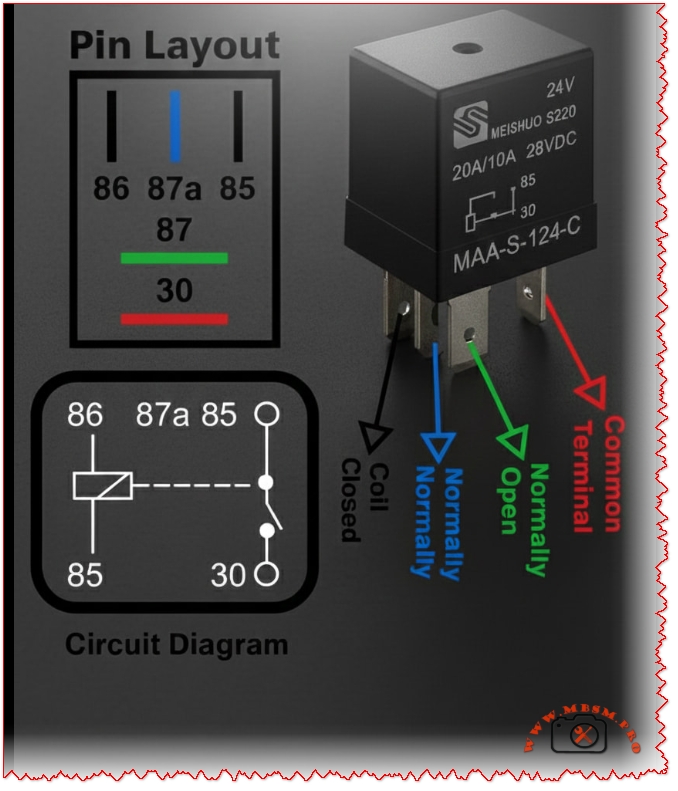
Its terminals follow the DIN 72552 standard numbering: 30, 85, 86, 87 and 87a, which simplifies wiring and troubleshooting for technicians.

Relay terminal functions (DIN 72552)

The DIN 72552 standard assigns each pin a clear functional role that does not depend on the physical layout of the housing.
This universal coding is crucial when replacing relays in mixed fleets, where the same harness may receive different brands or body styles.

Table 1 – Terminal numbers and roles

Terminal Standard name Electrical role / connection
30 Common terminal Main common contact; connects to 87 or 87a depending on relay state.
85 Coil − (ground) One side of the electromagnetic coil, usually tied to chassis ground.
86 Coil + (control voltage) Coil feed from switch, ECU or control circuit.
87 Normally open (NO) contact Connected to 30 only when the coil is energized.
87a Normally closed (NC) contact Connected to 30 when the relay is de‑energized (changeover function).

Internal SPDT changeover architecture

Internally, this relay is a single‑pole double‑throw (SPDT) changeover design: one moving armature switches the common terminal 30 between 87a (NC) and 87 (NO).
When no voltage is applied to 85–86, 30 remains connected to 87a; once the coil is powered, a magnetic field pulls the armature and transfers 30 to 87, never joining 87 and 87a at the same time.

Table 2 – Contact state vs coil status

Coil state 30–87 connection 30–87a connection Typical use case
De‑energized (OFF) Open Closed Power present when system is idle (e.g., courtesy lights).
Energized (ON) Closed Open Power only when commanded (e.g., fan, compressor, auxiliary lights).

Key electrical specifications and practical limits

While the S220 MAA‑S‑124‑C is rated at 20 A/10 A at 28 VDC, the NC path (30–87a) typically carries the lower current rating compared with the NO path (30–87), a common convention for changeover relays.
Coil voltage is fixed at 24 VDC, and coil resistance in similar MEISHUO 24 V changeover models is around 1.6 kΩ, giving a coil power of roughly 0.36 W, which helps in low‑power control systems.

Table 3 – Typical MEISHUO 24 V changeover relay data

Parameter MEISHUO MAA‑S‑124‑C (S220 family) Typical 12 V automotive relay Solid‑state relay module*
Coil voltage 24 VDC 12 VDC 3–32 VDC input
Contact configuration 1× SPDT (5‑pin) 1× SPDT (4 or 5 pin) 1× SPST or SPDT
Max contact current (NO/NC) 20 A / 10 A @ 28 VDC 30–40 A / 20–30 A 2–40 A depending model
Coil resistance (approx.) 1.6 kΩ 70–90 Ω N/A (no coil)
Isolation method Mechanical gap Mechanical gap Semiconductor junction

*Values for generic industrial SSRs.

Comparison with standard ISO mini automotive relays

Standard ISO mini relays share the same numbering but often target 12 V passenger vehicles, whereas the MAA‑S‑124‑C addresses 24 V commercial, HVAC or industrial systems.
Type‑A and Type‑B ISO layouts may swap the physical locations of pins 30 and 86, but the numeric role stays constant, so technicians working with mixed stocks must always wire by number, not by drawing lines from the plastic footprint.

Table 4 – MEISHUO S220 vs generic ISO mini relay

Feature MEISHUO MAA‑S‑124‑C 24 V Generic ISO mini 12 V relay
Nominal system voltage 24 VDC 12 VDC
Application segment Trucks, HVAC, industrial control Passenger cars, light utility
Coil current (typical) ≈15 mA at 24 V 150–200 mA at 12 V
Contact current rating 20 A/10 A 30–40 A / 20–30 A
Common failure symptoms Pitted contacts, open coil Same, plus melted sockets at high load

Practical wiring scenarios for technicians

A 5‑pin SPDT relay like this offers flexible logic: the same control signal can switch loads that must be ON with the system and loads that must be OFF at the same time.
In an HVAC unit, for example, a 24 V thermostat output connected to 86 can feed the compressor contactor on 87, while 87a maintains a safety interlock loop when the compressor is idle.

Table 5 – Example wiring schemes using terminals 30‑85‑86‑87‑87a

Application 30 connection 87 (NO) load 87a (NC) load Coil trigger (86) source
Auxiliary fan with fail‑safe off Battery positive via fuse Fan motor positive Not used Ignition‑controlled switch
HVAC compressor enable / disable 24 V supply from control transformer Compressor contactor coil Alarm indicator when compressor idle Thermostat or PLC digital output
Headlamp‑driven work light Dedicated fused feed Work light lamp Not used Headlamp main‑beam circuit
Power‑saving standby mode Constant 24 V to non‑critical loads System ON bus Low‑power standby bus Control panel selector or remote contact

Advantages over simple 4‑pin NO relays

Compared with a basic 4‑pin make‑and‑break relay, the 5‑pin MAA‑S‑124‑C supports changeover logic without extra components, saving wiring time and panel space.
Because 87a is closed at rest, designers can implement safety interlocks that drop out automatically once the relay energizes, improving fault detection in automotive and industrial controls.

Relay, model MAA‑S‑124‑C, is a 24 VDC, 5‑pin mbsmpro

Focus keyphrase (Yoast SEO)

MEISHUO MAA‑S‑124‑C 5‑pin relay 30‑85‑86‑87‑87a DIN 72552 terminal functions and wiring guide for 24V automotive and industrial control

SEO title (Yoast SEO)

MEISHUO MAA‑S‑124‑C Relay 24V, 5‑Pin 30‑85‑86‑87‑87a Wiring Guide | Mbsmpro.com

Meta description (Yoast SEO)

Learn how to wire the MEISHUO MAA‑S‑124‑C 24V 5‑pin relay using DIN 72552 terminals 30, 85, 86, 87 and 87a. See pin functions, tables, examples and comparisons for automotive and industrial control.

Slug (Yoast SEO)

meishuo-maa-s-124-c-5-pin-relay-30-85-86-87-87a-wiring

Tags

MEISHUO relay, MAA‑S‑124‑C, S220 relay, 5 pin relay, SPDT relay, DIN 72552, terminal 30 85 86 87 87a, automotive relay, 24V relay, relay wiring, relay pinout, HVAC control relay, industrial control relay, Mbsmgroup, Mbsm.pro, mbsmpro.com, mbsm

Excerpt (first 55 words)

The MEISHUO S220 series relay, model MAA‑S‑124‑C, is a 24‑volt 5‑pin SPDT automotive relay rated 20 A/10 A at 28 VDC. Its DIN 72552 terminal numbering—30, 85, 86, 87 and 87a—gives technicians a universal language for wiring and troubleshooting in vehicles, HVAC equipment and industrial control panels.


Finder 66.82.8.230.0000 Power Relay: Reliable 30A Solution for HVAC and Industrial Control

Finder 66.82.8.230.0000 Power Relay: Reliable 30A Solution for HVAC and Industrial Control

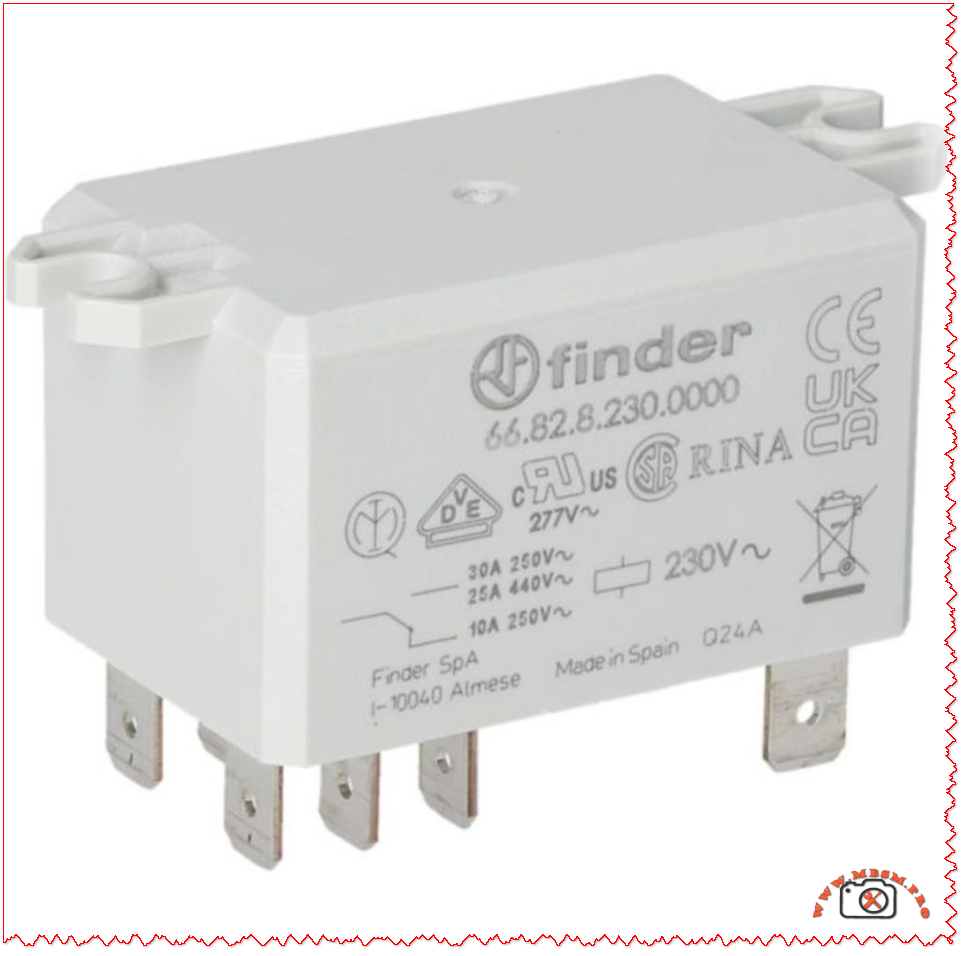
The Finder 66.82.8.230.0000 is a high‑power, flange‑mount relay designed for demanding switching tasks in HVAC, refrigeration and industrial control panels. With a 230 V AC coil and 30 A contact rating, it offers a compact but robust alternative to contactors in many applications.

Product overview

The Finder 66.82 series is a family of 30 A power relays with Faston terminals and reinforced insulation that comply with international safety standards for electrical equipment. The 66.82.8.230.0000 variant pictured is a DPDT (2 changeover contacts) relay with a 230 V AC coil, suitable for single‑phase loads up to 440 V AC.

Mounted on a panel via integrated flanges, this relay is widely used in OEM machines, control panels and HVAC units where reliable separation between the control circuit and the power circuit is essential. Its compact housing and Faston 6.3 × 0.8 mm connections make wiring quick and maintenance friendly for installers and service technicians.

Key electrical specifications

For designers and technicians, the most critical data are contact rating, coil voltage and insulation performance. The table below summarizes the main technical characteristics of the Finder 66.82.8.230.0000 as presented in distributors’ listings and the manufacturer’s catalog.

Specification Value Notes
Manufacturer / Series Finder 66.82 Power relays 30 A series.
Coil voltage 230 V AC Standard mains control voltage.
Contact configuration DPDT (2CO) Two changeover contacts.
Max. switching current 30 A Per contact set for AC loads.
Max. switching voltage 440 V AC For power applications.
Terminals Faston 6.3 × 0.8 mm For push‑on connectors.
Mounting Flange mount For panel or chassis mounting.
Insulation Reinforced between coil and contacts According to EN 60335‑1.

These values make the relay particularly suitable for switching compressors, fan motors, heating elements and resistive or slightly inductive loads in HVAC and refrigeration systems.

Typical applications in HVAC and industry

In real‑world installations, the Finder 66.82.8.230.0000 often replaces bulkier contactors in medium‑power circuits where panel space and cost must be optimized. Common uses include:

  • Switching single‑phase compressors in cold rooms, display cabinets and small chillers up to 30 A at 230–250 V AC.
  • Controlling electric heaters, defrost elements and fan banks in air‑handling units and rooftop HVAC packages.
  • Interfacing low‑power thermostats, PLC outputs or electronic boards with mains loads in industrial machinery and building automation.

Because it provides reinforced insulation between coil and contacts, the relay is suitable for applications governed by household and similar equipment standard EN 60335‑1, which is frequently referenced in HVAC and appliance design. This insulation level enhances safety where user‑accessible electronics coexist with high‑voltage power circuits.

Installation and safety guidelines

When integrating this relay into a control panel, technicians should follow the wiring diagrams supplied in the Finder datasheet and the equipment manufacturer’s instructions. Faston terminations must be fully mated with correctly sized push‑on connectors, and conductors should be chosen according to the 30 A rating and ambient temperature in the enclosure.

The relay must be mounted on a flat surface using the dedicated flanges, ensuring adequate clearance for cooling and respecting creepage distances to nearby live parts. As with all power components, switching capacity must be derated for highly inductive loads, frequent cycling or elevated temperatures, conditions that are common in heavy‑duty HVAC duty cycles.