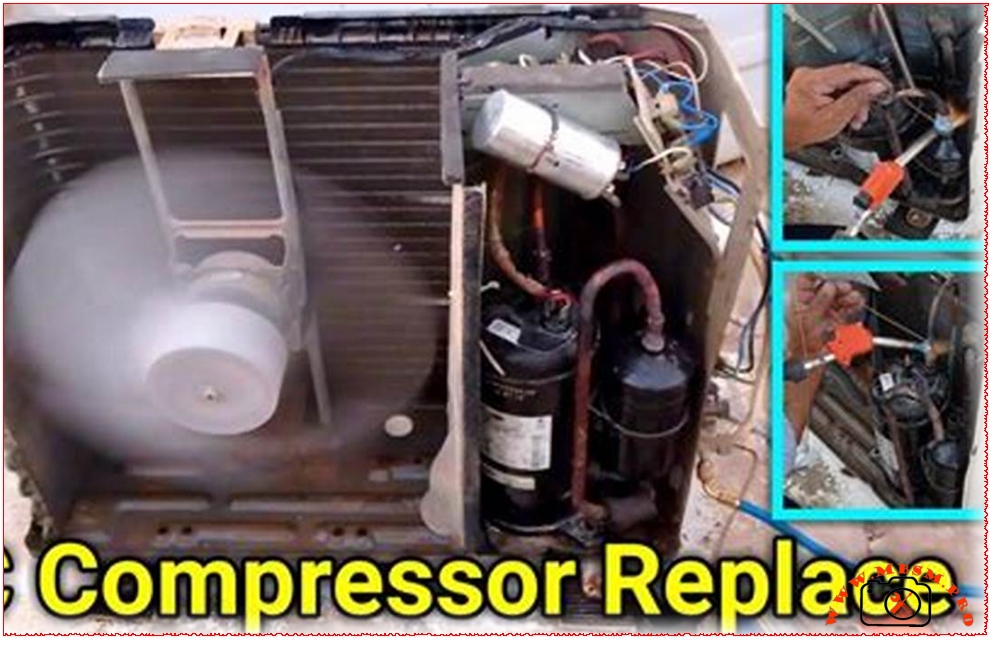
The process of replacing the air conditioner compressor is successful, and it is working as it was before ?
Category: Refrigeration
written by www.mbsmpro.com | April 12, 2026
“The process of replacing the air conditioner compressor is successful, and it is working as it was before.”
Alternatively, if you are asking whether the process is viable, it can be translated as: “Is replacing the air conditioner compressor effective, and will it work as well as it did before?”
Key Points regarding Compressor Replacement:
If you are considering this repair, here are a few things to keep in mind to ensure it works “as it was”:
Matching Specifications: The new compressor must have the exact same cooling capacity (BTU) and electrical specifications as the original.
System Flushing: It is vital to flush the refrigerant lines to remove any contaminants or burnt oil from the old compressor; otherwise, the new one may fail quickly.
Vacuuming: A deep vacuum must be pulled on the system to remove moisture before recharging with gas.
Cost-Benefit: Since the compressor is the “heart” of the AC, the repair can be expensive. If the unit is more than 10 years old, it is often more cost-effective to replace the entire unit.
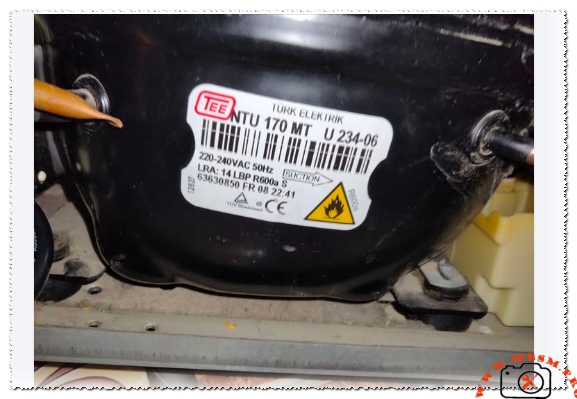
TEE NTU 170 MT Compressor 1/4 HP R600a
Category: Refrigeration
written by www.mbsmpro.com | April 12, 2026
Focus Keyphrase: TEE NTU 170 MT Compressor 1/4 HP R600a Low Back Pressure Technical Specifications and Replacement Guide
SEO Title: Mbsmpro.com, Compressor, NTU 170 MT, 1/4 hp, TEE, Cooling, R600a, 204 W, 0.9 A, 1Ph 220-240V 50Hz, LBP, RSIR, -35°C to -10°C
Meta Description: Technical analysis of the TEE NTU 170 MT compressor. Discover 1/4 HP power specs, R600a efficiency, LBP cooling capacity, wiring diagrams, and cross-reference replacement charts.
Slug: compressor-tee-ntu170mt-r600a-1-4-hp-specs
Tags: Mbsmgroup, Mbsm.pro, mbsmpro.com, mbsm, TEE, Turk Elektrik, NTU 170 MT, R600a, 1/4 HP Compressor, LBP, Refrigerator Repair, HVAC Engineering, EMT2121U, HTK12AA, HMK12AA, NT1114Y, HYB12MHU, GL90AA, FFI7.5HAK, NL7F
Excerpt: The TEE NTU 170 MT is a high-efficiency hermetic reciprocating compressor designed for low back pressure applications using R600a refrigerant. Known for its reliability in household refrigeration, this unit operates at 220-240V 50Hz. This article explores its technical specs, cooling capacity, and suitable replacements for HVAC technicians and engineers worldwide.
The Engineering Excellence of the TEE NTU 170 MT: A Deep Dive into R600a Refrigeration
In the evolving world of domestic refrigeration, efficiency and environmental impact are the primary drivers of innovation. The TEE NTU 170 MT, manufactured by Turk Elektrik, stands as a testament to these principles. As a Low Back Pressure (LBP) compressor optimized for R600a (isobutane), this model has become a staple in modern household refrigerators and freezers across Europe and the Middle East.
Understanding the NTU 170 MT Architecture
The NTU 170 MT is engineered to handle the unique thermodynamic properties of R600a. Unlike older R134a systems, R600a operates at lower pressures but requires a larger displacement to achieve comparable cooling capacities. This compressor utilizes a robust motor designed for RSIR (Resistive Start – Inductive Run) operation, ensuring a reliable start even under varying voltage conditions typically found in domestic environments.
The “MT” series is specifically calibrated for high-performance cooling while maintaining a low noise floor. With a Locked Rotor Amperage (LRA) of 14A, it demonstrates significant starting torque, which is essential for overcoming the initial pressures of the refrigeration cycle after a defrost period.
Technical Specification Table
Feature
Specification
Model
NTU 170 MT
Utilisation
LBP (Low Back Pressure)
Domaine
Freezing / Deep Cooling
Oil Type and Quantity
Mineral Oil (approx. 180 ml)
Horsepower (HP)
1/4 HP
Refrigerant Type
R600a (Isobutane)
Power Supply
220-240VAC / 50Hz / 1Ph
Cooling Capacity BTU
~700 BTU/h (at -23.3°C Evaporating Temp)
Motor Type
RSIR
Displacement
11.20 cc
Winding Material
High-Grade Copper
Pression Charge
0.5 to 1.2 Bar (Low side depending on load)
Capillary Recommendation
0.031″ ID x 3 meters (approximate)
Temperature Function
-35°C to -10°C
Cooling System
Static (No fan required for compressor)
Commercial Class
Domestic / Light Commercial
Amperage (FLA)
0.8 A – 1.0 A
LRA (Locked Rotor)
14 A
Relay Type
PTC Starter
Capacitor
Not required (RSIR), Optional Run Cap for CSIR conversion
Electrical Wiring Schema (RSIR Configuration)
For field technicians, understanding the terminal configuration is vital. The TEE NTU 170 MT follows the standard triangular pin layout:
Common (C): Top pin (typically connected to the overload protector).
Start (S): Right pin (connected to the PTC relay for starting).
Main/Run (M): Left pin (connected to the neutral line).
Performance Comparison: R600a vs. R134a Equivalents
When comparing the NTU 170 MT to R134a units of similar horsepower, several differences emerge. The R600a model offers a superior Coefficient of Performance (COP).
Metric
TEE NTU 170 MT (R600a)
Equivalent R134a Model (e.g., GL90AA)
Efficiency (COP)
1.45 – 1.55 W/W
1.20 – 1.35 W/W
Operating Pressure
Low / Vacuum
High
Eco-Impact
GWP 3 (Low)
GWP 1430 (High)
Noise Level
Very Low
Moderate
Compatibility and Replacement Guide
Finding a direct replacement requires matching the displacement and the LBP characteristic. Below are the recommended alternatives for the NTU 170 MT.
Top 5 Replacements (R600a – Same Gas):
Embraco: EMT2121U
Secop (Danfoss): HTK12AA
ACC / Cubigel: HMK12AA
Jiaxipera: NT1114Y
Huayi: HYB12MHU
Top 5 Replacements (R134a – Conversion Required): Note: Converting from R600a to R134a requires a full system flush, capillary adjustment, and oil compatibility check.
Zem: GL90AA
Embraco: FFI 7.5HAK
Secop: TLES7.5KK.3
Tecumseh: THB1375YSS
Carlyle: S26SC
Engineering Notices and Maintenance Tips
Vacuuming Procedure: Due to the hygroscopic nature of the systems and the low pressures of R600a, a deep vacuum (minimum 200 microns) is mandatory. R600a systems are highly sensitive to non-condensables.
Charging Safety: R600a is flammable. Always ensure the work area is well-ventilated. Use a dedicated electronic scale, as the charge weight is significantly lower than R134a (often only 40-60 grams).
Filter Drier: Always replace the filter drier with one specifically labeled for R600a (XH-9 or equivalent) during any compressor swap.
Capillary Blockage: Because R600a operates at lower discharge temperatures, carbonization is rare, but moisture-related ice blockages are common if the system is not perfectly dry.
Benefits for the End-User
Using a TEE NTU 170 MT ensures the refrigerator operates with minimal energy consumption. For the homeowner, this translates to lower electricity bills and a quieter kitchen environment. For the technician, the wide availability of parts for the TEE/Arçelik ecosystem makes it a preferred choice for long-term maintenance.
Evaporator and Condenser Data, Two-Door Refrigerators
Category: Refrigeration
written by www.mbsmpro.com | April 12, 2026
Mbsmpro.com, Evaporator and Condenser Data, Two-Door Refrigerators, 1/8 hp, 1/6 hp, 1/5 hp, System Sizing, Static Cooling, R134a or R600a, Heat Exchange Balancing
The Engineering Art of Balancing Refrigeration Systems: Evaporators, Condensers, and Compressors
In the world of domestic refrigeration, specifically for two-door appliances, the harmony between the three primary components—the compressor, the evaporator, and the condenser—determines the longevity and efficiency of the unit. As a field expert who has spent years troubleshooting and designing cooling circuits, I can tell you that a mismatch in these components is the leading cause of premature compressor failure and poor cooling performance.
Selecting a compressor is only the first step. To achieve thermal equilibrium, the heat absorbed by the evaporator in the freezer and fridge compartments must be effectively rejected by the condenser. This article breaks down the technical standards for small, medium, and jumbo two-door systems to ensure your repairs or builds meet professional engineering benchmarks.
Technical Specifications and Component Matching
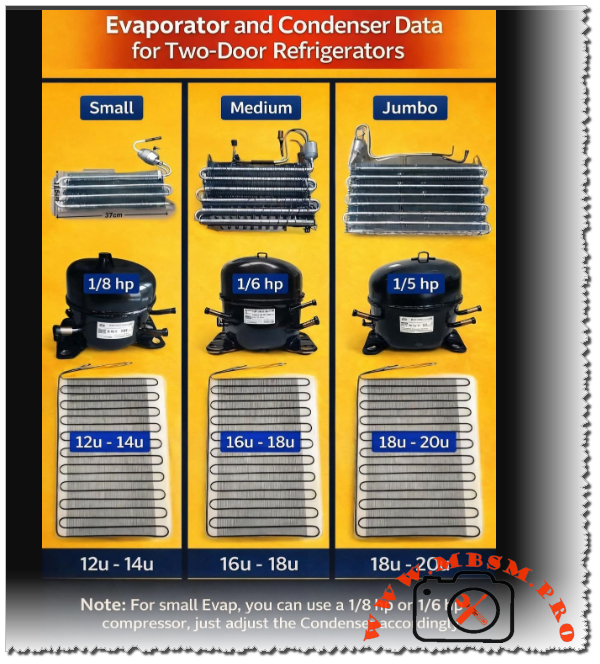
The following data provides the standard configurations for static-cooled two-door refrigerators. These values are critical for technicians performing “system upgrades” or replacing missing components.
System Category
Compressor HP
Evaporator Type
Condenser Size (U-Bends)
Typical Capacity (Liters)
Small
1/8 hp
Compact (~37cm)
12u – 14u
180L – 240L
Medium
1/6 hp
Standard Fin
16u – 18u
250L – 320L
Jumbo
1/5 hp
Large Surface
18u – 20u
330L – 450L
Deep Dive into System Scaling
1. The Small System (1/8 hp)
Designed for compact two-door units, the 1/8 hp compressor works best with a condenser featuring 12 to 14 U-bends. This provides enough surface area to reject heat without causing excessive high-side pressure. If you find a unit struggling in high ambient temperatures (Tropical Class), increasing the condenser to 14u can significantly lower the compressor’s operating temperature.
2. The Medium Workhorse (1/6 hp)
This is the most common configuration in the market. A 1/6 hp compressor requires a robust heat rejection path, typically 16 to 18 U-bends. Using a 1/6 hp compressor with a small (12u) condenser will lead to “thermal trip” where the overload protector cuts out because the refrigerant cannot liquify fast enough, causing high head pressure.
3. The Jumbo Configuration (1/5 hp)
For large domestic refrigerators, the 1/5 hp compressor is the standard. These systems utilize jumbo evaporators to handle larger food volumes. To balance this, the condenser must be 18 to 20 U-bends. Anything less will result in poor sub-cooling and high energy consumption.
Comparative Value Analysis: Heat Rejection vs. Horsepower
Understanding the relationship between compressor power and the physical dimensions of the heat exchangers is vital.
Feature
1/8 hp System
1/6 hp System
1/5 hp System
Evaporator Width
~37 cm
~45 cm
~52 cm+
Condenser Area
Baseline
+25%
+45%
Refrigerant Charge
Low (80-100g)
Medium (120-150g)
High (160g+)
Cooling Speed
Moderate
High
Professional Grade
Engineering Insights: The “Note” on Compressor Swapping
One of the most valuable secrets in the field involves “over-motoring” a system. If you have a refrigerator designed for a small evaporator (traditionally 1/8 hp), you can install a 1/6 hp compressor to achieve faster pull-down times.
The Engineer’s Notice: When upgrading from 1/8 hp to 1/6 hp on a small evaporator, you must adjust the condenser accordingly. By adding two extra U-bends or ensuring the existing condenser is perfectly clean and has maximum airflow, you prevent the higher-torque motor from overheating the system. Failing to adjust the condenser during a horsepower upgrade is a recipe for a “returned” repair within six months.
Professional Advice for Field Technicians
Cleanliness is Efficiency: A 20u condenser that is covered in dust performs worse than a clean 12u condenser. Always vacuum the condenser coils during every service call.
Capillary Tube Matching: When changing horsepower, verify the capillary tube length. A 1/5 hp compressor requires a different flow rate than a 1/8 hp unit to avoid liquid slugging.
The “Finger Test”: On a balanced system, the first two bends of the condenser should be hot (not burning), and the last bend should be slightly above room temperature. If the whole condenser is hot, it is undersized for the compressor.
Focus Keyphrase
Evaporator and Condenser Data for Two-Door Refrigerators 1/8 1/6 1/5 hp
Professional engineering guide for balancing two-door refrigerators. Learn the correct condenser U-bend counts and evaporator sizes for 1/8, 1/6, and 1/5 hp compressors.
Achieving perfect cooling requires a precise balance between the compressor horsepower and the heat exchange surface area. Whether you are working with a small 1/8 hp unit or a jumbo 1/5 hp system, understanding the required U-bends in the condenser is the key to professional, long-lasting refrigeration repairs and system design.