Embraco EGAS and EM Series
Embraco EGAS and EM Series: The Definitive Technician’s Guide to Specs, Diagnosis, and Pro-Level Replacement
In my 20-plus years of navigating the tight mechanical rooms and residential kitchens of this industry, I’ve lost count of how many times I’ve pulled the back panel off a high-end refrigerator or a reach-in cooler only to find an Embraco EGAS or EM series unit staring back at me. Usually, the customer is complaining about a “clicking” sound—the classic song of a struggling start relay—or a cabinet that’s slowly climbing toward room temperature. These compressors are the workhorses of the domestic and light commercial world, but they require a surgical touch and a deep understanding of their specific performance curves to service correctly.
Deep-Dive Technical Specifications
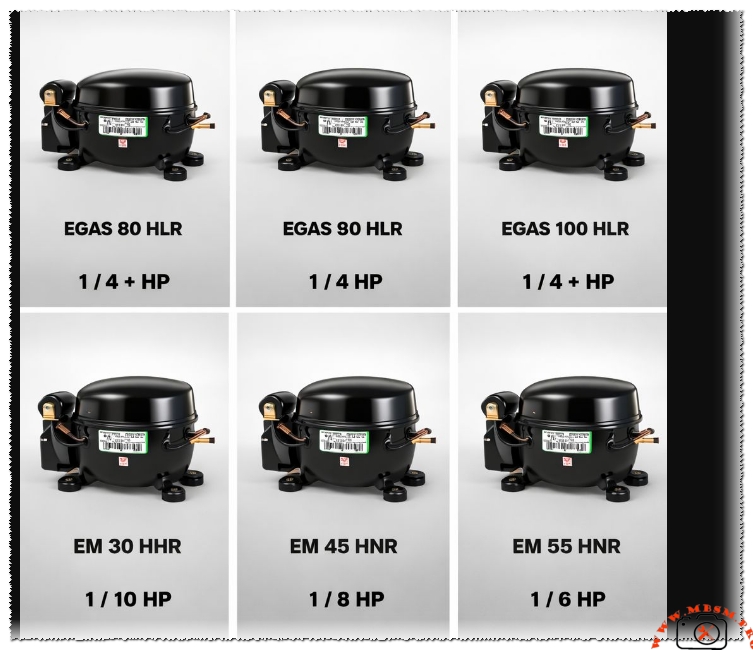
The following table breaks down the core specifications for the Embraco lineup shown in the field reference image. As an engineer, I always tell my juniors: never guess the HP. Always verify the displacement and the LBP/MBP application before selecting a replacement.
| Compressor Model | Horsepower (HP) | Series Type | Typical Application | Displacement Range (Approx.) |
| EGAS 80 HLR | 1/4 + HP | EG Series | LBP/MBP (Low/Med Back Pressure) | 6.76 cc |
| EGAS 90 HLR | 1/4 HP | EG Series | LBP/MBP | 7.15 cc |
| EGAS 100 HLR | 1/4 + HP | EG Series | LBP/MBP | 7.95 cc |
| EM 30 HHR | 1/10 HP | EM Series | LBP (Low Back Pressure) | 3.00 cc |
| EM 45 HNR | 1/8 HP | EM Series | LBP/MBP | 3.97 cc |
| EM 55 HNR | 1/6 HP | EM Series | LBP/MBP | 4.58 cc |
Note: The “HLR” and “HNR” suffixes typically denote the motor torque characteristics and the refrigerant type—usually R134a for these specific regional variants.
The Engineer’s Secret: Diagnosis & Failure Analysis
In my experience, these Embraco units don’t just “die”; they are usually murdered by external factors. Here is what I look for during a diagnostic call:
- The PTC Thermistor Failure: The EM and EG series often use a PTC (Positive Temperature Coefficient) starting device. Over time, the ceramic disc inside cracks due to heat cycles. If you hear the compressor trying to start every 3-5 minutes followed by a “click” (the overload protector tripping), check the relay before condemning the compressor.
- Heat Stress and Condenser Maintenance: Because these are often tucked into tight cabinets, the EM 45 and 55 models are prone to overheating if the condenser coils are impacted with dust. I’ve found that prolonged high discharge temperatures cause the oil to carbonize, eventually leading to mechanical “stiction” or valve plate failure.
- Capacitor Fatigue: On the larger EGAS 80 and 100 HLR models, a weak run capacitor can cause the motor to draw higher-than-normal Amps, leading to internal winding degradation. Always test your μF (microfarads) against the label rating; a 10% drop is enough to warrant a replacement.
Cross-Reference & Compatibility (Pro Replacements)
When the original Embraco isn’t on the truck, you need a high-quality equivalent that won’t result in a callback. Here are my “Pro-Choice” equivalents based on displacement and BTU capacity:
- For EGAS 100 HLR (1/4+ HP): I recommend the Secop (Danfoss) FR8.5G or the Tecumseh AE4430Y. Both offer excellent volumetric efficiency and fit well in standard mounting footprints.
- For EM 55 HNR (1/6 HP): The Secop TLES5.7KK.3 is a rock-solid alternative. It’s exceptionally quiet, which is vital for residential kitchen applications.
- For EM 30 HHR (1/10 HP): The Tecumseh THB1330Y is my go-to. It’s compact and handles the low-load cycles of small water dispensers or wine coolers perfectly.
Installation Masterclass: Critical Steps
If you want your replacement to last another 15 years, you cannot skip these steps. I’ve seen too many “slap-and-gas” jobs fail within six months.
- Nitrogen Purging is Mandatory: These small-diameter capillary tube systems are extremely sensitive to oxidation. Always braze with a low-flow nitrogen purge to prevent “copper scale” from clogging the inlet of the cap tube.
- The Deep Vacuum Protocol: Don’t trust your manifold gauges. Use a digital micron gauge and pull the system down to at least 500 microns, then perform a decay test. Moisture is the absolute enemy of the POE oil found in these R134a compressors.
- Filter Drier Replacement: Never, under any circumstances, reuse an old filter drier. I always upgrade to a high-capacity XH-9 molecular sieve drier to ensure any residual moisture or acid is neutralized.
- Oil Check: If you are retrofitting, verify that the oil in the new compressor is compatible with the system’s history. These units typically ship with Polyolester (POE) oil.
Full SEO Package
Slug: embraco-egas-em-compressor-technical-guide-replacement
Meta Description: Master Embraco EGAS & EM series compressors with this pro guide. Covers specs for EGAS 80/90/100, EM 30/45/55, failure diagnosis, and expert replacement tips.
Image Alt Text: A technical comparison chart of Embraco EGAS and EM series refrigeration compressors including 1/4 HP, 1/6 HP, and 1/10 HP models.
Keywords: embraco compressor specs, EGAS 80 HLR, EGAS 100 HLR replacement, EM 55 HNR horsepower, refrigeration compressor troubleshooting, HVAC technician tips, R134a compressor cross reference, embraco start relay failure, LBP compressor diagnosis, Secop equivalent for embraco, tecumseh compressor cross reference, refrigerator compressor clicking, HVAC tool kit, domestic fridge repair guide, compressor displacement chart, POE oil compatibility, vacuum micron levels, brazing with nitrogen.