Transformer, WDB4109, 220V 50Hz, Microwave Standby Power
Transformer, WDB4109, 220V 50Hz, Microwave Standby Power mbsmpro

Mbsmpro.com, Transformer, WDB4109, 220V 50Hz, Microwave Standby Power, 16.33V, 5.47V×2, Linear Supply, Samsung Compatible, Replacement, Repair Guide

WDB4109 Microwave Standby Transformer Overview

The WDB4109 is a small linear power transformer designed for the standby and control circuits of domestic microwave ovens powered from 220 V – 230 V AC at 50 Hz.
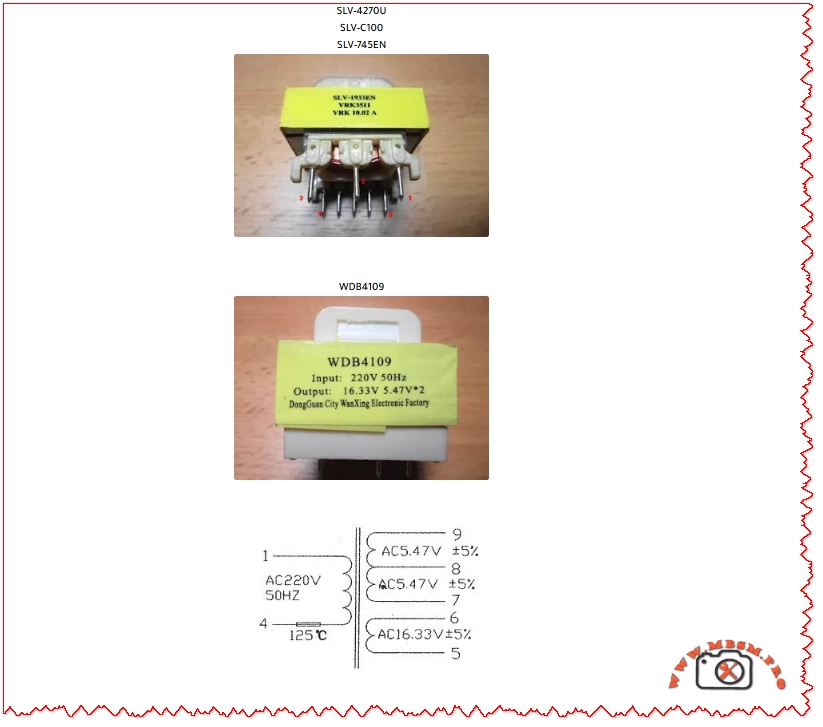
It converts the mains input to one low‑voltage secondary of about 16.33 V AC and two identical low‑voltage outputs of 5.47 V AC used for logic, relays and display boards.

Key electrical characteristics

  • Input: 220 V – 230 V AC, 50 Hz single phase.
  • Output: one secondary winding 16.33 V AC ±5%, plus two 5.47 V AC ±5% windings (often specified as 16.33 V / 5.47 V ×2).
  • Typical application: standby power transformer for Samsung and compatible microwave ovens, mounted on the main control PCB.

Pinout, wiring and application in microwave ovens

In most Samsung‑type control boards, the primary winding of the WDB4109 is connected directly across the 220 V mains through the line filter and protective thermal fuse.
The low‑voltage secondaries feed a rectifier and linear regulator stage, providing DC rails for the microcontroller, relay drivers, sensors and display modules, while remaining fully isolated from the mains.

Typical pinout description

  • Primary side: two pins marked “AC220V 50Hz”, usually pins 1 and 4 on the housing legend.
  • Thermal fuse: integrated in series with the primary and rated around 125 °C to protect from overheating.
  • Secondary side:

    • One pair of pins for 16.33 V AC used for relay and buzzer supplies.
    • Two pairs of pins, each 5.47 V AC, usually wired in series or separately rectified for logic and display circuits.

Correct orientation is critical in repair work; technicians should always match the original PCB silkscreen and verify voltages under load with an isolated multimeter.


Technical tables and performance comparison

Table 1 – WDB4109 main specifications

Parameter WDB4109 value Notes
Manufacturer type WDB4109 standby transformer Often used in Samsung microwave controllers 
Primary voltage 220–230 V AC, 50 Hz Single‑phase mains input 
Secondary 1 16.33 V AC ±5% For relay and auxiliary circuits 
Secondary 2 5.47 V AC ±5% Logic / display supply 1 
Secondary 3 5.47 V AC ±5% Logic / display supply 2 
Construction Laminated EI core, bobbin‑wound Linear, low‑frequency design 
Typical use Microwave oven standby / control power Samsung and compatible models 

Table 2 – WDB4109 vs generic microwave standby transformers

Feature WDB4109 Generic 12 V / 9 V transformer Generic 10.5 V, 300 mA transformer
Primary rating 220–230 V / 50 Hz  230 V / 50 Hz  220 V / 50 Hz 
Secondary configuration 16.33 V + 5.47 V ×2  12 V / 280 mA + 8.5 V /180 mA typical  10.5 V / 300 mA single output 
Main application Samsung microwave control board  Universal small appliances  Specific YW35‑032‑1T control board 
Replacement flexibility Requires matching three‑output voltages Often interchangeable between brands Usually limited to original model

This comparison shows that the WDB4109 offers a rare triple‑output combination, making direct substitution with generic 12 V or 10.5 V transformers risky without redesigning the low‑voltage section.


Fault symptoms, testing and repair best practices

When the WDB4109 fails, common microwave symptoms include dead front panel, loss of clock and keypad response, or intermittent resetting when relays operate.
Technicians often discover an open primary winding or a blown internal thermal fuse after measuring infinite resistance between the primary pins, while the high‑voltage section and fuses remain intact.

Diagnostic and replacement guidelines

  • Measure primary and secondary resistances with power disconnected; very high or infinite readings indicate open windings.
  • Under isolation‑transformer protection, verify that secondary voltages reach approximately 16.33 V and 5.47 V AC under normal load, staying within ±5%.
  • When sourcing a replacement, match input voltage, frequency, all secondary voltages and approximate VA rating, and prefer verified WDB4109 units from reputable component suppliers.

Using genuine or equivalent WDB4109 transformers reduces overheating risk and prevents over‑voltage on the control PCB, which can otherwise damage microcontrollers and relays.


Installation safety, market availability and alternative solutions

Repair of mains‑connected power components requires strict adherence to electrical safety standards, including discharge of high‑voltage capacitors and isolation from live circuits.
In many regions, WDB4109 transformers are sold individually or in packs on specialized electronic‑spares marketplaces, often described as “microwave computer board power transformer WDB4109 16.33 V / 5.47 V ×2.”

Availability and alternatives

  • Online distributors and marketplace vendors list WDB4109 units as original or reclaimed parts from dismantled microwave ovens.
  • If an exact WDB4109 is unavailable, technicians sometimes adapt transformers with similar triple‑output voltages, but this requires recalculating rectifier and regulator stages and is recommended only for experienced repairers.

Choosing an unsuitable alternative, even with close voltage ratings, can lead to overheating, excessive standby consumption or unstable logic supply, which negatively affects both performance and user safety.

Transformer, WDB4109, 220V 50Hz, Microwave Standby Power mbsmpro

Yoast SEO elements for this article

Focus keyphrase (≤191 characters)

WDB4109 microwave standby transformer 16.33V 5.47V×2, Samsung control board linear power supply, input 220V 50Hz, repair, replacement, pinout, specifications and troubleshooting guide

SEO title for Yoast

WDB4109 Microwave Standby Transformer 16.33V 5.47V×2 – Specs, Pinout, Repair & Replacement Guide | Mbsm.pro

Meta description for Yoast

Professional guide to the WDB4109 microwave standby transformer: 220V 50Hz input, 16.33V and 5.47V×2 outputs, pinout, testing methods, typical failures and safe replacement options for Samsung ovens.

Slug for Yoast

wdb4109-microwave-standby-transformer-16-33v-5-47v2-specs-repair

Tags (comma separated)

WDB4109, microwave standby transformer, 16.33V 5.47V×2, Samsung microwave repair, microwave control board power supply, transformer pinout, linear transformer fault, appliance spare parts, Mbsmgroup, Mbsm.pro, mbsmpro.com, mbsm


Excerpt (first 55 words)

The WDB4109 is a compact linear transformer used as the standby power source in many Samsung microwave ovens, converting 220 V – 230 V AC to 16.33 V and dual 5.47 V outputs for the control board. It is critical for powering the clock, keypad, relays and low‑voltage electronics safely.


Samsung front‑load tub front half assembly: dimensions, components and replacement guide

Samsung front‑load tub front half assembly: dimensions, components and replacement guide

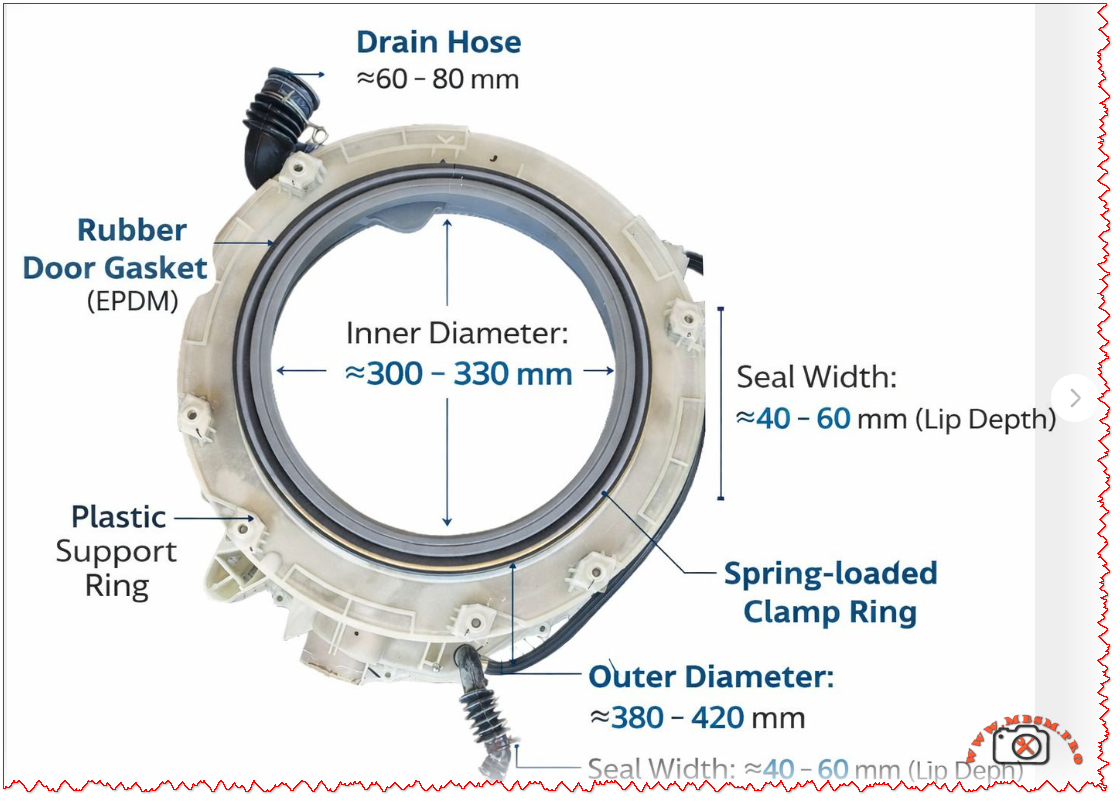
The tub front half assembly on Samsung front‑load washing machines combines the plastic support ring, EPDM rubber door gasket, drain hose and spring‑loaded clamp into one critical sealing unit between the drum and the cabinet front. It defines the loading opening (≈300–330 mm inner diameter) and overall front tub size (≈380–420 mm outer diameter), while controlling water drainage and leak‑free operation during high‑speed spin cycles.


Main components

  • Plastic support ring (semi tub front)
    The plastic semi tub front forms the rigid structure of the assembly and bolts to the rear half of the outer tub, typically listed in Samsung parts lists as “ASSY SEMI TUB FRONT”. It carries mounting points for the hinge area, latch, front panel screws and hose connections that surround the loading opening.
  • Rubber door gasket (EPDM)
    The grey EPDM door gasket works as a flexible diaphragm between the rotating stainless drum and the fixed plastic tub, absorbing vibration and preventing splashes through the door opening. Its lip depth or seal width is typically about 40–60 mm, providing a deep channel that guides water back into the tub instead of toward the door glass.​
  • Spring‑loaded clamp rings
    Two metal clamps are usually used: an inner clamp secures the gasket to the plastic tub, and an outer spring clamp band fixes it to the cabinet front panel. The outer band relies on a strong tension spring so that the elastomer lip remains compressed even under drum imbalance and door vibration at high spin speeds.
  • Drain hose connection
    A molded drain hose stub integrated into the front tub section channels residual water away from the gasket area and lower sump, typically matching Samsung’s EPDM drain hoses specified in spare‑parts diagrams. Hose internal diameters in this class of machines are commonly within 60–80 mm at the large bellows connection shown in the image, ensuring rapid evacuation and reducing standing water that could cause odors.​

Key dimensions from the assembly

The illustration corresponds to a common size range used on 7–9 kg Samsung front‑loaders, and the measurements help technicians and spare‑parts sellers match non‑OEM or compatible tubs and door boots.

Parameter Typical range (mm) Technical role
Inner opening diameter ≈300–330 Defines usable drum access and must match door glass and hinge geometry.
Outer tub front diameter ≈380–420 Matches cabinet cut‑out and rear tub half for correct bolt alignment.
Seal width / lip depth ≈40–60 Controls how deeply the gasket overlaps the drum rim and door glass to avoid leaks.​​
Drain‑hose connector length ≈60–80 Provides sufficient fall for water to clear the boot and flow to the pump housing.

Such dimensional ranges also influence replacement choices when original part numbers are no longer available, allowing cross‑referencing by diameter and seal width.


Typical failure modes and maintenance

  • Leakage and gasket damage
    Front leaks usually come from cuts, hardening or mold damage on the EPDM gasket lip, especially around the lower section where coins or sharp objects scrape during spin. Early signs include water tracks on the front panel, standing water in the door boot and musty odors after a cycle.​
  • Clamp loosening or mis‑seating
    If the spring clamp is not seated evenly in its groove after service, the boot can pull away from the cabinet, producing intermittent leaks only on high‑load or high‑speed programs. Corroded or stretched bands should always be replaced with genuine door‑seal clamp kits to maintain uniform radial pressure.​
  • Blocked drain hose connection
    Lint, detergent residue and small objects can partially block the drain hose stub shown at the bottom of the assembly, increasing water retention inside the boot and generating mold growth. Routine cleaning of the filter housing and periodic inspection of the lower hose path reduces these problems and extends component life.​

Replacement and selection tips

  • Identifying the correct part
    The fastest method is to read the full model code from the washer rating label and search for the matching “ASSY SEMI TUB FRONT” or “door boot / diaphragm” in Samsung’s illustrated parts lists or reputable spare‑parts catalogues. Where the exact code is unavailable, technicians can use the inner and outer diameters plus seal width shown in the image to select compatible universal boots within the 300–330 mm and 380–420 mm ranges.
  • Installation considerations
    When replacing the tub front half or door boot, manufacturers recommend removing the front panel, control panel and door lock assembly and carefully transferring hoses and wiring harness clips to the new ring. The gasket must be aligned to witness marks on the tub, with the drain holes positioned at the lowest point and both inner and outer clamps tightened uniformly to prevent wrinkles.​
  • Professional vs DIY service
    Although many guides and videos demonstrate door‑boot replacement as a do‑it‑yourself repair, full tub front‑half replacement involves heavy lifting and more extensive disassembly and is better performed by experienced technicians or advanced DIY users with proper support stands. For machines still under manufacturer warranty or covered by extended service contracts, any tub replacement should follow Samsung’s official service procedures and part numbers to maintain coverage.