Carel DN33V9MR20 Universal Controller: Reliable DIN-Rail Control For Modern HVAC Systems
Carel DN33V9MR20 Universal Controller: Reliable DIN-Rail Control For Modern HVAC Systems mbsmpro

Carel DN33V9MR20 Universal Controller: Reliable DIN-Rail Control For Modern HVAC Systems

The Carel DN33V9MR20 is a compact universal electronic controller designed for DIN‑rail mounting, widely used in refrigeration, air‑conditioning and process cooling where accurate temperature and universal input management are required. Its robust construction, broad power‑supply range and flexible I/O configuration make it a trusted choice for OEMs and technicians looking for stable control with a small footprint.

Key technical overview

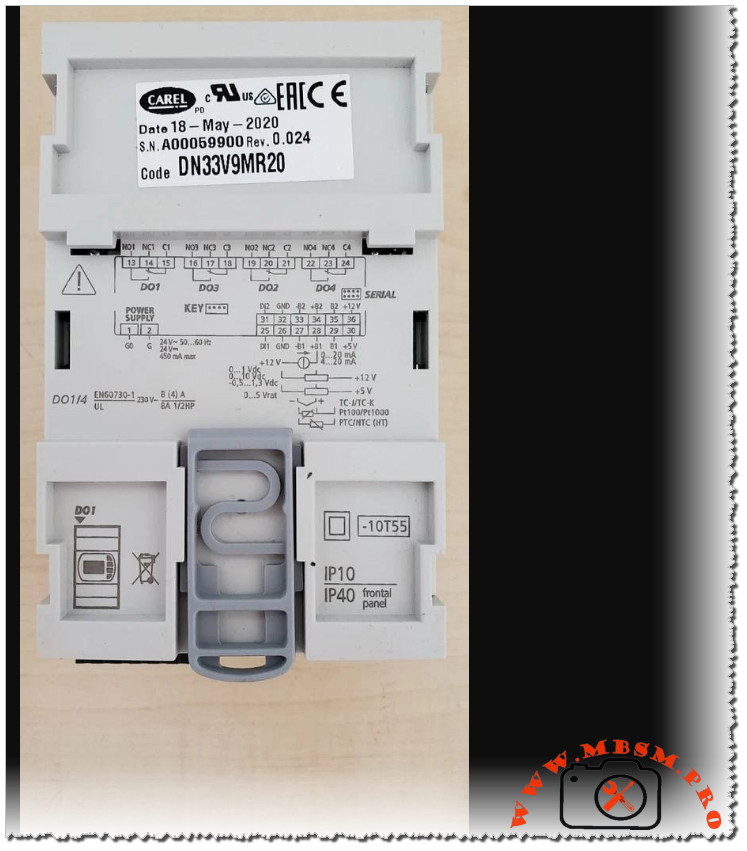
The DN33V9MR20 belongs to Carel’s IR33/DN33 “Universale” family, supporting multiple sensor types and control strategies in a single platform. It is supplied for DIN‑rail mounting, with front‑panel protection rated IP40 and overall device protection IP10, matching the markings visible on the housing.

  • Power supply: 12–24 Vac or 12–30 Vdc, allowing integration in low‑voltage cabinets and retrofit projects.
  • Inputs: 2 analogue inputs (2AI) and 2 digital inputs (2DI), suitable for NTC/PTC probes, Pt1000, 0–5 V or 0–20 mA depending on configuration.
  • Outputs: 1 relay / digital output (1DO) with buzzer and infrared receiver (BUZ, IR) for local and remote interaction.

Main functions and applications

Carel designed the DN33 line to manage temperature but also humidity, pressure and other signals when paired with compatible sensors, giving OEMs a single platform for various units. The controller can operate in “direct” or “reverse” mode, meaning it can drive cooling or heating stages depending on how the measured value must react to set‑point deviations.

  • Typical applications include refrigerated cabinets, small chillers, air‑handling units and process cooling panels where space is limited but high functionality is required.
  • Two independent control loops are available in the IR33/DN33 architecture, enabling simultaneous management of, for example, temperature and defrost or auxiliary outputs when used with multistage variants.

Installation and wiring highlights

The body of the DN33V9MR20, as seen in the image, shows clearly printed terminal numbers and internal diagrams that simplify cabinet work for technicians. DIN‑rail mounting speeds up installation while the plug‑in terminals, shared with the IR33 series, help reduce downtime during replacement or servicing.

  • The front label identifies the product code DN33V9MR20, manufacturing date and revision, which technicians should record for maintenance history and firmware compatibility.
  • Wiring diagrams on the housing indicate the correct connection of power supply, analogue probes, digital inputs and relay output, minimising wiring errors in the field.

User interface and integration

Although the DN33V9MR20 is a DIN‑rail model without an integrated front keypad, it is compatible with Carel’s external user interfaces and programming key, allowing quick parameter upload and cloning across multiple controllers. Infrared reception and an acoustic buzzer provide simple local feedback for alarms and set‑point adjustments when used with the appropriate accessories.

  • The series supports RS‑485 networking on selected variants, enabling connection to supervisory systems for remote monitoring and data logging in supermarkets or industrial plants.
  • Standard Carel parameter maps give installers access to control modes, sensor calibration, alarm thresholds and defrost strategies, ensuring the DN33V9MR20 can be tuned precisely to each HVAC or refrigeration application.

Technical data table
Feature DN33V9MR20 specification
Mounting DIN‑rail, compact housing DN33 series
Power supply 12–24 Vac, 12–30 Vdc (multi‑voltage)
Analogue inputs 2 AI (NTC/PTC, Pt1000, 0–5 V, 0–20 mA, depending on configuration)
Digital inputs 2 DI for door switches, compressor status or alarms
Outputs 1 relay / digital output with buzzer and IR receiver
Protection Front panel IP40, complete controller IP10
Typical uses Refrigerated cabinets, small chillers, HVAC units, process temperature control


CR20-06 A-F-A-E-HQQE

CR20-06 A-F-A-E-HQQE mbsmpro

The Grundfos CR20-06 A-F-A-E-HQQE is a vertical multistage centrifugal pump delivering 21 m³/h at 70.4 m head with a 7.5 kW IE3 motor, designed for demanding water boosting and industrial applications.​​
Its cast‑iron base, stainless‑steel internals and HQQE mechanical seal make it a durable, energy‑efficient solution for process water, HVAC, boiler feed and general pressure boosting systems.


Introduction

In modern industry and building services, stable water pressure is no longer a luxury but a basic requirement. The Grundfos CR20-06 A-F-A-E-HQQE has become one of the quiet workhorses in this field, combining compact vertical design with serious performance for installations where downtime is simply not an option.


Technical profile of the CR20-06

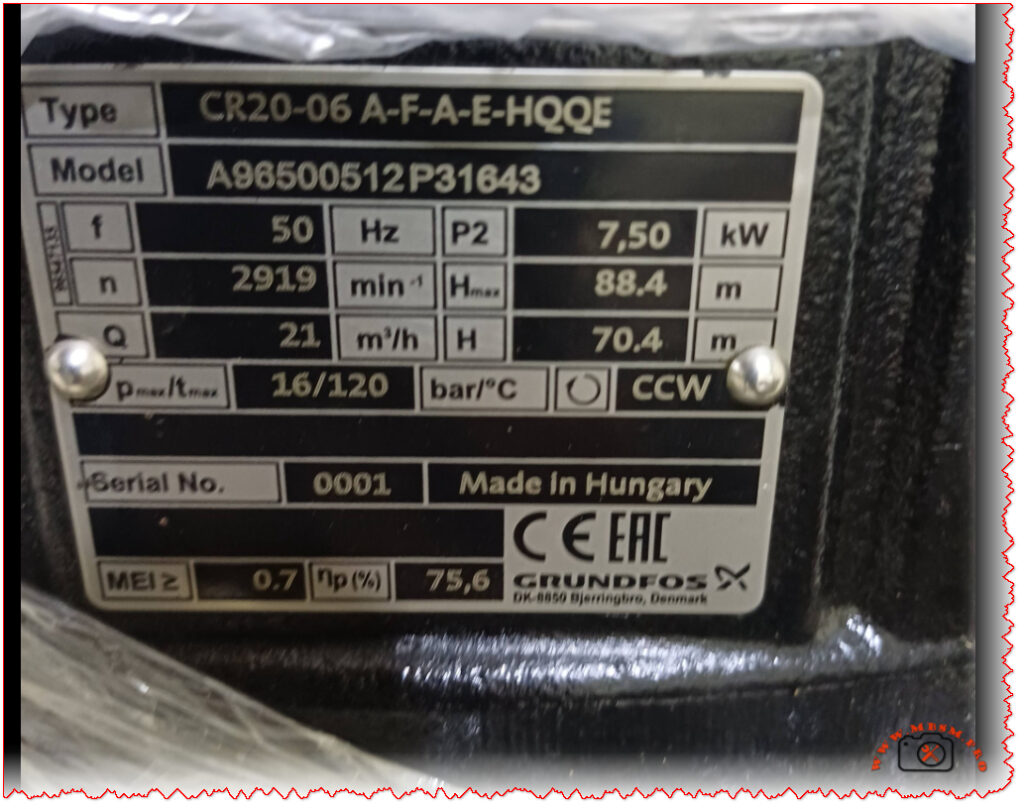
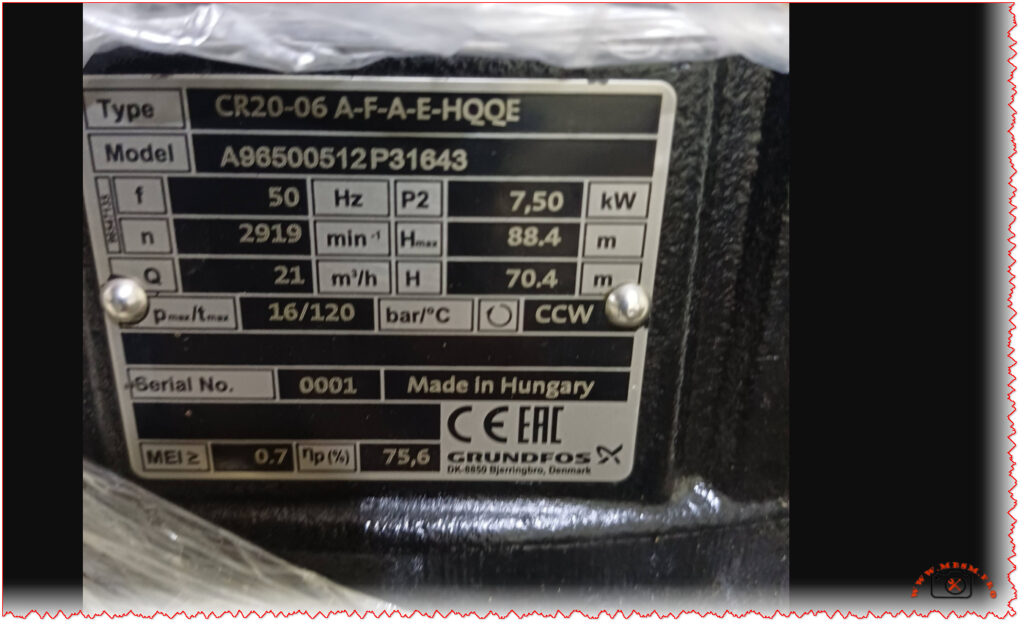
The pump in the photo is clearly identified on its nameplate as a Grundfos CR20-06 A-F-A-E-HQQE with a 7.50 kW motor operating at 50 Hz and about 2919 rpm.​
It delivers a nominal flow of 21 m³/h at a rated head of 70.4 m, with a maximum head up to 88.4 m and a maximum operating pressure of 16 bar at liquid temperatures up to 120 °C.

Main nameplate data

Item Value
Pump type CR20-06 A-F-A-E-HQQE
Rated power P2 7.5 kW
Frequency / speed 50 Hz / ≈2919 rpm
Rated flow Q 21 m³/h
Rated head H 70.4 m
Maximum head Hmax 88.4 m
Maximum pressure / temp. 16 bar / 120 °C
Shaft seal code HQQE (single mechanical seal)
Pump orientation Vertical, inline
Efficiency (pump) ≈75.6% (MEI ≥ 0.70)

​​

The pump uses a vertical, inline layout with suction and discharge on the same level (DN 50 flanged connections, PN 25 rating), simplifying installation in compact plant rooms and on rigid pipe manifolds.
Its IE3 motor (size 132SB) offers motor efficiencies above 90% at typical loads, helping operators reduce long‑term energy costs.


Construction, materials and seal

The CR20-06 belongs to the widely used CR multistage family, where several impellers are stacked in series to build pressure while maintaining moderate flow.
In this specific model, the base and pump head are in cast iron, while all wetted parts such as impellers and chambers are stainless steel AISI 304, providing a good balance between robustness and corrosion resistance for clean water duties.

The HQQE mechanical seal is a single cartridge seal with silicon carbide/silicon carbide faces, EPDM elastomers and a stainless‑steel spring, designed for long service life and easy replacement.
This configuration suits cold and hot water, mildly aggressive media used in HVAC and process plants, and reduces the risk of dry‑running damage during commissioning or transient operating conditions.


Typical applications and operating benefits

With its 21 m³/h at 70.4 m operating point, the CR20-06 is well suited to medium‑pressure boosting in commercial buildings, industrial wash and rinse systems, boiler feed for small to mid‑size boilers, and general process water circulation.
Installers appreciate the inline design, which often allows direct replacement of older horizontal pumps without major changes to the pipework, while plant operators value the quiet operation and low vibration levels of the multistage design.

From an energy perspective, the combination of high hydraulic efficiency and IE3 motor makes this model a strong candidate in projects where life‑cycle cost analysis is required or where regulations demand a minimum efficiency index (MEI ≥ 0.70).
Paired with an external frequency converter, the CR20-06 can be turned into a variable‑speed booster, maintaining constant pressure in domestic water systems, process loops or district cooling circuits while cutting energy consumption during partial‑load operation.


Practical selection notes for engineers

When selecting a CR20-06 for a project, engineers typically start from the required duty point on the pump curve and verify that 21 m³/h at around 70 m head fits the system’s pressure losses, static height and safety margin.
System designers also check NPSH requirements, temperature range from −20 to 120 °C, and maximum ambient temperature up to 60 °C to ensure trouble‑free operation in machinery rooms and outdoor installations.

Because the pump offers a maximum operating pressure of 16 bar with PN 25 flanges, it can be integrated into higher‑pressure manifolds and ring mains, provided that upstream valves, fittings and vessels share compatible ratings.
For users planning future upgrades, the CR range gives a modular platform: additional models and variants can be combined in parallel booster sets, or replaced one‑to‑one if system demand increases.