Fresh SFW13C1P‑B Split Air Conditioner

Fresh SFW13C1P‑B Split Air Conditioner mbsmpro

Fresh SFW13C1P-B Split Air Conditioner: Technical Label, Specifications, and Error 11.1 Guide

The Fresh SFW13C1P-B split air conditioner is a 1.5 HP cooling‑only indoor unit designed for 220–240 V residential applications, with a cooling capacity around 12,000 BTU/h and R22 refrigerant. Its nameplate also references the diagnostic code ERR 11.1, which technicians commonly associate with serial communication faults between indoor and outdoor units on similar split systems.


Nameplate data overview

The identification label on the Fresh SFW13C1P-B indoor unit groups the key electrical and operating data needed for installation, commissioning, and service.

  • Model family: SFW13C series, 1.5 HP, cooling‑only split air conditioner.
  • Typical application: Small to medium rooms (about 12–18 m² depending on climate and insulation).
  • Refrigerant: R22 on legacy units in this series, with specified maximum operating pressures for high and low sides.

Fresh SFW13C1P-B basic specifications

Parameter Typical value / range Notes
Series / model SFW13C / SFW13C1P-B Smart digital wall‑mounted split. 
Type Split air conditioner, indoor unit Wall hi‑wall design. 
Nominal horsepower 1.5 HP Residential/light‑commercial class. 
Cooling capacity ≈ 12,000 BTU/h Catalog values for 1.5 HP Fresh SFW13C. 
Function Cooling only No heat pump on this variant. 
Refrigerant R22 On older SFW13C inverter range. 
Voltage 220–240 V Single‑phase supply. 
Frequency 50 Hz MEA / Africa grid standard. 
Moisture protection IP24 (indoor casing) Splash‑resistant enclosure category on label. 
Sound pressure level ≈ 39 dB(A) indoor Quiet residential operation. 

Electrical and operating characteristics

The label on the SFW13C1P‑B provides detailed electrical data that help installers size breakers, cables, and protection devices correctly.

  • Rated voltage 220–240 V, 50 Hz single‑phase with electronic inverter control on associated outdoor units in the SIFW/SFW families.
  • Rated and maximum currents are specified (often around 6–8 A running and 20–25 A max), guiding breaker choice and cable sizing.
  • Input power on cooling is in the 1.5 kW class for a 1.5 HP Fresh split, which matches catalog data for SIFW13C‑IP and SFW13C series.

Indicative electrical table for 1.5 HP Fresh SFW13C series

Item Typical value Practical implication
Rated current (cooling) ≈ 6–7 A Used to check running load. 
Maximum current ≈ 25 A Used for MCB / fuse rating margin. 
Rated input power ≈ 1,560 W Helps estimate energy consumption. 
Isolation / protection 25 A marking, IP24 Indoor unit protection coordination. 

ERR 11.1 on Fresh SFW13C1P-B

The nameplate of this indoor unit explicitly lists “ERR 11.1”, indicating that self‑diagnostic communication is part of the design.

  • On many inverter split systems, error 11 or 11.1 corresponds to a serial communication error between indoor and outdoor units (loss or corruption of signal on the interconnecting terminals).
  • Service manuals for comparable brands describe error 11 as forward or reverse transfer serial communication failure, often triggered when the outdoor PCB does not properly receive the indoor control signal for 10 seconds or more.

Typical causes associated with error 11 / 11.1

Possible cause Description Reference behavior
Loose or oxidized interconnecting terminals Poor contact on indoor–outdoor signal cable can interrupt data communication. 
Wrong wiring sequence Reversed communication cores (e.g., terminals 2–3 swapped) lead to serial transfer errors. 
Damaged communication cable Mechanical damage or moisture ingress causes intermittent signal loss. 
PCB failure Indoor or outdoor main board cannot generate or read serial signal. 
External electrical noise Strong interference, bad earthing or voltage dips disturb the serial bus. 

Professional troubleshooting approach

Professional technicians treating a Fresh SFW13C1P‑B that displays ERR 11.1 can follow a methodical process inspired by standard inverter AC service instructions.

  1. Reset and verify supply

    • Isolate power for several minutes, then re‑energize and confirm that error 11.1 reappears under normal load, ruling out a temporary voltage dip.
    • Check mains voltage within 220–240 V and verify correct earthing to reduce electrical noise on the serial line.

  2. Inspect communication wiring

    • Confirm that the communication terminals on indoor and outdoor units are tightened, corrosion‑free, and wired in the manufacturer’s order.
    • Trace the cable path for cuts, joints, or water ingress, replacing suspect lengths with shielded cable where specified.

  3. Measure serial signal

    • Service documentation for similar systems specifies that the AC serial signal between designated terminals should swing within an expected voltage window (for example, 30–130 V AC) during operation; abnormal readings indicate PCB or wiring faults.
    • During measurement, verify that fan motors and relays do not induce excessive noise on the same harness.

  4. Evaluate PCBs and external causes

    • When wiring and supply are correct, error 11.1 persisting usually points to indoor or outdoor controller PCB failure.
    • Before replacing boards, technicians should rule out external causes such as unstable power feeders, undersized generators, or nearby heavy electrical machinery.


User‑oriented best practices

End users operating a Fresh SFW13C1P‑B split unit can reduce the risk of error codes and extend system life by following a few simple best practices derived from documentation of modern Fresh air conditioners.

  • Maintain clean indoor filters to preserve airflow and reduce strain on the refrigeration circuit and electronics.
  • Avoid repeatedly cycling power from the main breaker, as frequent restarts stress inverter components and communication circuits; instead use the remote control for routine on–off operations.
  • If error 11.1 appears repeatedly after a full power reset, contact qualified HVAC service instead of attempting to rewire the communication cable.
Fresh SFW13C1P‑B Split Air Conditioner mbsmpro


Trane 24000 BTU, 4MXTE24ASB000AB, 4TXKE24ASB0000A
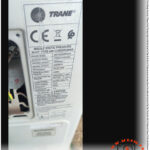
Trane 24000 BTU, 4MXTE24ASB000AB, 4TXKE24ASB0000A mbsmpro

Trane Middle Static Pressure Duct Type Air Conditioner: Technical Overview and Performance Guide

Trane’s middle static pressure duct type air conditioner in the 24,000 BTU/h class is designed for residential and light commercial projects that demand reliability, silent operation and precise air distribution. This unit combines robust construction with R410A refrigerant technology to deliver efficient cooling and heating across a wide range of indoor applications.

Main specifications

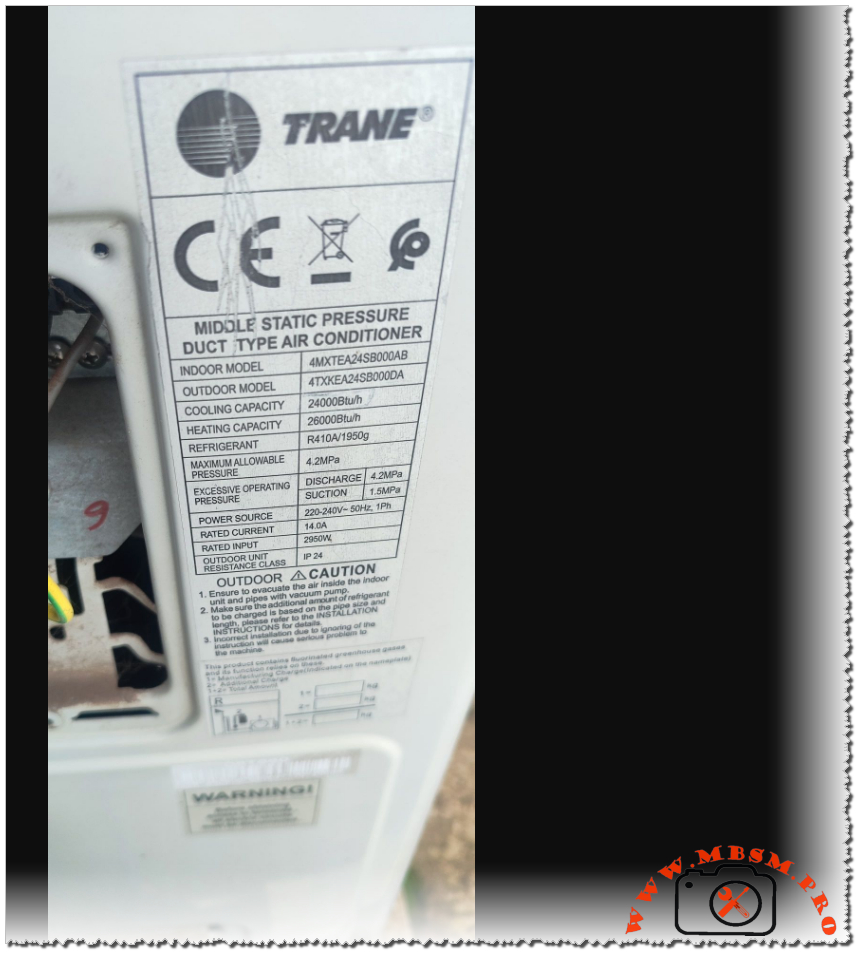
The nameplate identifies the indoor model as 4MXTE24ASB000AB and the outdoor model as 4TXKE24ASB0000A. The cooling capacity is rated at 24,000 BTU/h, while the heating capacity reaches 26,000 BTU/h, placing the system firmly in the 2‑ton segment for ducted installations. The unit uses R410A with a factory charge of 1950 g, ensuring compatibility with current environmental regulations and high operating pressures typical of this refrigerant. The maximum allowable pressure is specified at 4.2 MPa, with typical operating conditions of 4.2 MPa on discharge and 1.5 MPa on suction, reflecting the design for medium static pressure duct networks.

Electrical data and power performance

The power source requirement for this Trane ducted system is 220–240 V, 50 Hz, single phase, which aligns with standard low‑voltage networks in many markets, including residential and small commercial buildings. Rated current is listed at 14.0 A, with a rated input power of 2950 W, providing a clear reference point for circuit sizing and energy consumption estimation. The outdoor unit carries a protection class of IP24, indicating resistance to water splashes and solid objects larger than 12.5 mm, which is essential for safe operation in exposed external locations. These electrical characteristics help designers and installers evaluate cable sizing, breaker selection and overall energy performance when integrating the system into a building.

Refrigerant circuit and pressure safety

Operating with R410A at high pressures, the system is engineered to handle demanding conditions while maintaining safety. The maximum allowable pressure of 4.2 MPa for the circuit, together with specified discharge and suction pressures, underlines the importance of using compatible tools, hoses and gauges during service operations. Excessive operating pressure limits on discharge and suction sides guide technicians during commissioning and troubleshooting, helping to identify abnormal conditions such as overcharging, blocked airflow or non‑condensable gases in the circuit. Correct handling of R410A and adherence to pressure limits are critical to protect the compressor, heat exchangers and associated piping over the life of the installation.

Installation considerations and duct design

As a middle static pressure duct type air conditioner, this Trane model is optimized for installations where air must be distributed to multiple rooms through short to medium duct runs. Medium static pressure capability allows the unit to overcome resistance from supply grilles, filters and bends, while still maintaining comfortable airflow levels in each zone. Installers must calculate total external static pressure, select appropriate duct dimensions and ensure proper balancing dampers to match the fan performance curve of the indoor unit. Good duct design, combined with adequate return air pathways and filtration, contributes to stable room temperatures, low noise levels and reduced energy losses.

Safety instructions and maintenance

The manufacturer emphasizes several safety and maintenance instructions directly on the rating label of the outdoor unit. Technicians are instructed to evacuate the air inside the indoor unit and piping before charging refrigerant in order to avoid moisture and non‑condensable gases that could damage the compressor. Only qualified personnel should perform installation and service work, following local electrical and refrigeration codes to prevent electric shock, fire or refrigerant leakage. Regular maintenance, including cleaning coils, checking electrical connections and verifying refrigerant pressures against the nameplate data, is essential to keep the system operating at the stated capacities and to extend the equipment’s service life.


Key technical data table

Parameter Value
Indoor unit model 4MXTE24ASB000AB
Outdoor unit model 4TXKE24ASB0000A
Cooling capacity 24,000 BTU/h
Heating capacity 26,000 BTU/h
Refrigerant type / charge R410A / 1950 g
Power supply 220–240 V, 50 Hz, 1‑phase
Rated current 14.0 A
Rated input power 2950 W
Maximum allowable pressure 4.2 MPa
Typical discharge / suction press. 4.2 MPa / 1.5 MPa
Outdoor unit protection class IP24
Trane 24000 BTU, 4MXTE24ASB000AB, 4TXKE24ASB0000A mbsmpro


DC05CDNC1C 48V DC Cabinet Air Conditioner

DC05CDNC1C 48V DC Cabinet Air Conditioner: Technical Overview and Practical Guide

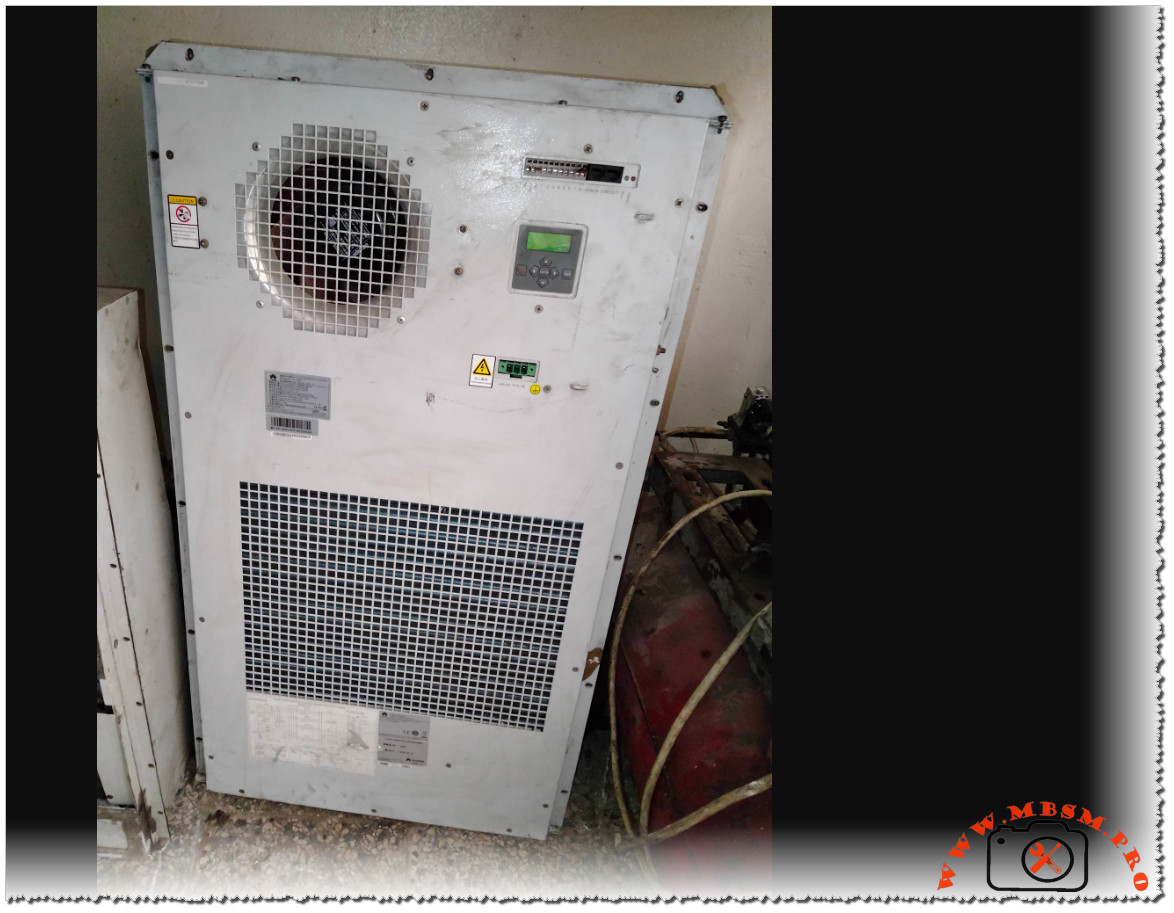
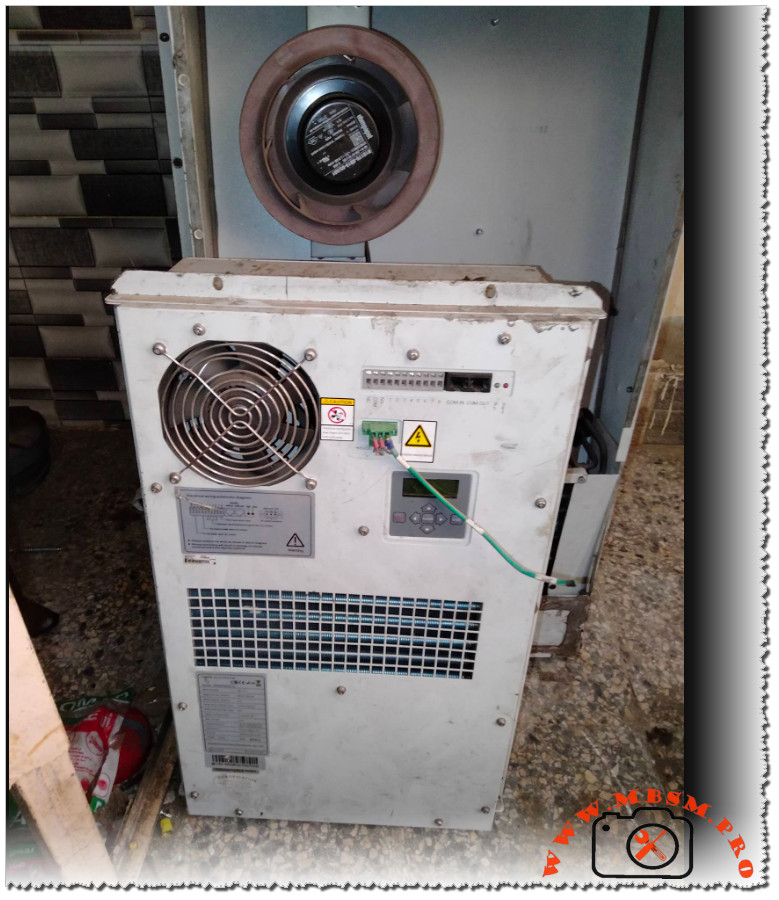
Outdoor telecom cabinets, base stations and industrial enclosures rely on compact DC air conditioners to keep sensitive electronics within a safe temperature range. The Envicool DC05CDNC1C 48V DC cabinet air conditioner is one of these dedicated solutions, delivering 550 W of cooling capacity in a sealed IP65 housing for harsh outdoor environments.

Product identification

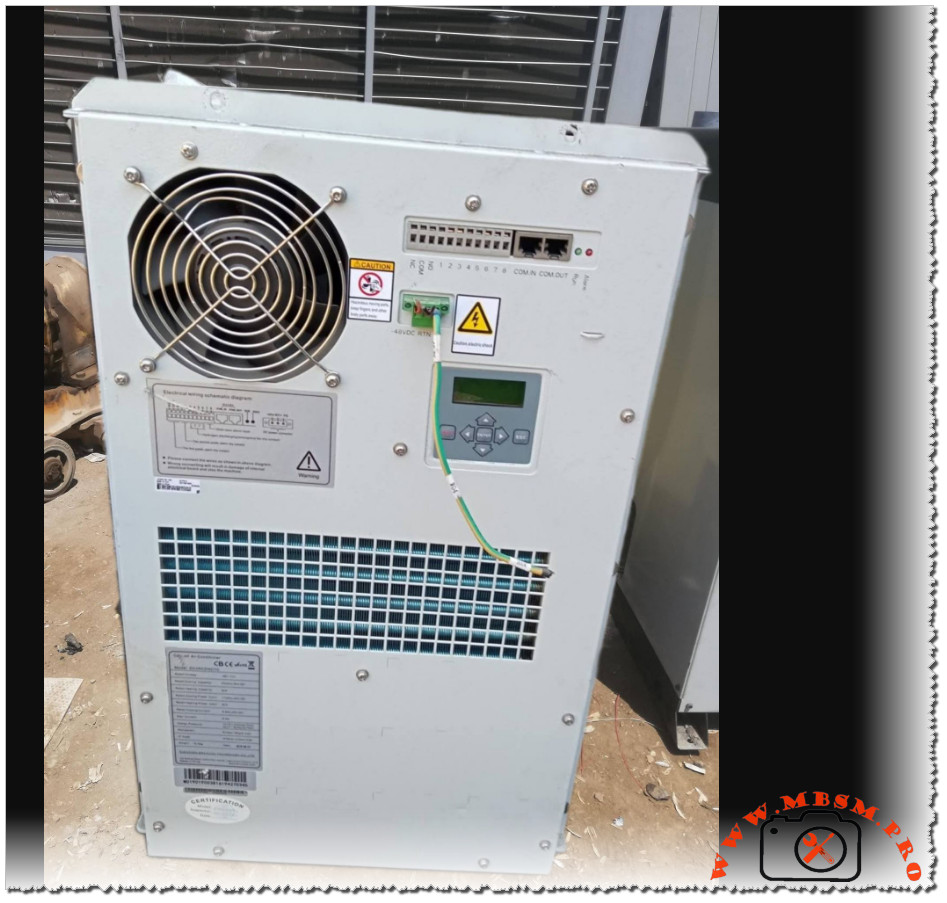
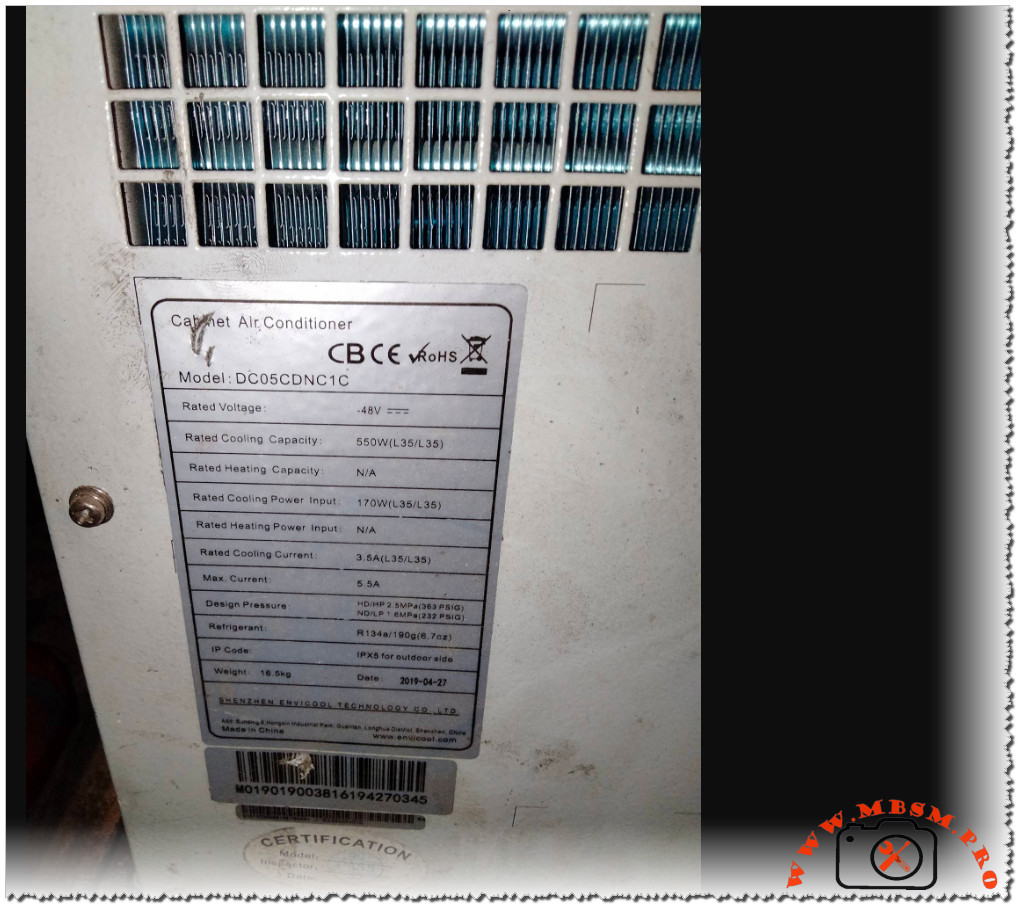
The nameplate in the photo clearly identifies the unit as a Cabinet Air Conditioner – Model DC05CDNC1C manufactured by Shenzhen Envicool Technology Co., Ltd.
It is a 48 VDC powered system using refrigerant R134a, designed specifically for outdoor telecom and electronics cabinets rather than for human comfort cooling.

Main technical specifications

From the label and available product listings, the DC05CDNC1C offers 550 W (≈1700 BTU/h) of rated cooling capacity at test conditions L35/L35, with a rated cooling power input of 170 W, which indicates a high-efficiency DC compressor.
The unit works on –48 V DC, draws a rated current around 3.6 A and a maximum current of 5.5 A, and uses R134a refrigerant within an IP65 enclosure suitable for dusty or rainy outdoor sites.

Key data table

Specification Value
Model DC05CDNC1C cabinet air conditioner
Power supply –48 V DC nominal
Rated cooling capacity 550 W at L35/L35 (≈1700 BTU/h)
Rated cooling input 170 W at L35/L35
Refrigerant R134a
Cooling function Cooling only or cooling + heating (depending on configuration)
Working temperature Approximately –40 °C to +55 °C (typical for this model range)
Protection rating IP65 for outdoor installation
Approx. dimensions 315 × 170 × 545 mm (W×D×H)

Typical applications and installation

This compact DC air conditioner is used on outdoor telecom cabinets, wireless base stations, battery cabinets and other critical enclosures where grid AC power is limited but –48 V DC is available from telecom power systems or solar-hybrid supplies.
Installers mount the unit directly on the cabinet wall, ensuring correct cut-out size, gasket sealing for IP65, and proper connection to the DC power and control terminals according to Envicool’s cabinet air-conditioner manuals.

Advantages for telecom and industrial users

The DC05CDNC1C offers several operational advantages: it reduces energy consumption by using DC power directly without an AC/DC conversion stage, keeps electronics within their design temperature for higher reliability, and protects against dust and moisture thanks to its sealed IP65 construction.
For operators of remote sites, the 48 V DC architecture integrates smoothly with solar and battery systems, helping to maintain cooling even during AC grid outages and extending equipment life in severe climates.