Emkarate RL 68H Compatibility Chart with HFC HCFC HFO
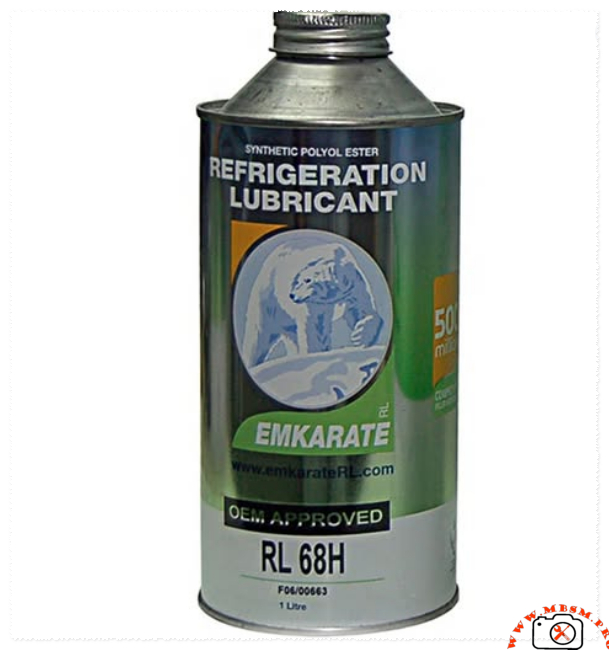
RL 68H POE Oil with R600 Refrigerant mbsmpro

Focus Keyphrase: Emkarate RL 68H Compatibility Chart with HFC HCFC HFO and Hydrocarbon Refrigerants

SEO Title: Mbsmpro.com, Emkarate RL 68H, Refrigeration Lubricant, POE Oil, Refrigerant Compatibility, R134a, R404A, R600a, R22, Ammonia Warning

Meta Description: Technical analysis of Emkarate RL 68H POE lubricant compatibility. Detailed guide on using synthetic oil with HFC, HCFC, HFO, and Hydrocarbon refrigerants like R600a.

Slug: emkarate-rl-68h-refrigerant-compatibility-technical-guide

Tags: Emkarate RL 68H, POE Lubricant, Refrigerant Compatibility, R134a, R600a, R22, Ammonia Compatibility, Mbsmgroup, Mbsm.pro, mbsmpro.com, mbsm, Synthetic Oil, Compressor Maintenance

Excerpt: Emkarate RL 68H is a high-performance synthetic polyol ester (POE) lubricant designed for modern refrigeration systems. Understanding its chemical compatibility across different refrigerant generations—from HFCs like R134a to hydrocarbons like R600a—is vital for system longevity. This guide breaks down compatibility, technical reasons for usage, and critical warnings for technicians.


Mbsmpro.com, Emkarate RL 68H, Refrigeration Lubricant, Synthetic POE, ISO VG 68, Global Refrigerant Compatibility Guide

In the evolving landscape of HVAC-R technology, the choice of lubricant can determine the success or failure of a compressor. Emkarate RL 68H is a premium Synthetic Polyol Ester (POE) lubricant engineered to meet the demands of various cooling systems. As an engineer or field technician, understanding the chemical relationship between this oil and different gas categories is essential for maintaining high efficiency and preventing mechanical breakdown.

Comprehensive Compatibility Analysis: Emkarate RL 68H vs. Refrigerant Categories

The following table outlines how RL 68H interacts with major refrigerant classes, providing the technical reasoning behind each classification based on chemical behavior and miscibility.

Refrigerant Class Common Examples Compatibility Status Technical Reasoning (The “Why”)
HFC (Modern Generation) R134a, R404A, R410A, R407C, R507 Fully Compatible These gases are polar and specifically require POE oils for proper miscibility, ensuring oil returns to the compressor.
HCFC (Legacy Transition) R22, R123, R401A, R402A Compatible Ideal for “Retrofit” operations when converting older systems from Mineral Oil to more environmentally friendly HFC blends.
HFO (Eco-Friendly Gen) R1234yf, R1234ze Compatible Exhibits high chemical stability, making it suitable for new low Global Warming Potential (GWP) refrigerants.
HC (Hydrocarbons) R600a, R290 Chemically Compatible Miscibility is excellent, but viscosity is the barrier; small HC systems typically require lower viscosity (ISO 10-32).
Natural (Carbon Dioxide) R744 Compatible RL 68H is robust enough to handle the high pressures and discharge temperatures typical of CO2 systems.
Ammonia R717 NOT Compatible NEVER use with Ammonia. POE oils react chemically with R717, leading to sludge, corrosion, and system failure.

Deep Dive: The Relationship with R600a and Hydrocarbons

While Emkarate RL 68H is chemically “safe” for R600a (meaning it won’t break down the oil structure), there is a significant engineering caveat regarding Viscosity.

Most domestic R600a compressors are designed for low-viscosity oils (often Mineral or Alkylbenzene). Using an ISO VG 68 oil in a system designed for ISO 15 or 22 creates internal drag. This increased resistance puts unnecessary load on the motor, leading to higher energy consumption and potential starting issues in cold environments. Therefore, while it is compatible in a laboratory sense, it is often too “heavy” for standard domestic refrigerators.


Engineering Value and Performance Comparison

When comparing Emkarate RL 68H to standard Mineral Oils (MO) or lower-grade synthetics, the performance benefits are clear in high-load scenarios.

Stability and Protection Factors:

  • Oxidation Resistance: Synthetic POE resists breakdown much better than mineral oils when exposed to heat.
  • Wear Protection: The film strength of ISO 68 is superior for commercial-grade compressors (e.g., 2 HP to 10 HP units), providing a thick protective layer on bearings.
  • Miscibility Range: It maintains flow and return characteristics across a wider temperature spectrum than traditional lubricants.
Lubricant Property Emkarate RL 68H (POE) Standard Mineral Oil (MO)
Base Fluid Synthetic Ester Petroleum Based
Moisture Sensitivity High (Hygroscopic) Low
Thermal Range Excellent (High/Low) Moderate
Application HFC / Retrofit CFC / HCFC / Ammonia

Expert Notices and Professional Advice

1. The Ammonia Rule:
As highlighted in our compatibility chart, never introduce POE oil into an Ammonia (R717) system. Ammonia requires Mineral Oils (MO) or Polyalphaolefins (PAO). The chemical reaction between POE and Ammonia creates soaps and acids that will destroy the compressor valves and seals.

2. Moisture is the Enemy:
POE oil is “thirsty.” It will pull moisture directly from the air. Always keep the cap tightly sealed. If a bottle has been open for more than a few minutes in a humid environment, its dielectric strength and chemical purity are compromised.

3. Retrofitting Legacy Systems:
When converting an R22 system to an HFC blend (like R422D), RL 68H is the industry standard for flushing. It helps carry residual mineral oil back to the separator, ensuring a clean transition.


Technical Specifications Summary

  • Model: Emkarate RL 68H
  • Viscosity Grade: ISO VG 68
  • Application: Commercial Refrigeration, Industrial Chillers, Retrofitting.
  • Approvals: Approved by major OEMs including Copeland, Bitzer, and Danfoss.

Final Engineering Verdict

The Emkarate RL 68H is a versatile powerhouse for modern HFC and HFO systems. While it offers a bridge for HCFC retrofits and possesses the chemical stability for CO2 and Hydrocarbons, the field technician must always respect the viscosity requirements of the specific compressor model and the strict exclusion of Ammonia environments. Correct lubrication is not just about the gas; it’s about the mechanical harmony of the entire system.

14.5sinfoGoogle AI models may make mistakes, so double-che
RL 68H POE Oil with R600 Refrigerant mbsmpro


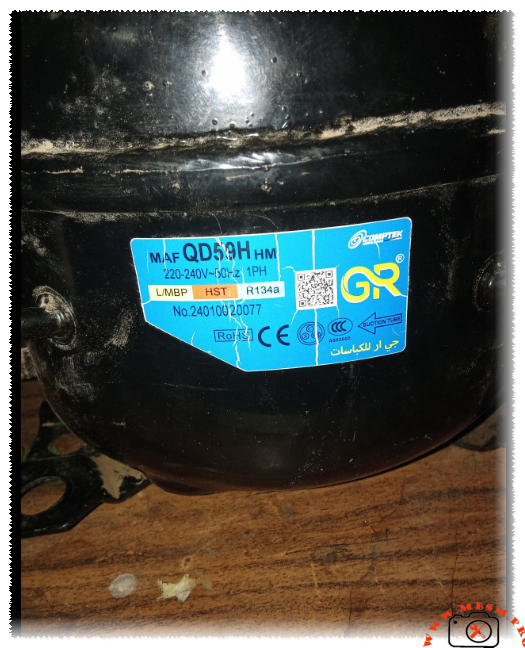
Compressor MAF QD59H HM for Ideal 8-foot Refrigerator

Mbsmgroup-files-2026-01-16_203856 mbsmpro

Focus Keyphrase: Compressor MAF QD59H HM for Ideal 8-foot Refrigerator Technical Specifications and Compatibility Guide

SEO Title: Mbsm.pro, Compressor, MAF QD59H HM, 1/6 HP, Comptek, Cooling, R134a, 220-240V 50Hz, L/MBP, HST, Ideal 8ft Refrigerator

Meta Description: Discover if the MAF QD59H HM Comptek compressor is the right fit for your Ideal 8-foot refrigerator. Comprehensive technical specs, 1/6 HP performance, and engineering tips.

Slug: compressor-maf-qd59h-hm-1-6-hp-r134a-ideal-fridge

Add Tags: Mbsmgroup, Mbsm.pro, mbsmpro.com, mbsm, Comptek Compressor, MAF QD59H HM, Ideal Refrigerator Repair, R134a Cooling, 1/6 HP Compressor, LBP Refrigeration

Excerpt: Choosing the correct compressor for a classic Ideal 8-foot refrigerator requires technical precision. The MAF QD59H HM, a robust 1/6 HP unit by Comptek, is a frequent candidate for these repairs. This article explores the mechanical compatibility, electrical requirements, and performance values necessary to ensure a long-lasting and efficient cooling system restoration.


The Engineering Guide to Compressor MAF QD59H HM: Performance and Compatibility for Ideal 8-Foot Refrigerators

In the world of domestic refrigeration maintenance, the Ideal 8-foot refrigerator remains a legendary appliance known for its sturdy build. However, when the heart of the system—the compressor—fails, selecting a modern replacement requires an understanding of displacement, cooling capacity, and motor torque. The MAF QD59H HM, manufactured by Comptek, is a specialized L/MBP (Low/Medium Back Pressure) unit designed for R134a systems.

Technical Breakdown: MAF QD59H HM Characteristics

The MAF QD59H HM is engineered for efficiency. As a 1/6 HP class compressor, it provides the necessary thermal displacement to handle the internal volume of an 8-cubic-foot unit without overstressing the condenser coils.

Table 1: Technical Specifications

Feature Specification
Model MAF QD59H HM
Brand Comptek / GR
Horsepower (HP) 1/6 HP
Refrigerant R134a
Voltage/Frequency 220-240V ~ 50Hz
Phase 1 PH (Single Phase)
Application Range L/MBP (Low/Medium Back Pressure)
Motor Type RSIR / CSIR (Depending on Starter Kit)
Starting Torque HST (High Starting Torque)
Cooling Capacity ~150W – 165W (at -23.3°C LBP)

Is it Compatible with an Ideal 8-Foot Refrigerator?

The short answer is yes. An 8-foot refrigerator typically requires between 1/8 HP and 1/6 HP. Using the MAF QD59H HM ensures that the system reaches the desired temperature quickly, even in high-ambient-temperature environments.

The HST (High Starting Torque) designation is particularly beneficial. In many regions where voltage can fluctuate or where the refrigerator is opened frequently, an HST motor ensures the compressor starts reliably against the pressure of the refrigerant without tripping the thermal overload protector.

Comparative Analysis: Displacement vs. Cooling Efficiency

When comparing the MAF QD59H HM to other common industry standards like the Danfoss or Embraco equivalents, we see a focus on balancing energy consumption with cooling speed.

Table 2: Comparison with Equivalent Models

Compressor Model Displacement (cc) Cooling Capacity (W) Efficiency (COP)
Comptek MAF QD59H 5.9 158 1.25
Embraco EMT56CLP 5.6 145 1.22
Danfoss TL5G 5.0 135 1.18
ZMC GM70AZ 6.5 170 1.28

Engineering Insights: Wiring and Installation

For the field technician, the electrical configuration is standard but requires precision. Below is the typical schematic logic for the MAF series.

Electrical Connection Schematic:

  1. Common (C): Connected to the Internal/External Overload Protector.
  2. Main/Run (R): Connected to the Neutral line.
  3. Start (S): Connected via the PTC (Positive Temperature Coefficient) or Start Capacitor.

Notice: Always ensure the suction tube is identified correctly (marked by an arrow on the label) to prevent oil slugging into the manifold during the first start-up.

Professional Advice for Maximum Longevity

  • System Flushing: Before installing the MAF QD59H HM, always flush the evaporator and condenser with R141b to remove old mineral oil or carbon deposits.
  • Capillary Tube Check: For an 8-foot Ideal fridge, ensure the capillary tube is not restricted. A restricted tube will cause the HST motor to overheat.
  • Vacuuming: Achieve a vacuum of at least 500 microns to ensure the R134a/POE oil environment remains moisture-free.
  • Filter Drier: Always replace the filter drier with a high-quality 20g or 30g XH-9 molecular sieve drier.

Benefits of Using the MAF QD59H HM

  • Thermal Stability: Excellent heat dissipation during long run cycles.
  • Quiet Operation: Low vibration levels compared to older reciprocating models.
  • Versatility: Suitable for both freezers and standard refrigerators due to its L/MBP range.

Expert Notice: While the MAF QD59H HM is a robust replacement, always verify the original nameplate of the refrigerator. If the original compressor was significantly larger (e.g., 1/4 HP), a QD59H may lead to extended run times. However, for the standard Ideal 8ft model, this unit remains a top-tier engineering choice.

Mbsmgroup-files-2026-01-16_203856 mbsmpro


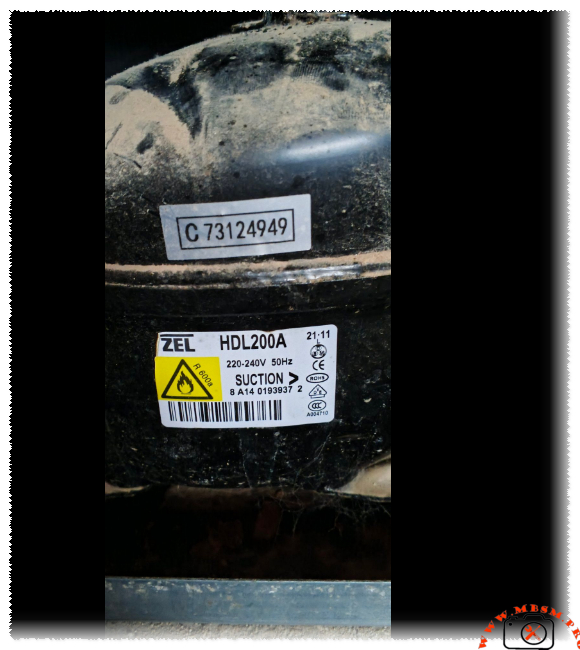
Technical Comparison: ZEL HDL200A vs. Huaguang ATA72XL

Technical Comparison: ZEL HDL200A vs. Huaguang ATA72XL mbsmpro

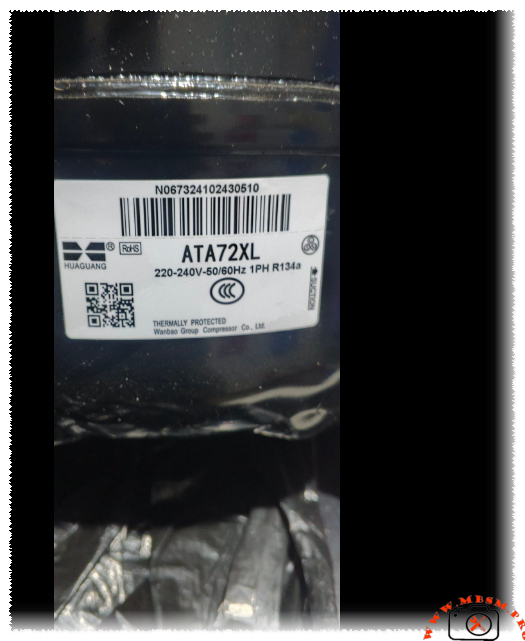
technical comparison between two common refrigerator compressors: the ZEL HDL200A and the Huaguang (Wanbao) ATA72XL. We will examine their specifications and address the critical question: Can one be used as a replacement for the other?


Technical Comparison: ZEL HDL200A vs. Huaguang ATA72XL

When evaluating compressors for replacement, we must look at three primary factors: Refrigerant type, cooling capacity (power), and electrical compatibility.

1. ZEL HDL200A Specifications

  • Refrigerant: R600a (Isobutane)
  • Voltage/Frequency: 220-240V / 50Hz
  • Cooling Capacity: Approximately 180–200 Watts (roughly 1/4 HP class)
  • Lubricant: Typically uses Mineral or Alkylbenzene oil compatible with R600a.
  • Application: Modern, high-efficiency domestic refrigerators.

2. Huaguang ATA72XL Specifications

  • Refrigerant: R134a (Tetrafluoroethane)
  • Voltage/Frequency: 220-240V / 50-60Hz
  • Cooling Capacity: Approximately 190–210 Watts (roughly 1/4 HP class)
  • Lubricant: POE (Polyolester) oil.
  • Application: Standard domestic refrigerators and water dispensers.

The Compatibility Verdict: Can they be swapped?

The short answer is: No.

You cannot directly replace a ZEL HDL200A with a Huaguang ATA72XL (or vice versa) without significant and specialized modifications to the entire refrigeration system. Here is why:

A. Refrigerant Incompatibility (The Dealbreaker)

The ZEL compressor uses R600a, which is a hydrocarbon gas that operates at much lower pressures than R134a.

  • A system designed for R600a has a different capillary tube length and diameter compared to an R134a system.
  • If you put an R134a compressor into an R600a system, the high pressures of R134a will likely “choke” the narrow R600a capillary tube, leading to poor cooling or compressor failure.

B. Oil and Chemical Issues

R600a compressors usually use mineral-based oils, while R134a compressors require synthetic POE oil. These oils are not cross-compatible. If residues of the old oil remain in the lines, they can react with the new refrigerant, creating sludge that clogs the expansion device (capillary tube), ultimately destroying the new compressor.

C. Safety and Design

R600a is flammable. Systems designed for R600a have specific safety considerations regarding electrical components (non-sparking relays). While putting an R134a (non-flammable) compressor into an R600a shell is less of a fire risk, the mechanical performance will be abysmal because the evaporator and condenser sizes are optimized for the specific thermodynamic properties of the original gas.


Summary Comparison Table

Feature ZEL HDL200A Huaguang ATA72XL Compatible?
Refrigerant R600a R134a No
Cooling Power ~1/4 HP ~1/4 HP Yes (Close)
Voltage 220-240V 220-240V Yes
Oil Type Mineral/AB POE No
Operating Pressure Low High No

Conclusion

While both compressors fall into the same general “power bracket” (roughly 1/4 HP), they are built for entirely different chemical environments.

Recommendation: Always replace a compressor with one that uses the same refrigerant as the original. If your fridge is labeled for R600a, you must use an R600a compressor like the ZEL HDL200A. Using the Huaguang ATA72XL in its place would require flushing the entire system, changing the capillary tube, and vacuuming the system extensively—a process that is often more expensive and less reliable than simply buying the correct part.

Technical Comparison: ZEL HDL200A vs. Huaguang ATA72XL mbsmpro


mbsmgroup2026-01-16_121136-mbsmpro mbsmpro

Mbsmpro.com, Gree Multi VRF, Error Codes List, Troubleshooting Guide, E1 E2 E3 E4 E5 E6 E9 F1 F2 F3 F4 F5 F6 F7 F8 F9 FA Fb Fc Fd EH, HVAC Diagnostics, Variable Refrigerant Flow Systems


Mastering the Diagnostics of Gree Multi VRF Systems: An Engineering Perspective

In the demanding world of commercial climate control, Multi VRF (Variable Refrigerant Flow) systems represent the pinnacle of efficiency and complexity. As a field engineer who has spent countless hours on rooftops and in mechanical rooms, I understand that an error code is not just a letter and a number; it is a vital communication from the machine’s brain. When a Gree Multi VRF unit halts operation, the diagnostic display becomes your most powerful tool.

Understanding the Logic of Protection and Sensor Errors

Modern HVAC systems are built with a philosophy of “self-preservation.” The error codes displayed on the digital control panel allow technicians to pinpoint whether a fault is mechanical, electrical, or related to the refrigerant cycle. These codes are divided into primary protection triggers (the “E” series) and sensor malfunctions (the “F” series).

Table 1: Primary Protection and Communication Codes

Error Code Description Potential Root Cause Engineer’s Field Action
E1 High-Pressure Protection Blocked condenser, overcharge, or fan failure. Check high-pressure switch and coil cleanliness.
E2 Prevention against low temperature Low airflow or evaporator icing. Inspect filters and indoor blower motor.
E3 Low-pressure protection Refrigerant leak or clogged expansion valve. Leak test and check suction pressure levels.
E4 Exhaust overtemperature Shortage of refrigerant or compressor strain. Verify discharge line temperature and charge.
E5 Overcurrent Protector Voltage instability or compressor seizure. Check supply voltage and compressor windings.
E6 Communication error Wiring fault between indoor and outdoor units. Verify signal wire continuity and shielding.
E9 Water-Full protection Drain pump failure or blocked condensate line. Clean the drain pan and test the float switch.

The Role of Thermistors in System Performance

The “F” series codes are dedicated to the nervous system of the VRF—the sensors. In a Multi VRF environment, accuracy is everything. A deviation of even 2 degrees in a tube-inlet sensor can lead to inefficient cooling or unnecessary system shutdowns.

Table 2: Sensor Diagnostic Logic (Indoor and Outdoor)

Error Code Sensor Location Specific Component Circuit Check
F Indoor Ambient Temperature Check 10k/15k Ohm resistance.
F1 Indoor Tube-inlet Sensor Inspect thermistor contact with piping.
F2 Indoor Tube-middle Sensor Check for moisture ingress in sensor head.
F3 Indoor Tube-exit Sensor Ensure secure connection to the PCB.
F4 Outdoor Ambient Temperature Verify no direct sunlight on the sensor.
F5 Outdoor Tube-inlet Sensor Resistance check vs. temperature chart.
F6 Outdoor Tube-middle Sensor Check for corrosion on the terminal.
F7 Outdoor Tube-exit Sensor Ensure insulation is intact.
F8 / F9 Exhaust Temp Sensor 1 (Fixed) / 2 (Digital) Essential for discharge gas monitoring.
FA / Fb Oil Temp Sensor 1 (Fixed) / 2 (Digital) Critical for compressor lubrication health.

Advanced Valving and Relay Errors

When you encounter codes like Fc or Fd, the system is indicating a mechanical-electronic mismatch. High and Low-pressure valve errors usually point to a failure in the solenoid coil or a stuck valve body. Meanwhile, EH (Thermal Relay Error) is a critical warning that the internal heat protection of a component has been tripped, often due to excessive ambient heat or mechanical friction.

Comparative Analysis: VRF vs. Standard Split Systems

To truly appreciate the diagnostic depth of a Gree Multi VRF, one must compare it to standard residential split systems.

  • Diagnostic Granularity: While a standard split might give a generic “System Fault” blink, the VRF distinguishes between tube-inletmiddle, and exit temperatures. This allows the engineer to calculate the exact superheat and subcooling at different stages of the evaporator.
  • Operational Protection: Conventional systems often run until a mechanical failure occurs. The VRF uses E1 through E4 logic to shut down before the compressor is permanently damaged, saving thousands in repair costs.

Professional Engineering Schema: Communication (E6) Troubleshooting

For electrical diagnostics, specifically for the E6 Communication Error, follow this logic flow:

  1. Isolate Power: Turn off the breaker for both indoor and outdoor units.
  2. Verify Shielding: Ensure the communication cable (usually 2-core or 3-core) is shielded and grounded only at the outdoor unit to prevent EMI (Electromagnetic Interference).
  3. Voltage Check: With power on, measure the DC voltage across the communication terminals. A fluctuating signal (typically between 12V and 24V DC) indicates active data transmission.
  4. Resistor Check: In some daisy-chain configurations, verify if a terminal resistor is required at the end of the line.

Expert Advice and Maintenance Benefits

  • Notice: Never bypass a pressure switch (E1/E3) to “test” the system. These protections are the only thing preventing a catastrophic compressor explosion.
  • Engineering Tip: Most sensor errors (F series) are caused by poor contact or moisture. Before replacing a sensor, clean the terminal with an electronic contact cleaner and ensure the thermistor is tightly clipped to the copper pipe with thermal paste.
  • Benefit: Understanding these codes reduces “part-swapping” syndrome. A technician who knows that E9 is simply a clogged drain can fix the issue in 10 minutes, rather than misdiagnosing a faulty PCB.

Focus Keyphrase: Gree Multi VRF Error Codes Troubleshooting Guide

SEO Title: Gree Multi VRF Error Codes: Expert Troubleshooting Guide (E1-EH)

Meta Description: Decode Gree Multi VRF error codes like E1, E6, and F1. Our engineering guide provides expert solutions for pressure protection, sensor errors, and system diagnostics.

Slug: gree-multi-vrf-error-codes-diagnostics-guide

Tags: Mbsmgroup, Mbsm.pro, mbsmpro.com, mbsm, Gree HVAC, VRF Troubleshooting, Air Conditioning Repair, HVAC Engineering, Error Code E1, Error Code E6, Sensor Calibration, Refrigerant Cycle.

Excerpt: Mastering Gree Multi VRF systems requires a deep understanding of their diagnostic language. From high-pressure protection (E1) to complex sensor logic (F1-F9), this comprehensive guide offers field-proven engineering insights to help technicians identify root causes, perform precise electrical checks, and ensure optimal system performance in commercial environments.


mbsmgroup2026-01-16_121136-mbsmpro mbsmpro
air conditioning repair, Error Code E1, Error Code E6, Gree HVAC, HVAC Engineering, mbsm, mbsm.pro, mbsmgroup, mbsmpro.com, Sensor Calibration, VRF Troubleshooting


Danfoss Secop BD35F 101Z0200 DC compressor technical specifications and 12V 24V, 1/8 hp

Danfoss Secop BD35F 101Z0200 DC compressor technical specifications and 12V 24V, 1/8 hp mbsmpro


Focus Keyphrase:
 Danfoss Secop BD35F 101Z0200 DC compressor technical specifications and 12V 24V wiring guide for mobile refrigeration Mbsmpro

SEO Title: Mbsmpro.com, Compressor, BD35F, 1/8 hp, Secop Danfoss, R134a, 12V 24V DC, Mobile Refrigeration, 101Z0200, Technical Datasheet

Meta Description: Professional guide to the Danfoss Secop BD35F 101Z0200 compressor. Includes 12/24V DC electrical schemas, HP ratings, R134a cooling capacities, and technical data for marine and solar cooling.

Slug: compressor-bd35f-101z0200-secop-danfoss-r134a-12-24v-dc-guide

Tags: BD35F, 101Z0200, Secop, Danfoss, R134a, 12V DC Compressor, 24V DC Compressor, Mobile Cooling, Solar Fridge, Mbsmgroup, Mbsm.pro, mbsmpro.com, mbsm

Excerpt: The Danfoss Secop BD35F 101Z0200 is the industry standard for DC mobile refrigeration. Engineered for 12V and 24V systems using R134a, this compressor offers variable speed performance from 1/8 to 1/5 hp. This Mbsmpro technical guide explores its electronic control unit, wiring schemas, and cooling capacities for trucks, boats, and solar-powered appliances.

Danfoss Secop BD35F 101Z0200 DC compressor technical specifications and 12V 24V, 1/8 hp mbsmpro
101Z0200, 12V DC Compressor, 24V DC Compressor, BD35F, Danfoss, mbsm.pro, mbsmgroup, mbsmpro.com, Mobile Cooling, R134a, Secop, Solar Fridge

Mbsmpro.com, Compressor, BD35F, 1/8 to 1/5 hp, Secop Danfoss, Mobile Cooling, R134a, 35-120 W, 12-24V DC, LBP/MBP/HBP, Brushless DC, -30°C to +10°C, Cooling or Freezing

The Secop Danfoss BD35F (code 101Z0200) is widely regarded as the most reliable and versatile direct current (DC) compressor ever engineered. Designed specifically for mobile applications—ranging from marine refrigeration and truck cabins to solar-powered medical coolers—this unit utilizes a high-efficiency brushless DC motor. As a field expert, I have seen these units operate in extreme conditions where stability and low energy consumption are the highest priorities.

Unlike standard household compressors that run on a fixed frequency, the BD35F is a variable-speed machine controlled by an integrated electronic unit. This allows it to adapt its cooling capacity precisely to the demand, significantly extending battery life in off-grid environments.

Technical Specifications and Performance Data

The following table outlines the mechanical and thermodynamic characteristics of the BD35F unit.

Property Technical Detail
Model Number 101Z0200 (BD35F)
Refrigerant R134a
Voltage Range 12V DC and 24V DC (Automatic Switching)
Horsepower (HP) 1/8 hp (at 2000 RPM) to 1/5 hp (at 3500 RPM)
Displacement 2.00 cm³
Oil Type / Amount Polyolester (POE) / 150 cm³
Cooling Type Static or Fan Cooled (Recommended)
Application Range LBP / MBP / HBP (-30°C to +10°C)
Standard Control Unit 101N0210, 101N0212, or 101N0510

Cooling Capacity and Power Consumption

The BD35F’s performance is directly linked to its rotational speed (RPM), which is determined by a resistor in the thermostat circuit.

Speed (RPM) Cooling Capacity (Watts) Power Consumption (Watts) Current Draw (12V)
2,000 35 W 28 W 2.3 A
2,500 48 W 38 W 3.1 A
3,000 62 W 51 W 4.2 A
3,500 76 W 65 W 5.4 A

Note: Values based on LBP conditions (-25°C evaporation temperature).


Electrical Schema and Control Unit Interface

The electronic unit is the “brain” of the compressor. It handles the starting sequence, battery protection (low voltage cut-out), and speed regulation.

Electronic Unit Connection Map:

  1. Terminals (+) and (-): Connect directly to the battery. Crucial Notice: Always use a fuse (15A for 12V, 7.5A for 24V) and ensure wire thickness is sufficient to prevent voltage drop.
  2. Terminal (F): Connection for a small 12V/24V DC fan (max 0.5A). The fan helps cool the condenser and the electronics.
  3. Terminals (C) and (T): Thermostat connection. Placing a resistor here sets the compressor speed (e.g., no resistor = 2000 RPM; 1500 Ω = 3500 RPM).
  4. Terminal (D): Diagnostic port. A LED connected between (+) and (D) will flash error codes to indicate faults like low battery or motor overload.
  5. Terminal (P): Battery protection setting. Connecting different resistors here changes the low-voltage cut-out levels.

Logic Schema Summary:
[Battery 12/24V] –> [Electronic Unit] –> [3-Phase BLDC Output] –> [Compressor Motor]


Comparative Analysis: BD35F vs. BD50F

In the field, technicians often choose between the BD35F and the slightly larger BD50F. While they look identical externally, their internal displacement differs.

Feature BD35F (101Z0200) BD50F (101Z1220)
Displacement 2.0 cm³ 2.5 cm³
Max Capacity 120 Watts (HBP) 160 Watts (HBP)
Efficiency Best for small boxes (under 100L) Better for large coolers/freezers
Energy Usage Lower idle/starting current Slightly higher power requirement

Engineering Advice and Maintenance Notices

  • Wire Gauge Importance: DC systems are extremely sensitive to voltage drops. If your wiring is too thin, the electronic unit will detect “low voltage” and shut down the compressor (1 flash on the LED), even if the battery is full.
  • Heat Dissipation: Always install the compressor in a ventilated area. If the electronic unit reaches 85°C, it will trigger a thermal shut-down.
  • Refrigerant Precision: These systems usually have very small charge weights (30g to 90g). Overcharging by even 5 grams can cause high pressure and motor stalling.
  • Benefit of Variable Speed: For solar setups, running the compressor at 2000 RPM (lowest speed) is the most energy-efficient way to maintain temperature, as it minimizes the start/stop cycles that consume the most peak power.

Technician’s Troubleshooting Checklist

  1. LED Flashes (1): Low voltage. Check wire connections and battery charge.
  2. LED Flashes (3): Motor start error. The system is likely over-pressurized or the compressor is seized.
  3. LED Flashes (5): Thermal cut-out. Improve ventilation around the electronic module.

Mbsmgroup remains your leading resource for professional refrigeration engineering. By mastering the technical nuances of the BD35F 101Z0200, you ensure the longevity and efficiency of mobile cooling systems worldwide.

Danfoss Secop BD35F 101Z0200 DC compressor technical specifications and 12V 24V, 1/8 hp mbsmpro


 LG washing machine error codes troubleshooting

 LG washing machine error codes troubleshooting mbsmpro


Focus Keyphrase:
 LG washing machine error codes troubleshooting guide for professional technicians and home maintenance Mbsmpro

SEO Title: Mbsmpro.com, LG Washing Machine, Error Codes, OE, IE, UE, LE, CL, Troubleshooting, Repair Solutions, Appliance Maintenance Guide

Meta Description: Master LG washing machine repairs with this expert guide. Learn to decode OE, IE, UE, and LE error codes with professional field-tested solutions from Mbsmpro.

Slug: lg-washing-machine-error-codes-troubleshooting-guide-mbsmpro

Tags: LG Washing Machine, Error Codes, Troubleshooting, OE Error, IE Error, UE Error, CL Child Lock, Motor Lock LE, Appliance Repair, Maintenance Tips, Mbsmgroup, Mbsm.pro, mbsmpro.com, mbsm

Excerpt: Decoding LG washing machine error codes is essential for any technician or homeowner looking to maintain peak performance. From the common OE drainage error to the complex LE motor lock fault, understanding these digital signals saves time and prevents further damage. This comprehensive Mbsmpro guide provides field-tested solutions to keep your laundry appliances running efficiently.


Mbsmpro.com, LG Washing Machine, Error Codes, OE, IE, UE, LE, Troubleshooting, Maintenance Guide

In the modern world of smart appliances, LG washing machines stand out for their efficiency and advanced self-diagnostic systems. However, when the digital display flashes an alphanumeric code instead of the remaining cycle time, it can be frustrating for the end-user. As an engineering-focused field expert, I have spent years analyzing these systems to provide a definitive guide for troubleshooting and repair.

Understanding these codes is not just about clearing a notification; it is about diagnosing the mechanical or electronic root cause to ensure the longevity of the appliance. Below is a comprehensive breakdown of the most frequent faults encountered in the field.

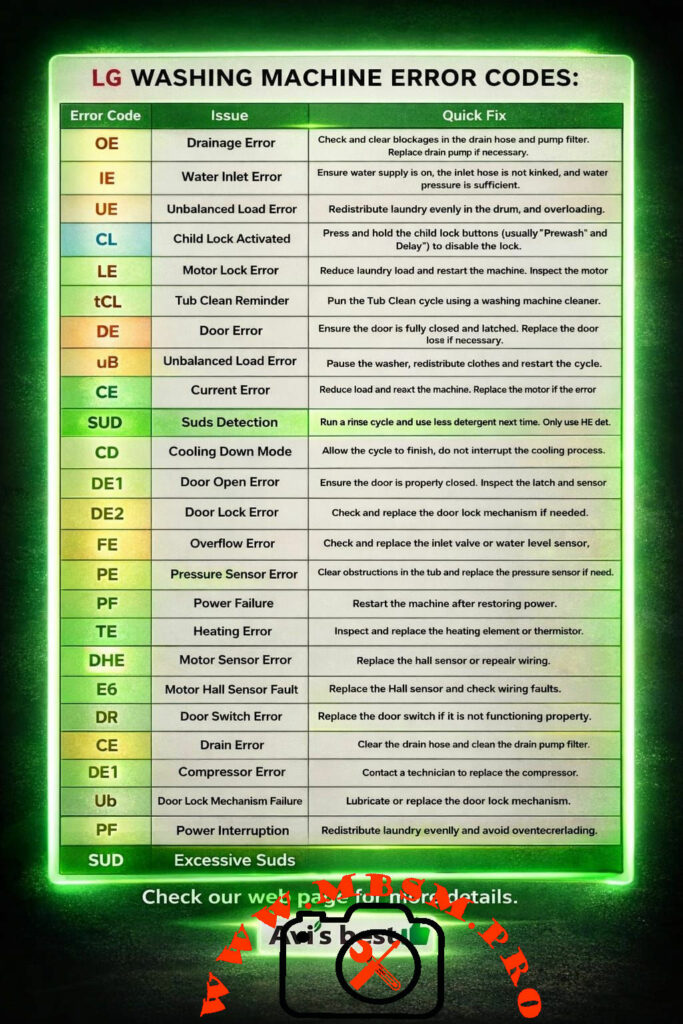
Comprehensive LG Error Code Reference Table

The following table serves as a primary diagnostic tool for identifying common issues and their immediate resolutions.

Error Code Issue Description Professional Diagnostic & Quick Fix
OE Drainage Error Inspect the drain hose for kinks. Clean the pump filter. Test the drain pump motor for continuity.
IE Water Inlet Error Verify water supply valves are open. Check inlet filters for sediment. Ensure house water pressure is adequate.
UE / uB Unbalanced Load Redistribute laundry evenly. Ensure the machine is perfectly level on the floor.
CL Child Lock Activated Not a fault. Press and hold the “Child Lock” button combination (often Prewash/Delay) for 3 seconds.
LE Motor Lock Error Possible heavy load. Reduce weight. Inspect the wiring harness between the PCB and the stator.
tCL Tub Clean Reminder Maintenance prompt. Execute the Tub Clean cycle using a high-quality citric-acid-based cleaner.
DE / DE1 / DE2 Door Error / Lock Fault Ensure the door is fully latched. Inspect the door switch and solenoid for electrical failure.
CE Current / Drain Error Can indicate a short circuit in the motor or a drainage obstruction. Inspect the main control board for scorch marks.
SUD Excessive Suds Detection High-efficiency (HE) detergent usage is mandatory. Run a rinse cycle to clear the drum.
FE Overflow Error Typically caused by a faulty water inlet valve that fails to close or a defective pressure sensor.
PE Pressure Sensor Error Check the air tube connecting the drum to the pressure switch. Verify the sensor’s frequency output.
PF Power Failure Indicates an interruption in electrical supply. Restart the cycle once power is stabilized.
TE Heating Error Inspect the heating element and the thermistor (NTC). Measure resistance values (typical 10k-15k ohms at room temp).
DHE Motor Sensor Error Focus on the Hall Effect sensor located on the back of the stator.
E6 Motor Hall Sensor Fault Often requires replacement of the Hall sensor or repairing the wiring harness.

Engineering Analysis: Sensors and Electronic Components

When a washing machine displays an error, it is reacting to data provided by specific electronic sensors. For the technician, understanding the electrical characteristics of these parts is vital.

Electrical Specification Comparison Table

Component Expected Value (Approx.) Fault Symptom
Inlet Valve Solenoid 1.1k – 1.5k Ohms IE Error, No water entry
Drain Pump Motor 150 – 200 Ohms OE Error, Standing water
Thermistor (NTC) 10k – 15k Ohms (at 25°C) TE Error, Water not heating
Stator Windings 8 – 12 Ohms (between pins) LE Error, Motor stuttering
Door Lock Solenoid 50 – 150 Ohms DE2 Error, Door won’t lock

Electronic Logic Schema (Simplified)

[Main PCB] <–> [Pressure Switch (PE)] <–> [Water Level Frequency]
[Main PCB] <–> [Hall Sensor (LE/E6)] <–> [Motor RPM Tracking]
[Main PCB] <–> [Thermistor (TE)] <–> [Temperature Feedback]


Comparative Study: LG vs. Industry Standards

In comparison to brands like Samsung or Whirlpool, LG utilizes a Direct Drive motor system in many models. This eliminates the belt, which reduces common mechanical “No Spin” errors found in older machines. However, it places more importance on the Hall Sensor (RPM sensor). While a Whirlpool might show a “Suds” error, LG’s SUD detection is often more sensitive to the specific viscosity of the water, requiring stricter adherence to HE detergent standards.

Professional Advice and Notices

  • Notice on Maintenance: Always perform a tCL (Tub Clean) cycle at least once a month. This prevents the buildup of biofilm which can interfere with the PE (Pressure Sensor) accuracy.
  • Benefit of Proper Leveling: A perfectly level machine significantly reduces the occurrence of UE (Unbalanced Load) errors and prevents premature wear on the shock absorbers.
  • Engineering Tip: If you encounter an LE error on a new machine, always check the wiring harness at the bottom of the tub. During high-vibration shipping, these connectors can sometimes wiggle loose.

Technical Troubleshooting Summary

  1. Safety First: Always disconnect the power supply before inspecting internal components.
  2. Visual Inspection: 60% of OE and IE errors are caused by external factors like clogged house filters or pinched hoses.
  3. Sensor Cleaning: Before replacing a PE sensor, blow air through the pressure tube to ensure there is no “water log” or debris blocking the signal.

Mbsmgroup remains committed to providing the highest quality technical insights for the appliance repair industry. Whether you are a master engineer or a dedicated DIYer, following these diagnostic steps will ensure your LG Washing Machine operates at peak performance for years to come.

 LG washing machine error codes troubleshooting mbsmpro
 LG washing machine error codes troubleshooting mbsmpro

https://www.lg.com/us/support/help-library