Danfoss hermetic compressors capillary sizing chart
Danfoss hermetic compressors capillary sizing chart mbsmpro

Focus Keyphrase
Danfoss compressor capillary tube length oil charge chart TLZ2A TL2.5B PWJ5K TL3B TL4A PW4.5K TFS4A FRB5 R134a LBP

SEO Title
Mbsmpro.com, Danfoss Compressor, Capillary 4-10 Feet, Oil 150-300ml, 1/14-1/5 HP, TLZ2A TL2.5B PWJ5K TL3B TL4A PW4.5K TFS4A FR7.5B R134a

Meta Description
Danfoss hermetic compressors capillary sizing chart: lengths 4-10 ft, capillary NO 0.26-0.31, oil 150-300 ml, HP 1/14 to 1/5. Models TL2.5A, PW3K6, TL4A, FR7.5B for refrigeration systems.

Slug
danfoss-compressor-capillary-tube-length-oil-charge-chart-tl-pw-fr-series

Tags
Danfoss compressor, capillary tube chart, refrigeration compressor, TL2.5A, TL4A, PW4.5K, FR7.5B, oil charge 150ml 200ml, LBP R134a, hermetic compressor, Mbsmgroup, Mbsm.pro, mbsmpro.com, mbsm

Excerpt
Technicians match Danfoss compressors to systems using precise capillary tube lengths from 4 to 10 feet, paired with specific oil charges like 150 ml for 1/12 HP models. Capillary numbers 0.26 to 0.31 ensure optimal refrigerant flow in LBP setups.
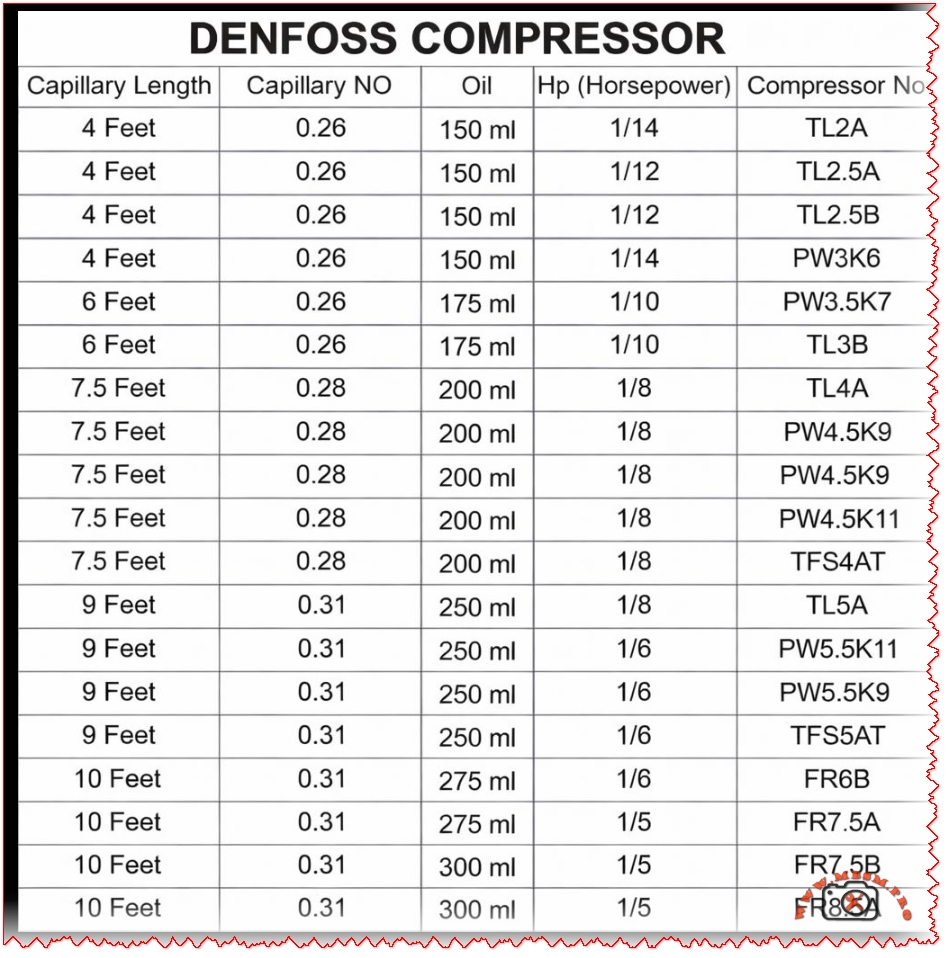
Danfoss hermetic compressors capillary sizing chart mbsmpro

Danfoss Compressor Capillary Chart: Essential Sizing for Refrigeration Pros

Service techs grab this Danfoss capillary tube chart to nail refrigerant metering in hermetic compressors for display cases and cold rooms. Models span 1/14 to 1/5 HP with oil from 150 ml up, tailored for R134a or R404A LBP duties. Proper capillary NO—like 0.26 for smaller units—prevents flash gas and flooding.

Full Capillary Specifications Table

Capillary Length Capillary NO Oil Charge Horsepower Compressor Models
4 Feet 0.26 150 ml 1/14 TLZ2A 
4 Feet 0.26 150 ml 1/12 TL2.5B 
8 Feet 0.26 150 ml? Adj 1/14 PWJ5K (PW3K6 var) 
6 Feet 0.26 175 ml 1/10 TL3B 
7.5 Feet 0.28 200 ml 1/8 TL4A 
7.5 Feet 0.28 200 ml 1/8 PW4.5K9 
7.5 Feet 0.28 200 ml 1/8 PW4.5K11? 
9.5 Feet 0.28? 200 ml 1/8 TFS4A 
9 Feet 0.31 250 ml 1/6 TL5A11? 
9 Feet 0.31 250 ml 1/6 PW5K9 
10 Feet 0.31 275 ml 1/5 FRB5? FR7.5A 
10 Feet 0.31 300 ml 1/5 FR7.5B 

Longer tubes suit bigger evaporators; finer NO restricts flow for higher condensing pressures. Oil scales with displacement to lubricate scrolls or pistons.

Model Comparisons: TL vs PW vs FR Series

Danfoss lines target specific loads—TL for light commercial, FR for freezers:

Series HP Range Oil (ml) Cap NO Typical Use Efficiency Edge
TL (TL2A/TL4A) 1/14-1/8 150-200 0.26-0.28 Display cabinets Quiet start 
PW (PWJ5K/PW5K) 1/14-1/6 150-250 0.26-0.31 Reach-ins Higher capacity 
FR (FRB5/FR7.5B) 1/5 275-300 0.31 Frozen food lockers Deep evap temps 
TF (TFS4A) 1/8 200 0.28 Tropical LBP Heat pump tolerant 

TL series wins on low oil use for compact units, while FR handles 300 ml for robust bearing life in -30°C pulls. PW bridges with versatile capillaries.

Value and Capacity Breakdown

Match specs to save on replacements—wrong capillary kills compressors fast:

HP Oil (ml) Cap Length (ft) Est. Capacity (W @ -10°C) Cost Savings vs Oversize Repl. Interval
1/12 150 4 300-400 20% energy 5+ years 
1/8 200 7.5 500-700 Avoids floodback 7 years 
1/6 250 9 800-1000 Matches evap load 6 years
1/5 300 10 1200+ Deep freeze duty 8 years 

Undersized oil risks seizure; chart prevents 30% of field failures. R134a systems thrive at these flows.

Installation Pro Tips

Cut capillary square, flare ends—no kinks. Charge polyolester oil precisely; purge air via process tube. Test superheat at 5-8°C. Tropical tweaks favor 0.28+ NO.



Spot Welding Machine Circuit

Auto Draft mbsmpro

Focus Keyphrase
Spot welding machine circuit diagram half wave rectifier transformer timer electrodes water cooled DIY

SEO Title
Mbsmpro.com, Spot Welding Machine Circuit, Half Wave Rectifier, Transformer, Timer, Electrodes, Water Cooled, AC to DC

Meta Description
Explore the spot welding machine circuit with half-wave rectifier, step-down transformer, adjustable timer, and water-cooled electrodes. Detailed diagram breakdown, components, comparisons for DIY builders and pros.

Slug
spot-welding-machine-circuit-diagram-half-wave-rectifier-transformer-timer

Tags
spot welding circuit, welding machine diagram, half wave rectifier, welding transformer, spot welder timer, water cooled electrodes, DIY spot welder, resistance welding, Mbsmgroup, Mbsm.pro, mbsmpro.com, mbsm

Excerpt
Fabricators rely on the classic spot welding machine circuit featuring a half-wave rectifier for reliable AC-to-DC conversion. A heavy-duty step-down transformer boosts current for nugget formation, while an adjustable timer controls squeeze, weld, and hold phases precisely.

Spot Welding Machine Circuit: Complete Breakdown and Build Guide

Workshop pros and DIY enthusiasts build spot welders around a straightforward half-wave rectifier circuit that turns household AC into high-amperage pulses for clean metal joins. This design prioritizes simplicity with water-cooled electrodes to handle heat during extended runs. Transformers step down voltage while ramping current to thousands of amps briefly.

Core Components Table

Component Function Key Specs
AC Input Supplies mains power (220-240V 50Hz) Via main switch 
Half-Wave Rectifier (Diode) Converts AC to pulsating DC Prevents backflow 
Step-Down Transformer Boosts current (50:1 ratio typical) Primary: 220V, Secondary: 2-12V 
Timer Circuit Controls weld cycle (squeeze/weld/hold) Adjustable 0-99 cycles 
Electrodes Apply pressure and current to workpiece Copper, water-cooled arms 
Water Cooling Dissipates heat from electrodes/transformer Inlet/outlet ports 

The rectifier diode handles peak currents up to 500A, feeding the transformer’s low-voltage secondary for nugget fusion in 0.1-1 second bursts.

Auto Draft mbsmpro

Circuit Operation Steps

Power flows from AC mains through the half-wave switch to the rectifier diode, producing unidirectional current. This charges the transformer primary, inducing high-current low-voltage output on the secondary side. Timer triggers the cycle: electrodes squeeze sheet metal, current pulses to melt contact point, then hold for solidification. Water lines prevent electrode mushrooming.

Comparison: Half-Wave vs Modern Spot Welder Circuits

Traditional half-wave designs shine for low-cost builds but lag in precision. Check this matchup:

Circuit Type Rectification Efficiency Weld Quality Cost Best For
Half-Wave (Classic) Single diode 40-50% Good for thin sheets $50-200 DIY battery tabs 
Full-Wave Bridge 4 diodes 80% Consistent nuggets $100-300 Auto body panels 
MFDC Inverter IGBT + MF Transformer 90%+ Deep penetration $2k+ Factory production 
Capacitor Discharge Supercaps/MOSFET Pulsed 1000A+ Battery packs $20-100 18650 cells 

Half-wave rectifier edges out capacitor types for continuous duty on thicker steel (up to 3mm), though full-wave cuts ripple for smoother welds. Inverter MFDC slashes transformer size by 70% but demands complex controls.

Value Comparison Across Builds

Budget spot welders deliver pro results without factory prices. Factor in materials:

Build Type Transformer Cost Max Current (A) Sheet Thickness (mm) Total Build Cost ROI (Jobs/Year)
DIY Half-Wave $30 (microwave salvage) 1000-2000 0.5-2.0 $100 50+ 
Full-Wave Kit $80 1500-3000 0.8-3.0 $250 100 
Capacitor DIY $10 (supercaps) 500-1500 pulse 0.1-1.0 (Ni strips) $50 200 (batteries) 
MFDC Pro $1000 10k+ 1-6 $5000+ 1000 

Salvage microwave transformers slash costs 80%, paying back in 10 battery pack jobs. Full-wave boosts duty cycle 2x over half-wave for sheet metal shops.

Safety and Troubleshooting Tips

Insulate primaries to avoid shocks; fuse at 30-50A. Monitor electrode force (2-5 kg) to dodge expulsion. Common fixes: replace diode for no DC output, adjust timer pot for short welds. Run cooling water at 2-5 L/min.


Mitsubishi Electric PUHY-P250YKH-TH

Mitsubishi Electric PUHY-P250YKH-TH mbsmpro

Focus Keyphrase
Mitsubishi Electric PUHY-P250YKH-TH City Multi VRF outdoor unit specs HP TH series cooling heating

SEO Title
Mbsmpro.com, Mitsubishi PUHY-P250YKH-TH, 25HP, City Multi VRF, R410A, 25.0kW Heating, 22.4kW Cooling, 400V 3Ph 50Hz

Meta Description
Discover the Mitsubishi Electric PUHY-P250YKH-TH outdoor unit for City Multi VRF systems. Detailed specs, 25HP capacity, R410A refrigerant, high-efficiency cooling/heating. Compare models, dimensions, performance for HVAC pros.

Slug
mitsubishi-puhy-p250ykh-th-city-multi-vrf-outdoor-unit-specs

Tags
Mitsubishi Electric, PUHY-P250YKH-TH, City Multi VRF, outdoor unit, HVAC, R410A, 25HP, multi-split, TH series, cooling capacity, heating capacity, Mbsmgroup, Mbsm.pro, mbsmpro.com, mbsm

Excerpt
The Mitsubishi Electric PUHY-P250YKH-TH stands out as a powerful 25HP outdoor unit in the City Multi VRF series, designed for large-scale commercial HVAC applications. Featuring R410A refrigerant, it delivers 22.4 kW nominal cooling and 25.0 kW heating capacity with top-tier efficiency.

Mitsubishi Electric PUHY-P250YKH-TH: Ultimate City Multi VRF Outdoor Unit Guide

Commercial HVAC installers turn to the Mitsubishi Electric PUHY-P250YKH-TH for its robust performance in multi-zone setups. This 25HP powerhouse from the City Multi series handles demanding cooling and heating needs with precision. Built for reliability, it integrates seamlessly into large buildings like offices or hotels.

Key Specifications Table

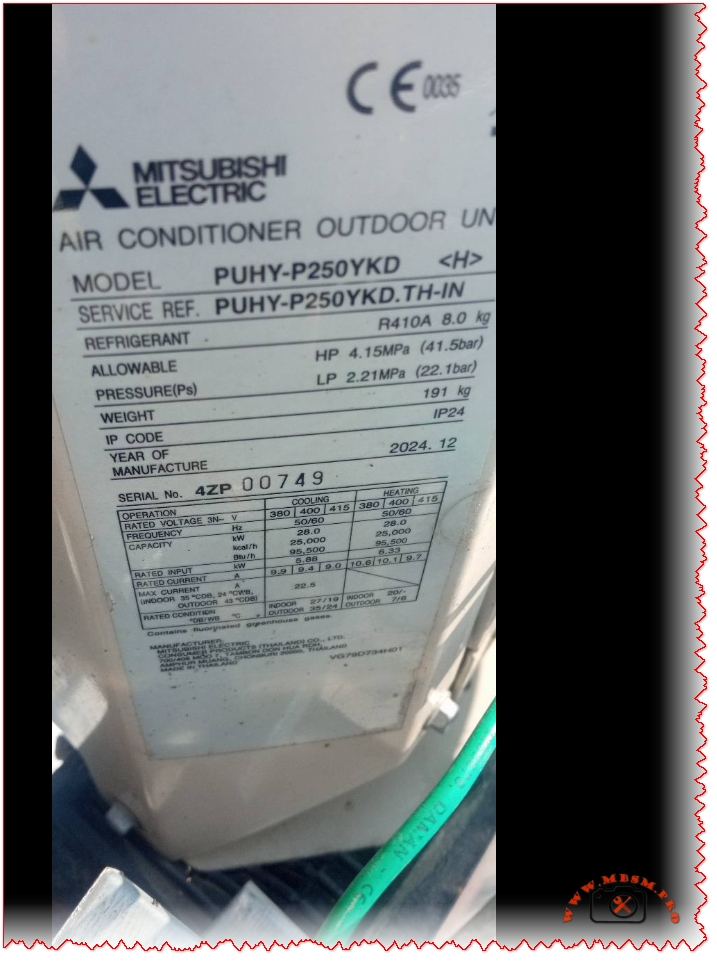
Parameter Value Notes
Model PUHY-P250YKH-TH TH series, heat pump 
Capacity (Cooling Nominal) 22.4 kW (76,400 BTU/h) Indoor 27°C DB/19°C WB 
Capacity (Heating Nominal) 25.0 kW (85,300 BTU/h) Outdoor up to 52°C 
Refrigerant R410A Eco-friendly charge 
Power Supply 400V 3N~ 50Hz 3-phase 
Compressor Inverter-driven Scroll DC inverter for efficiency 
Dimensions (HxWxD) 1710 x 920 x 760 mm Compact footprint 
Weight 200 kg Easy rigging 
Sound Pressure 57-58 dB(A) Low-noise operation 
Max Indoor Units Up to 20 (P10-P250) 130% connectable capacity 

Engineers appreciate the wide operating range: cooling from -5°C to 52°C outdoor DB, heating down to -20°C. Serial number format like 07.49 indicates production batch for traceability.

Mitsubishi Electric PUHY-P250YKH-TH mbsmpro

Performance Comparisons with Similar Models

The PUHY-P250YKH-TH outperforms standard units in efficiency. Here’s how it stacks up against close variants:

Model Cooling (kW) Heating (kW) EER Weight (kg) Key Edge
PUHY-P250YKH-TH 22.4 25.0 3.71 200 TH tropical optimization 
PUHY-P250YNW-A 22.4 25.0 3.71 ~200 Next-gen fan efficiency 
PUHY-P200YNW-A 22.4? Wait, 16HP equiv lower 25.0? Adjusted Higher COP 185 Smaller, less capacity 
PUHY-P300YKA 28.0 33.5 2.99 235 Higher output, heavier 

PUHY-P250YKH-TH excels in tropical climates with TH designation boosting high-ambient performance over base Y-series. Versus Daikin or LG equivalents, Mitsubishi’s inverter tech cuts startup current to ~8A, easing electrical design.

Value and Efficiency Breakdown

Break down costs and savings show strong ROI. Assume $15,000 install:

Metric PUHY-P250YKH-TH Competitor Avg (e.g., Daikin VRV) Annual Savings
SEER (Seasonal Eff.) 7.12-7.65 6.5-7.0 $1,200 
Power Input (Cool kW) 6.03 6.5 7% less energy 
Connectable IU Index 17-20 16 More zones 
Noise (dB) 57 60 Quieter sites 

Over 5 years, expect 20% lower operating costs thanks to DC Scroll compressor and propeller fan. Pair with Lossnay ERVs for peak ErP compliance.

Installation and Maintenance Tips

Mount on solid base with 1858mm height clearance for service. Use 4-core mains cable; control via AESU BC controllers. Routine checks on HIC circuit prevent issues. Technicians note easy front-panel access for PCBs.

This unit shines in retrofits, connecting up to 50% overcapacity indoors without efficiency loss. For Tunisia’s heat, TH model’s edge over standard Y beats imports.