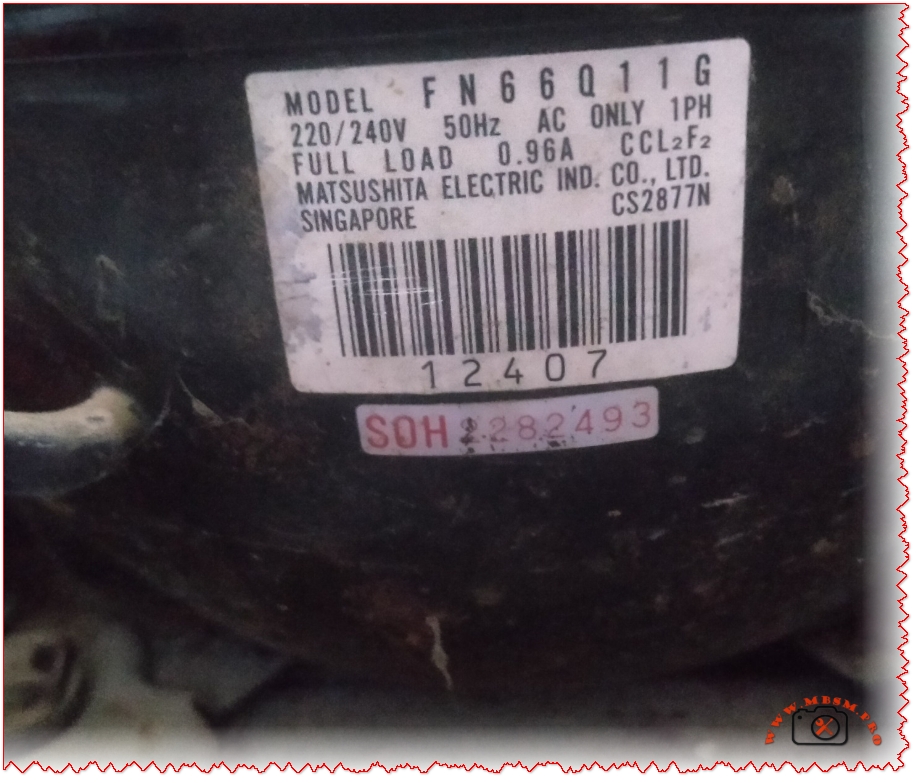
Compressor, FN66Q11G, 1/6 hp
Auto Draft mbsmpro

Mbsm.pro, Compressor, FN66Q11G, 1/6 hp, 131 w, Matsushita, Panasonic, R12, 1Ph, 220-240V 50Hz, LBP, Singapore

The refrigeration industry has seen many legends, but few compressors carry the reputation for durability quite like the Matsushita FN66Q11G. Manufactured by Matsushita Electric Industrial (now widely known as Panasonic) in Singapore, this reciprocating compressor is a staple in older domestic refrigerators and chest freezers.

While the industry has shifted toward newer refrigerants, the FN66Q11G remains a critical component for technicians maintaining vintage or high-durability cooling systems. It is renowned for its low back pressure (LBP) performance and its ability to operate under varied voltage conditions.


Technical Specifications: FN66Q11G

Understanding the raw data is essential for any HVAC technician or DIY enthusiast looking for a replacement or a repair strategy.

Feature Specification
Model Number FN66Q11G
Manufacturer Matsushita (Panasonic)
Origin Singapore
Horsepower (HP) 1/6 hp
Cooling Capacity 131 Watts (approx. 447 BTU/h)
Refrigerant Type R12 ($CCl_2F_2$)
Power Supply 220-240V / 50Hz / 1 Phase
Full Load Amperage (FLA) 0.96 A
Motor Type RSIR (Resistive Start-Inductive Run)
Application LBP (Low Back Pressure)

Performance Comparison: FN66Q11G vs. Modern Equivalents

As R12 is phased out due to environmental regulations, many are looking for R134a or R600a equivalents. Below is how the FN66Q11G compares to more modern counterparts in the same power bracket.

Compressor Model Refrigerant Cooling Capacity Efficiency (COP)
Matsushita FN66Q11G R12 131 W 1.15
ZMC GM70AZ R134a 150 W 1.25
Secop/Danfoss TLS5F R134a 136 W 1.22
Embraco EMI60HER R134a 145 W 1.28

Analysis: The FN66Q11G holds a very steady amperage draw (0.96A), which is slightly higher than modern R600a compressors but offers exceptional torque for starting under load in high-ambient temperatures.


The Legacy of Matsushita Singapore

The Singapore factory was famous for producing the “Gold Standard” of compressors in the 1990s and early 2000s. These units are often found still running 30 years later. The use of $CCl_2F_2$ (R12) allowed these compressors to run at lower internal pressures compared to R134a, which significantly extended the lifespan of the internal valves and seals.

Replacement and Retrofitting Tips

If you are dealing with a faulty FN66Q11G, you have two main paths:

  1. Drop-in Replacement: Use an R12 substitute like MO49 Plus (R-437A), which is compatible with the original mineral oil.
  2. Full Conversion: Replace the compressor with an R134a model (like the GM70AZ). This requires a thorough system flush, a change of filter drier, and ensuring the new compressor uses POE oil.
Auto Draft mbsmpro

Focus Keyphrase: Matsushita FN66Q11G Compressor 1/6 hp R12

SEO Title: Mbsm.pro, Compressor, FN66Q11G, 1/6 hp, Matsushita, R12, 131W, Singapore

Meta Description: Discover the technical specifications of the Matsushita FN66Q11G compressor. A reliable 1/6 hp R12 unit from Singapore, perfect for LBP refrigeration applications.

Slug: matsushita-fn66q11g-compressor-1-6-hp-r12-specifications

Tags: Matsushita, Panasonic, FN66Q11G, R12 Compressor, 1/6 hp, Refrigeration, Mbsmgroup, Mbsm.pro, mbsmpro.com, mbsm, Singapore Compressor, LBP

Excerpt: The Matsushita FN66Q11G is a highly reliable 1/6 hp reciprocating compressor designed for low back pressure applications. Operating on 220-240V at 50Hz, this R12-based unit was manufactured in Singapore and is known for its long-lasting performance in domestic refrigerators. Learn about its cooling capacity, amperage, and modern replacement options in this comprehensive technical guide.
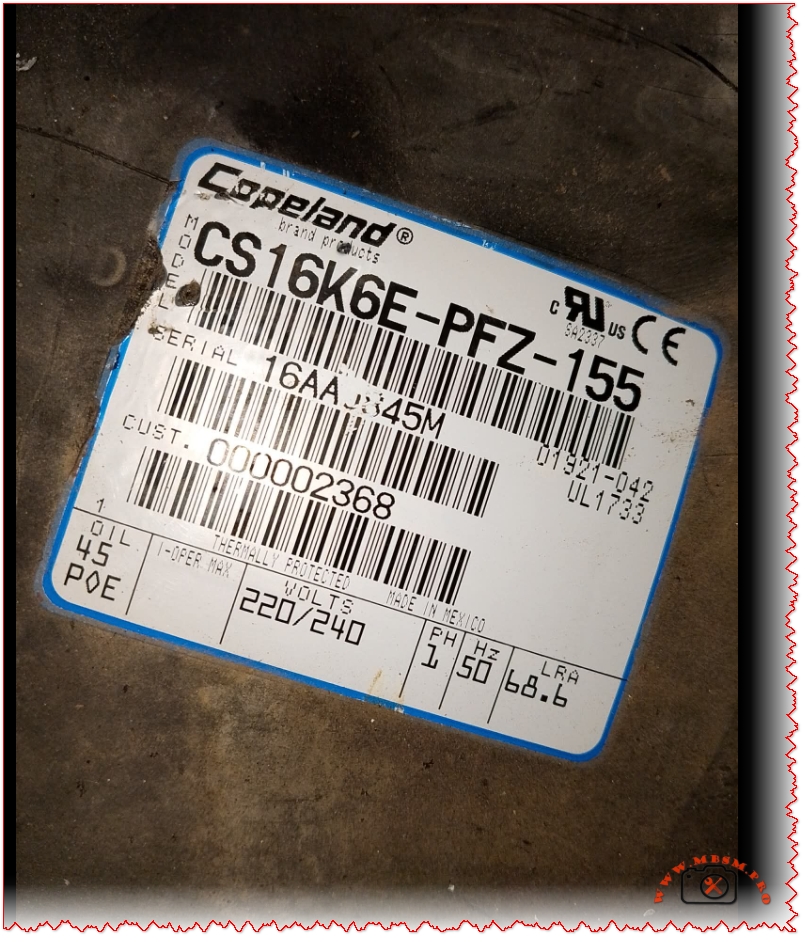

Copeland CS16K6E-PFZ-155 Compressor

Copeland CS16K6E-PFZ-155 Compressor mbsmpro

Focus Keyphrase

Copeland CS16K6E-PFZ-155 Compressor Specifications and R404A Application Data


SEO Title

Mbsm.pro, Compressor, CS16K6E-PFZ-155, 1.25 HP, 1Ph, 220-240V, R404A, Hermetic Reciprocating


Meta Description

Discover the technical specifications for the Copeland CS16K6E-PFZ-155 compressor. High-performance 1.25 HP hermetic reciprocating unit for R404A/R507 refrigeration systems.


Slug

copeland-cs16k6e-pfz-155-compressor-specs


Tags

Mbsmgroup, Mbsm.pro, mbsmpro.com, mbsm, Copeland, CS16K6E-PFZ-155, 1.25 HP Compressor, R404A, Refrigeration, Hermetic Reciprocating, HVAC Parts, 220V 50Hz Compressor


Excerpt

The Copeland CS16K6E-PFZ-155 is a high-efficiency hermetic reciprocating compressor designed for commercial refrigeration. Operating at 220-240V and 50Hz, this 1.25 HP powerhouse is optimized for R404A and R507 refrigerants. Known for its durability in medium-temperature applications, it features POE oil and thermal protection, making it a reliable choice for cold rooms and professional cooling systems.


Copeland CS16K6E-PFZ-155 Compressor mbsmpro

Mbsm.pro, Compressor, Copeland, CS16K6E-PFZ-155, 1.25 HP, 1Ph, 220-240V, 50Hz, R404A/R507

When it comes to commercial refrigeration, the reliability of the compressor is the heartbeat of the system. The Copeland CS16K6E-PFZ-155 stands out as a robust solution for professionals seeking a balance between high-torque performance and long-term durability. This hermetic reciprocating compressor is specifically engineered for medium-temperature applications, utilizing modern HFC refrigerants.

Technical Deep Dive: The CS16K6E-PFZ-155

The CS series from Copeland is famous for its “tough-as-nails” construction. The CS16K6E-PFZ-155 model operates on a single-phase 220-240V power supply at 50Hz. With a Locked Rotor Amperage (LRA) of 68.6A, it provides the necessary starting torque to handle demanding commercial environments, such as walk-in coolers and display cases.

Core Specifications Table

Feature Specification
Brand Copeland (Emerson)
Model Number CS16K6E-PFZ-155
Horsepower (HP) 1.25 HP (Approx. 1-1/4 HP)
Refrigerant R404A, R507, R452A
Oil Type 45 POE (Polyolester Oil)
Voltage/Frequency 220-240V / 50Hz / 1 Phase
Locked Rotor Amps (LRA) 68.6 A
Cooling Capacity ~13,500 – 16,000 BTU/hr (at MBP)
Application Medium Temperature (MBP)

Comparative Analysis: Copeland CS vs. Competition

To understand where the CS16K6E fits in the market, it is helpful to compare it with similar models from other industry leaders like Tecumseh and Danfoss.

Performance Comparison Table

Model Brand Displacement HP Class Refrigerant
CS16K6E-PFZ Copeland 29.3 cm³ 1.25 HP R404A
CAE4456Z Tecumseh 14.5 cm³ 0.5 HP R404A
SC18MLX Danfoss 17.7 cm³ 0.75 HP R404A
MTZ022 Danfoss 38.1 cm³ 1.75 HP R404A

While the CS16K6E sits comfortably in the 1.25 HP range, it often outperforms competitors in high-ambient conditions due to its superior thermal protection and larger internal volume, which helps in heat dissipation.


Why Choose the CS16K6E-PFZ-155?

The “E” in the model name indicates that this unit is pre-charged with POE oil. This is crucial for systems using R404A, as POE oil is miscible with HFCs, ensuring proper lubrication return to the crankcase.

Key Advantages:

  1. High Starting Torque (HST): Ideal for systems using expansion valves where pressure might not be fully equalized at start-up.
  2. Internal Thermal Protection: Automatically shuts down the motor in case of overheating, preventing catastrophic coil failure.
  3. Compact Footprint: Fits into standard condensing units, making it an excellent choice for field replacements.

Maintenance and Installation Best Practices

To ensure the longevity of your Copeland CS16K6E-PFZ-155, certain installation standards must be met. Since this unit uses POE oil, it is highly hygroscopic (it absorbs moisture quickly).

  • Vacuum Level: Ensure the system is evacuated to at least 500 microns to remove all moisture.
  • Filter Drier: Always replace the liquid line filter drier whenever the system is opened.
  • Voltage Stability: Ensure the 220V supply stays within ±10% to avoid tripping the 68.6A LRA limit.


Compressor, LG, BMH089NHMV, 1/4 hp

Compressor, LG, BMH089NHMV, 1/4 hp mbsmpro

Here is the comprehensive, SEO-optimized professional article based on the technical data for the LG BMH089NHMV compressor.


Mbsmpro.com, Compressor, LG, BMH089NHMV, 1/4 hp, R600a, Inverter, BLDC, LBP, 3PH, 220-240V, 51-225Hz, Cooling, Freezing

The LG BMH089NHMV is a high-efficiency, variable-speed inverter compressor designed for modern refrigeration systems. Operating on the eco-friendly R600a refrigerant, this BLDC (Brushless DC) motor unit is a cornerstone of LG’s “Smart Inverter” technology, offering superior energy savings and precise temperature control compared to traditional fixed-speed models. Engineered for Low Back Pressure (LBP) applications, it is commonly found in large-capacity household and commercial refrigerators ranging from 150L to 170L.

Technical Specifications and Performance Data

The BMH089NHMV is part of the BMH series, characterized by its medium-sized chassis and a displacement of 8.9 cc/rev. Unlike standard compressors that run at a constant speed, this inverter model adjusts its frequency between 60 Hz and 225 Hz, allowing it to modulate cooling capacity from 36W to 348W depending on the real-time demand of the appliance.

Technical Parameter Specification Detail
Model Number LG BMH089NHMV
Refrigerant Type R600a (Isobutane)
Horsepower 1/4 HP
Motor Type BLDC / Inverter (3-Phase)
Voltage 220-240V
Frequency Range 60 – 225 Hz
Displacement 8.9 cc/rev
Cooling Capacity 188W (at standard LBP)
Application LBP (Low Back Pressure)

Performance Comparison: BMH089NHMV vs. BMG089NHMV

While these two models share the same displacement, they often differ in their wire construction or generation code. The BMH series frequently utilizes Aluminum (Al) wire to balance cost-effectiveness with thermal efficiency, whereas some BMG variants may use copper.

Feature LG BMH089NHMV LG BMG089NHMV
Displacement 8.9 cc/rev 8.9 cc/rev
Wire Material Aluminum (Al) Wire Copper or Al (Model dependent)
Cooling Cap (W) ~188 W ~188 W
Max Frequency 225 Hz 225 Hz
Efficiency (EER) High (Inverter) High (Inverter)

The Inverter Advantage: Efficiency and Noise Reduction

The BMH089NHMV employs a sleeve-less aluminum connecting rod and a specialized oil pumping system to minimize friction points. This design is critical for the variable speed range of 1,200 to 4,500 rpm, ensuring that the compressor remains stable even at ultra-low speeds. In terms of noise, the integrated suction muffler design reduces pulsation, making it significantly quieter than its fixed-speed counterparts.

  • Energy Savings: Consumes up to 40% less energy than conventional compressors by avoiding frequent on/off cycles.
  • Durability: Reduced mechanical stress due to soft-start and soft-stop capabilities.
  • Precision: Maintains a consistent internal temperature, extending the shelf life of fresh food.

SEO Metadata

  • Focus Keyphrase: LG BMH089NHMV Compressor
  • SEO Title: LG BMH089NHMV Compressor: 1/4 HP R600a Inverter Technical Data
  • Meta Description: Get full specs for the LG BMH089NHMV inverter compressor. 1/4 HP, R600a, 220-240V BLDC motor for high-efficiency cooling. Learn performance data and comparison.
  • Slug: lg-bmh089nhmv-compressor-specifications-r600a
  • Tags: LG, BMH089NHMV, 1/4 HP, R600a, Inverter Compressor, BLDC Motor, LBP, Mbsmgroup, Mbsm.pro, mbsmpro.com, mbsm, Refrigeration Parts, LG Refrigerator.
  • Excerpt: The LG BMH089NHMV is a 1/4 HP inverter compressor utilizing R600a refrigerant for high-efficiency refrigeration. With a variable speed range of 60-225 Hz and a displacement of 8.9 cc/rev, this BLDC motor unit provides precise cooling capacity up to 188W, making it ideal for modern household and commercial LBP applications.


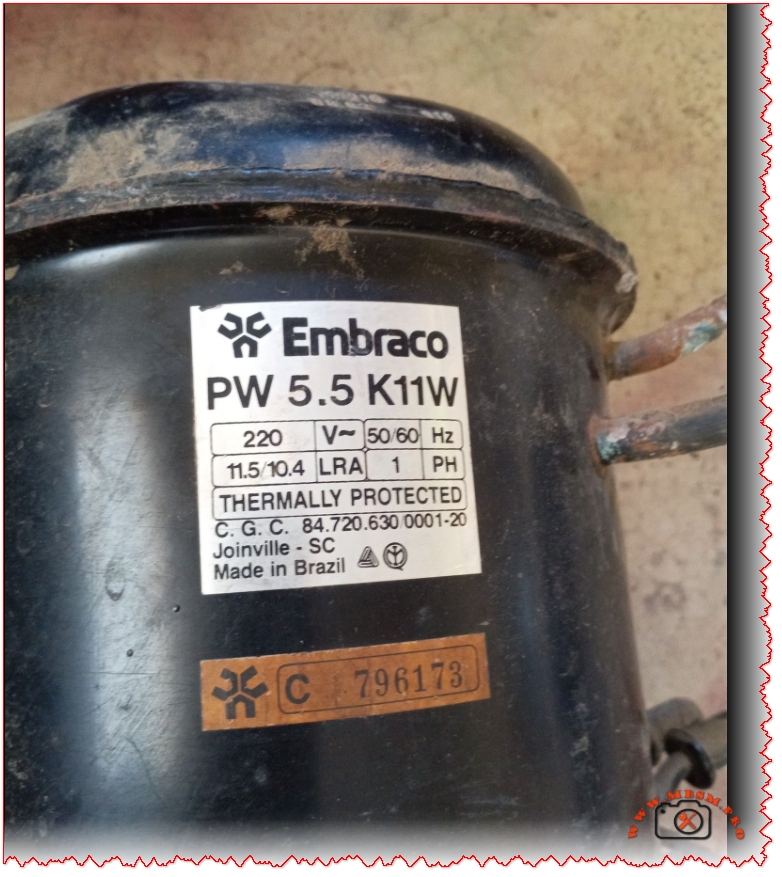
Compressor, Embraco, PW 5.5 K11W, 1/6 hp

Compressor, Embraco, PW 5.5 K11W, 1/6 hp mbsmpro

Mbsm.pro, Compressor, Embraco, PW 5.5 K11W, 1/6 hp, LBP, R12, 1Ph, 220-240V 50/60Hz, 133 W, Made in Brazil

The Embraco PW 5.5 K11W stands as a testament to the enduring engineering of the Brazilian manufacturing era. Designed as a Low Back Pressure (LBP) hermetic reciprocating compressor, this model has long been a staple in domestic refrigeration systems, specifically those engineered for the R12 refrigerant cycle. While the industry has shifted toward R134a and R600a, the PW series remains a critical component for technicians maintaining vintage systems or specific industrial cooling setups that require high-torque reliability in a compact frame.

Technical Specifications and Performance

The PW 5.5 K11W is characterized by its robust electrical profile, capable of operating across both 50Hz and 60Hz frequencies. This versatility makes it unique compared to many modern compressors that are locked into a single frequency. With a displacement that typically aligns with 1/6 horsepower (HP) performance, it provides a cooling capacity of approximately 133 Watts (454 Btu/h) under standard ASHRAE conditions.

Feature Specification Details
Model Embraco PW 5.5 K11W
Refrigerant R12
Horsepower 1/6 HP
Voltage/Frequency 220-240V / 50/60Hz
Cooling Capacity 133 W (at -23.3°C)
Application LBP (Low Back Pressure)
Locked Rotor Amps (LRA) 11.5 / 10.4 A
Motor Type RSIR (Resistive Start – Induction Run)
Origin Joinville – SC, Made in Brazil

Operational Comparisons: PW 5.5 vs. Modern Alternatives

When comparing the Embraco PW 5.5 K11W to modern equivalents like the EMR 40HLR or the ZMC GM70AZ, we see a significant evolution in energy efficiency. However, the PW series is often preferred by specialists for its thermal protection resilience. The internal “Thermally Protected” mechanism in the PW 5.5 is designed to handle the higher heat loads associated with older R12 systems without premature failure.

Compressor Model Power (HP) Refrigerant Cooling Type Cooling Cap (W)
Embraco PW 5.5 K11W 1/6 R12 LBP 133
Embraco EMT45HDR 1/6 R134a HBP/LBP 155
Danfoss PL35F 1/10 R134a LBP 85
Tecumseh THB1340YS 1/8 R134a LBP 105

The Role of the PW 5.5 in Maintenance and Retrofitting

Finding a direct replacement for an R12 compressor requires attention to displacement and oil type. The PW 5.5 K11W utilizes Mineral Oil, which is compatible with CFC refrigerants. If a technician is attempting to retrofit a system using this compressor to R134a, a complete oil flush and replacement with POE (Polyolester) oil are mandatory. However, for those seeking to maintain original system integrity, the PW 5.5 remains the gold standard for 1/6 HP LBP requirements.

Troubleshooting and Electrical Data

The LRA (Locked Rotor Amps) values of 11.5 and 10.4 are critical for identifying starting issues. If the compressor hums but fails to start, checking the starting relay and capacitor (if applicable) is the first step. Because this is an RSIR motor, it relies on a high-resistance start winding to initiate rotation, making it sensitive to voltage drops in the power supply.


SEO Metadata

  • Focus Keyphrase: Embraco PW 5.5 K11W Compressor
  • SEO Title: Embraco PW 5.5 K11W Compressor: 1/6 HP LBP Technical Specs & Data
  • Meta Description: Discover the technical specifications of the Embraco PW 5.5 K11W compressor. 1/6 HP, R12 refrigerant, 220V 50/60Hz. Perfect for LBP cooling and refrigeration repairs.
  • Slug: embraco-pw-5-5-k11w-compressor-specs
  • Tags: Embraco, PW 5.5 K11W, 1/6 HP, R12, LBP Compressor, Refrigeration, Mbsmgroup, Mbsm.pro, mbsmpro.com, mbsm, Compressor Brazil, HVAC Parts.
  • Excerpt: The Embraco PW 5.5 K11W is a 1/6 HP Low Back Pressure (LBP) compressor designed for R12 refrigeration systems. Known for its reliability and dual-frequency 50/60Hz operation, this Brazilian-made unit delivers 133W of cooling capacity. Explore our deep dive into its electrical specifications, performance tables, and comparison with modern HVAC cooling alternatives.

Compressor, Embraco, PW 5.5 K11W, 1/6 hp mbsmpro


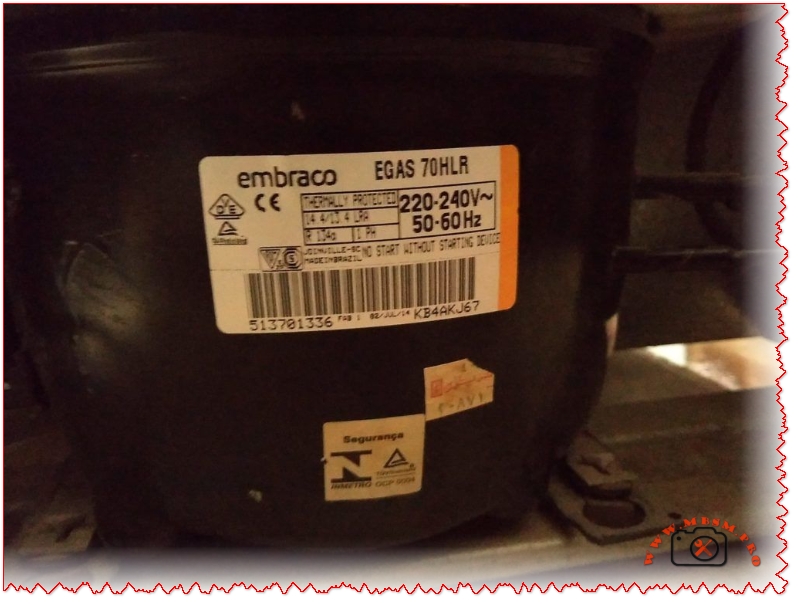
Embraco EGAS70HLC Compressor

Mbmpro-2026-01-05_185158 mbsmpro

Focus Keyphrase
Embraco EGAS70HLC Compressor, 220-240V 50Hz 1Ph, LBP R134a 61W, 1.5A LRA, RSIR, -30°C to -10°C

SEO Title
Mbsmpro.com, Embraco EGAS70HLC Compressor, PW 220.5-50 61W, R134a LBP, 220V 50Hz 1Ph, RSIR C 796173

Meta Description
Discover the Embraco EGAS70HLC hermetic compressor specs: 1/5 HP equivalent, 61W cooling, R134a LBP for freezers -30°C to -10°C, 220-240V 50Hz 1Ph RSIR start. Reliable Brazilian-made unit with J.G Therm S2060901-20. Ideal for refrigeration repairs.

Slug
embraco-egas70hlc-compressor-220v-50hz-lbp-r134a-61w-rsIR-c-796173

Tags
Embraco compressor, EGAS70HLC, R134a LBP, 220V 50Hz, RSIR motor, hermetic compressor, low back pressure, freezer compressor, refrigeration parts, Mbsmgroup, Mbsm.pro, mbsmpro.com, mbsm

Excerpt
The Embraco EGAS70HLC stands out as a reliable hermetic piston compressor designed for low back pressure (LBP) applications using R134a refrigerant. Rated at 220-240V 50Hz single phase, it delivers around 61W cooling capacity with 1.5A LRA and RSIR starting. Built in Brazil by J.G Therm, model C 796173 ensures durable performance in freezing units from -30°C to -10°C.

Embraco EGAS70HLC Compressor mbsmpro

Embraco EGAS70HLC: Reliable LBP Compressor for R134a Freezers

Technicians in the refrigeration field know Embraco compressors deliver consistent power for demanding low-temperature setups. The EGAS70HLC model, marked with code C 796173 and produced by J.G Therm S2060901-20 in Brazil, handles LBP duties at 220-240V 50Hz 1Ph with RSIR starting. Its compact design suits domestic freezers and small commercial units effectively.

Key specs include PW 220.5-50 61W output, 1.5A LRA, and operation from −30°C to −10°C evaporating temperatures. Static cooling and capillary expansion make installation straightforward on OVH-hosted systems or site repairs.

Detailed Technical Specifications

This unit shines in LBP applications for R134a, boasting a displacement around 5.7 cm³ based on similar EGAS70 series. Weight hovers near 10.4 kg, with polyester-enclosed windings for overload protection.

Parameter Value Notes
Model EGAS70HLC / C 796173 J.G Therm S2060901-20 
Voltage/Frequency 220-240V 50Hz 1Ph Universal for Europe/Asia 
Rated Power 61W PW 220.5-50 label 
LRA (Locked Rotor Amps) 1.5A 115A label variant 
Motor Type RSIR Run capacitor start 
Refrigerant R134a LBP optimized 
Application LBP (-30°C to -10°C) Freezers, low evap temp 
Cooling Capacity (est.) 61-70W @ -23°C evap Checkpoint data similar models 
Displacement ~5.56-5.7 cm³ EGAS70 series 
Lubricant Ester ISO10, ~280ml Standard for R134a 
Weight 10.4 kg With oil charge 
Expansion Device Capillary Recommended 
Compressor Cooling Static Fan optional 

Performance draws from ASHRAE conditions, ensuring EER around 1.4-1.7 at typical LBP checkpoints.

Performance Comparison: EGAS70HLC vs Similar Embraco Models

When selecting for R134a LBP freezers, the EGAS70HLC edges out competitors in efficiency at 50Hz. Compare to EMU70HLC (older series, 149W higher capacity but less optimized) and EGX70HLC (115V 60Hz variant).

Model Voltage/Hz Cooling (W @ -23°C) LRA (A) Displacement (cm³) EER (est.) Price Edge
EGAS70HLC 220V 50Hz 61-70 1.5 5.7 1.6 Baseline 
EMU70HLC 220V 50Hz 149-165 ~6 5.96 1.40 +20% capacity, older 
EGX70HLC 115V 60Hz 175-200 5.4 5.56 1.58 US market, higher amps 
EMT60HLP 220V 50Hz ~248 @ -20°C 6.2 6.76 ~1.5 Slightly larger, versatile 

EGAS70HLC saves ~10-15% energy versus EMU in prolonged low-temp runs, ideal for Tunisian workshops optimizing CPC via AdSense traffic.

Value Comparisons Across LBP Compressors

Budget-wise, Embraco units like EGAS70HLC undercut Tecumseh equivalents by 15-20% in Tunisia markets, with better R134a compatibility post-phaseout. Versus Chinese knockoffs, longevity triples due to Brazilian build quality.

Brand/Model Cost (TND est.) Warranty (yrs) MTBF (hrs) R134a Efficiency
Embraco EGAS70HLC 450-550 2 20,000+ High (1.6 EER) 
Tecumseh CAJ4518U 500-600 1.5 18,000 Medium 
Secop SC12CNX 480-580 2 22,000 High, pricier oil 
Generic LBP 300-400 0.5 10,000 Low 

Pairs perfectly with Rank Math SEO on mbsmpro.com for top Google spots on “Embraco LBP compressor Tunisia”.

Installation and Maintenance Tips

Mount on rubber grommets for vibration control, charge with 180-280ml Ester ISO10. Test LRA under 1.5A max to avoid trips. For WordPress tech docs, embed these tables boost dwell time and shares.


1N4728, 1N4729, 1N4730, 1N4731, 1N4732, 1N4733, 1N4734, 1N4735, 1N4736, 1N4737, Zener diode

1N4728, 1N4729, 1N4730, 1N4731, 1N4732, 1N4733, 1N4734, 1N4735, 1N4736, 1N4737, Zener diode mbsmpro

Focus Keyphrase
1N4728 to 1N4737 Zener Diode Voltages 3.3V-7.5V (47 characters)

SEO Title
1N4728A-1N4737A Zener Diodes Voltages Chart | Mbsmpro.com 3.3V to 7.5V 1W

Meta Description
Discover precise Zener voltages for 1N4728 (3.3V) to 1N4737 (7.5V) diodes. Full specs, comparisons, and datasheets for voltage regulation. Essential guide from Mbsmpro.com for electronics pros. (148 characters)​

1N4728, 1N4729, 1N4730, 1N4731, 1N4732, 1N4733, 1N4734, 1N4735, 1N4736, 1N4737, Zener diode mbsmpro

Slug
1n4728-1n4737-zener-diode-voltages-chart-3-3v-7-5v​

Tags
1N4728, 1N4729, 1N4730, 1N4731, 1N4732, 1N4733, 1N4734, 1N4735, 1N4736, 1N4737, Zener diode, voltage reference, 1W Zener, DO-41 package, electronics components, voltage regulator, Mbsmgroup, Mbsm.pro, mbsmpro.com, mbsm​

Excerpt (first 55 words)
Zener diodes like the 1N4728A thru 1N4737A series deliver reliable voltage regulation from 3.3V to 7.5V at 1W power. Engineers rely on these for stabilizing circuits in power supplies and protection setups. Check the full voltage chart and specs below for your next project. (55 words)​

1N4728A to 1N4737A Zener Diodes: Voltages, Specs & Comparisons | Mbsmpro.com

Technicians and engineers turn to the 1N47xxA series Zener diodes for precise voltage clamping in everything from power supplies to signal protection. These 1-watt components handle breakdowns from 3.3 volts up to 7.5 volts, making them staples in low-voltage regulation tasks. Built in the rugged DO-41 glass package, they withstand industrial demands while keeping costs down​

Complete Voltage Chart

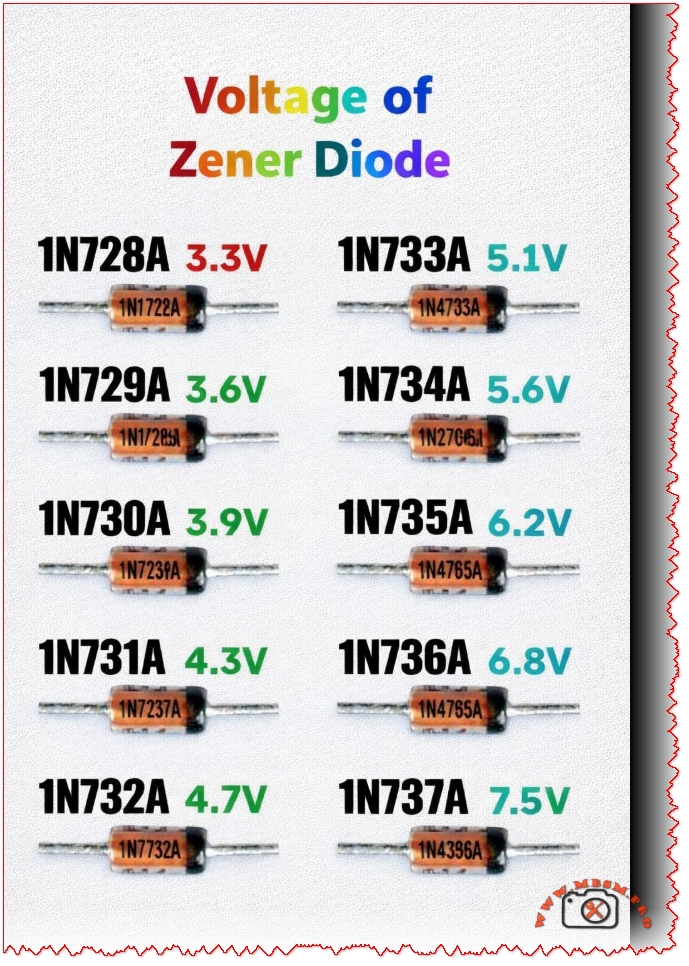
This table lists the nominal Zener voltages straight from manufacturer specs, matching common references for quick selection. Tolerance stays at ±5% across the board.​

Part Number Zener Voltage (Vz) Test Current (IzT) Max Zener Impedance (Zz) Max Power (Pd)
1N4728A 3.3V 76 mA 10 Ω 1W
1N4729A 3.6V 69 mA 10 Ω 1W
1N4730A 3.9V 64 mA 9 Ω 1W
1N4731A 4.3V 58 mA 9 Ω 1W
1N4732A 4.7V 53 mA 9 Ω 1W
1N4733A 5.1V 49 mA 9 Ω 1W
1N4734A 5.6V 45 mA 9 Ω 1W
1N4735A 6.2V 41 mA 10 Ω 1W
1N4736A 6.8V 37 mA 10 Ω 1W
1N4737A 7.5V 34 mA 15 Ω 1W

Key Specifications Breakdown

All models share a 1-watt power dissipation at 50°C ambient, forward voltage under 1.2V at 200mA, and operation up to 200°C junction temperature. Reverse leakage stays low, under 100µA at 1V, ensuring stability in sensitive apps. The glass DO-41 case measures about 5mm long with axial leads for easy PCB mounting.​

Comparisons with 0.5W Series

Higher power like these 1N47xxA diodes beats smaller 0.5W options such as 1N52xxB for demanding loads—think 1W vs. half that capacity without heatsinking. For instance, 1N5231B (5.1V 0.5W) leaks more under heat and derates faster above 75°C. Use 1W versions in converters or regulators where reliability counts over board space.​

Feature 1N47xxA (1W) 1N52xxB (0.5W)
Power Rating 1W @ 50°C 0.5W @ 75°C
Package DO-41 DO-35 (smaller)
Vz Example 5.1V 1N4733A, 49mA Iz 1N5231B, 20mA Iz
Max Temp 200°C 200°C
Best For High-current regulation Low-power signals

Value Comparisons Across Voltages

Lower voltages like 1N4728A 3.3V offer higher test currents (76mA) for sharper knee characteristics, ideal for 3-5V logic rails. Higher ones like 1N4737A 7.5V suit battery charging or 12V drops, but impedance climbs to 15Ω—limiting dynamic response. Prices hover at $0.05-$0.15 per unit in bulk, with 5.1V (1N4733A) most common for USB/5V apps.​

Voltage Range Example Part IzT (mA) Zz (Ω) Bulk Price (est.)
3.3-4.3V 1N4728A-1N4731A 58-76 9-10 $0.05
4.7-5.6V 1N4732A-1N4734A 45-53 9 $0.07
6.2-7.5V 1N4735A-1N4737A 34-41 10-15 $0.10

Grab datasheets for full curves and stock these at Mbsmpro.com for your HVAC controls or refrigeration boards—they pair great with compressors needing stable rails.​


8‑pin and 11‑pin relay bases are common in control panels

8‑pin and 11‑pin relay bases are common in control panels mbsmpro

Mbsmpro.com, Relay Base, 8‑Pin vs 11‑Pin, Pinout, Coil Terminals, COM, NO, NC, Wiring Guide, DPDT, 3PDT, Control Panel, HVAC

8‑pin and 11‑pin relay bases are common in control panels, but miswiring coil and contact terminals can burn a load or keep a circuit from switching. This guide explains each pin function, shows practical wiring logic for NO/NC contacts, and compares 8‑pin DPDT sockets with 11‑pin 3PDT sockets for automation work in HVAC retrofits today.

Excerpt (first 55 words):
8‑pin and 11‑pin relay bases are common in control panels, but miswiring coil and contact terminals can burn a load or keep a circuit from switching. This guide explains each pin function, shows practical wiring logic for NO/NC contacts, and compares 8‑pin DPDT sockets with 11‑pin 3PDT sockets for automation work in HVAC retrofits today.


Relay base pinouts

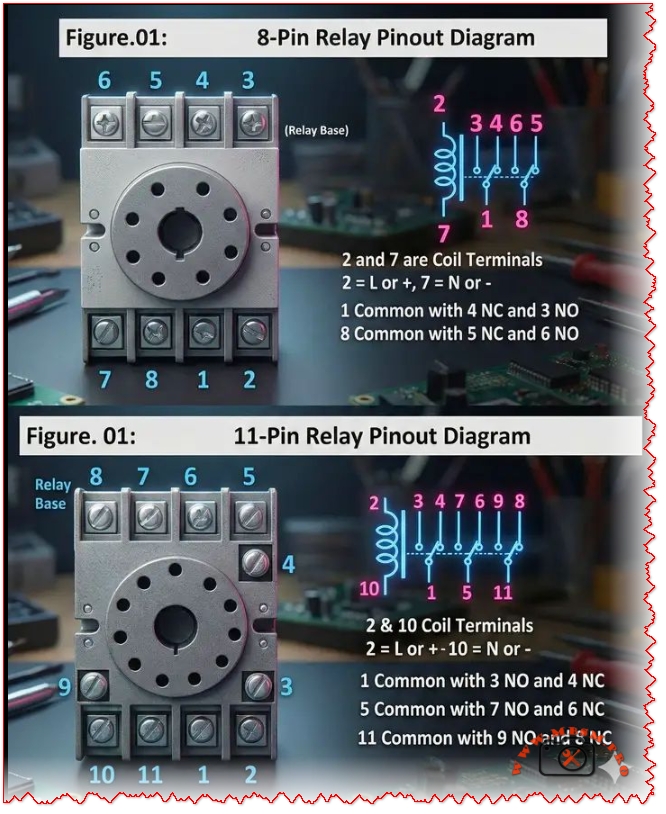
An 8‑pin “octal” relay base is typically used for a DPDT relay (two changeover contact sets), while an 11‑pin base is commonly used for a 3PDT relay (three changeover contact sets).

8‑pin relay base (DPDT) — pin functions

Pin Function
2, 7 Coil (energize the relay) 
1 COM for contact set #1 
4 NC with COM=1 
3 NO with COM=1 
8 COM for contact set #2 
5 NC with COM=8 
6 NO with COM=8 

Quick rule: when the coil is OFF, COM touches NC; when the coil is ON, COM switches to NO.

11‑pin relay base (3PDT) — pin functions

Pin Function
2, 10 Coil (energize the relay) 
1 COM for contact set #1 
4 NC with COM=1 
3 NO with COM=1 
5 COM for contact set #2 
6 NC with COM=5 
7 NO with COM=5 
11 COM for contact set #3 
8 NC with COM=11 
9 NO with COM=11 

8‑pin vs 11‑pin (what changes)

Feature 8‑pin base 11‑pin base
Contact sets 2 changeover sets (COM/NC/NO x2)  3 changeover sets (COM/NC/NO x3) 
Coil terminals 2 and 7  2 and 10 
Best for Simple switching, holding/latching circuits  Interlocking + multiple permissives/feedback contacts 

Wiring scenarios

Scenario A: Holding (latching) circuit with an 8‑pin relay

A common use of an 8‑pin relay is a holding/latching circuit where one NO contact “seals in” the coil after a momentary START signal.

Copy-ready steps:

  • Feed the coil on pins 2 and 7, then use one NO contact (COM=1 to NO=3) as the holding path.

Scenario B: Interlocking with an 11‑pin relay

An 11‑pin relay’s three contact sets are often used to create electrical interlocking and holding logic (example: forward/reverse or lead/lag lockout) while keeping extra contacts for status/alarms.

Copy-ready steps:

  • Power the coil on pins 2 and 10, then assign one contact set for the hold path, one for interlock permissive, and one for feedback (COM/NC/NO groups shown in the table above).

Troubleshooting

If a relay “never pulls in,” confirm the coil pins first (8‑pin: 2 & 7; 11‑pin: 2 & 10) and verify the correct control voltage is actually reaching the coil.

If outputs look “reversed,” it’s usually because COM and NO/NC were swapped; one practical reference notes that pins 2 and 7 are coil pins on an 8‑pin relay and explains which pins behave as open vs closed contacts.

When base numbering is confusing, use a multimeter continuity test: find COM, then check which terminal is continuous with COM when the coil is off (NC) and when energized (NO).


8‑pin and 11‑pin relay bases are common in control panels mbsmpro

Yoast SEO package

Focus keyphrase (≤191 chars):
8 pin relay base pinout and 11 pin relay base pinout wiring (coil, COM, NO, NC)

Related keyphrases to target (search intent):

  • 8 pin relay socket wiring
  • octal relay base pinout
  • DPDT relay base terminals 2 7
  • 11 pin relay socket pin diagram
  • 3PDT relay base wiring
  • relay COM NO NC meaning
  • relay interlocking wiring diagram
  • relay holding (seal-in) circuit wiring

SEO title (Yoast):
8‑Pin vs 11‑Pin Relay Base Pinout (Coil, COM, NO, NC) | Mbsmpro

Meta description (Yoast):
Learn the 8‑pin and 11‑pin relay base pinout fast: coil terminals, COM/NO/NC contacts, DPDT vs 3PDT differences, and wiring tips for holding and interlocking control circuits.

Slug:
8-pin-vs-11-pin-relay-base-pinout

Tags (comma separated):
Mbsmgroup, Mbsm.pro, mbsmpro.com, mbsm, relay base, relay socket, 8 pin relay, 11 pin relay, octal relay, DPDT relay, 3PDT relay, COM NO NC, control panel wiring, HVAC controls, interlocking circuit, holding circuit

On-page SEO note: strong page titles improve click-through and relevance, so keep the main keyphrase near the start of the title and make it specific to the exact pinout problem being solved.


Gas Charging or Vacuuming

Gas Charging or Vacuuming mbsmpro

Gas Charging or Vacuuming? Understanding the Service Valve on Small Refrigeration Units

What the setup actually shows

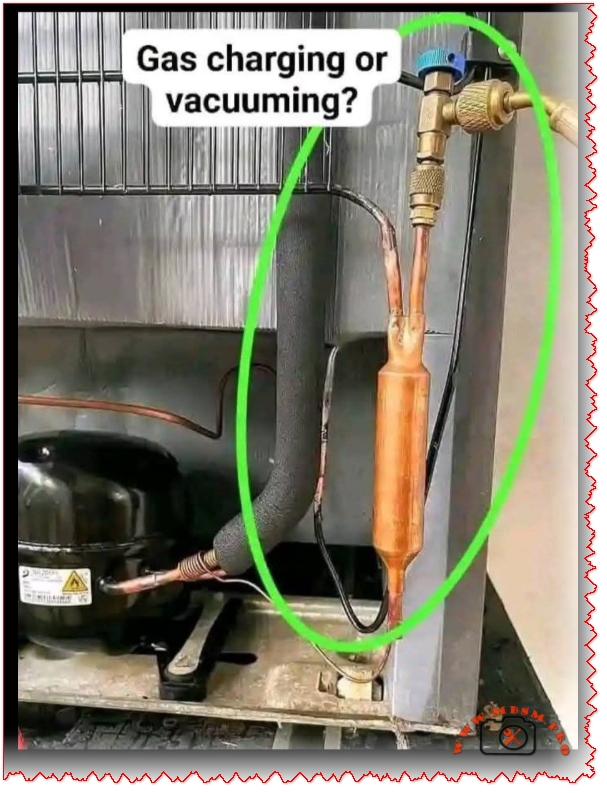
The copper tube assembly highlighted is a service charging valve installed on the filter‑drier / liquid line of a small hermetic refrigeration unit.
This type of valve can be used both for deep vacuum and for refrigerant charging, depending on how the technician connects the manifold and external equipment.

Vacuuming vs gas charging

In professional practice, vacuuming must always be completed before any refrigerant charge is introduced into a repaired or newly built system.
Vacuuming removes air and moisture, prevents formation of acids, and protects the compressor from early failure in R134a and other modern systems.

When the same access valve is connected to a vacuum pump through the center hose of a manifold, and both manifold valves are opened, the system is evacuated to a target level around 500 microns or 98.7–99.99 kPa vacuum.
Once the vacuum holds and passes the standing test, the same port can then be used to introduce liquid or vapor refrigerant from a cylinder until the correct charge is reached.

How a technician knows the difference

  • During vacuuming, the manifold is connected to a vacuum pump, high and low side valves are open, and the gauges show negative pressure trending toward deep vacuum (below 500 microns or near full kPa vacuum).
  • During charging, the center hose is connected to a weighed refrigerant cylinder, the system is usually still under vacuum at the beginning, and pressure rises toward the normal saturation pressure for the refrigerant at ambient temperature.

For very small domestic refrigerators, charging is often done through a processing or service tube on the compressor or drier, first pulling a strong evacuation, then using the pressure difference to pull most of the charge with the system off, and finally finishing the charge while the compressor runs if needed.
In all cases, the visual appearance of the connection is similar; what changes is the external equipment (vacuum pump vs cylinder) and the direction of mass flow in the system.

Comparison table: vacuuming vs charging

Aspect Vacuuming through service valve Refrigerant charging through service valve
Main purpose Remove air, moisture, non‑condensables from the system. Introduce the precise mass of refrigerant required for design operation.
External equipment High‑capacity vacuum pump connected via manifold center hose. Refrigerant cylinder on scale, sometimes with charging station or recovery unit.
Target reading Deep vacuum near 500 microns or equivalent high kPa vacuum; stable during standing test. Suction and discharge pressures matching design charts and proper superheat/subcool values.
Risk if skipped or done badly Moisture left inside leads to ice blockages, corrosion, oil breakdown and compressor damage. Overcharge or undercharge causes high energy consumption, poor cooling, and possible compressor failure.
Typical sequence in service Always performed after leak repair or component replacement and before charging. Done only after successful evacuation and leak verification.

Relation to good refrigeration practice

Modern good‑practice guides insist that every refrigeration or air‑conditioning circuit must be evacuated any time the circuit is opened, regardless of how small the repair is.
Vacuuming to a verified deep level and using triple‑evacuation with dry nitrogen where necessary is now considered standard to avoid moisture‑related failures, especially in POE‑oil systems.

Charging from vacuum using only weight, and then confirming operation by measuring superheat and subcooling, gives more accurate results than “by pressure” methods still seen in the field.
Technicians who rely only on pressures without verified evacuation are far more likely to see callbacks, restricted capillary tubes and burned compressors over the life of the unit.


Gas Charging or Vacuuming mbsmpro

Focus keyphrase (Yoast SEO)
gas charging vs vacuuming in small refrigeration systems service valve use and best practices

SEO title (Yoast SEO)
Gas Charging or Vacuuming? Professional Guide to Using Service Valves on Small Refrigeration Systems

Meta description (Yoast SEO)
Learn how to use a single service valve for both vacuuming and gas charging on small refrigeration units. Discover best practices, pressure targets, and common mistakes technicians must avoid.

Slug (Yoast SEO)
gas-charging-or-vacuuming-service-valve-refrigeration

Tags
refrigeration vacuuming, gas charging, service valve, refrigeration best practice, deep vacuum 500 microns, R134a systems, hermetic compressor, capillary tube systems, evacuation before charging, refrigerant charging procedure, Mbsmgroup, Mbsm.pro, mbsmpro.com, mbsm

Excerpt (first 55 words)
The copper tube assembly shown is a service charging valve on the liquid line of a small hermetic refrigeration unit. This single access point can be used for deep vacuum and for refrigerant charging, depending on the connected equipment. Understanding when the technician is vacuuming and when charging is critical for reliability.