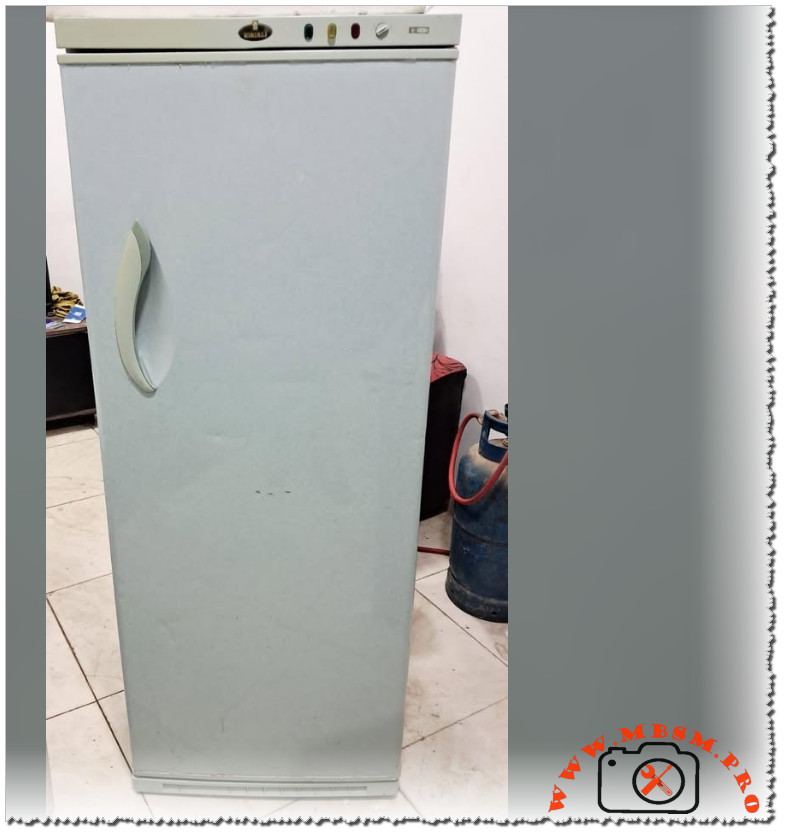
Electrostar 16 foot refrigerator 1/6 HP compressor 125W top freezer Mbsmgroup
Electrostar 16 foot refrigerator 1/6 HP compressor 125W top freezer Mbsmgroup

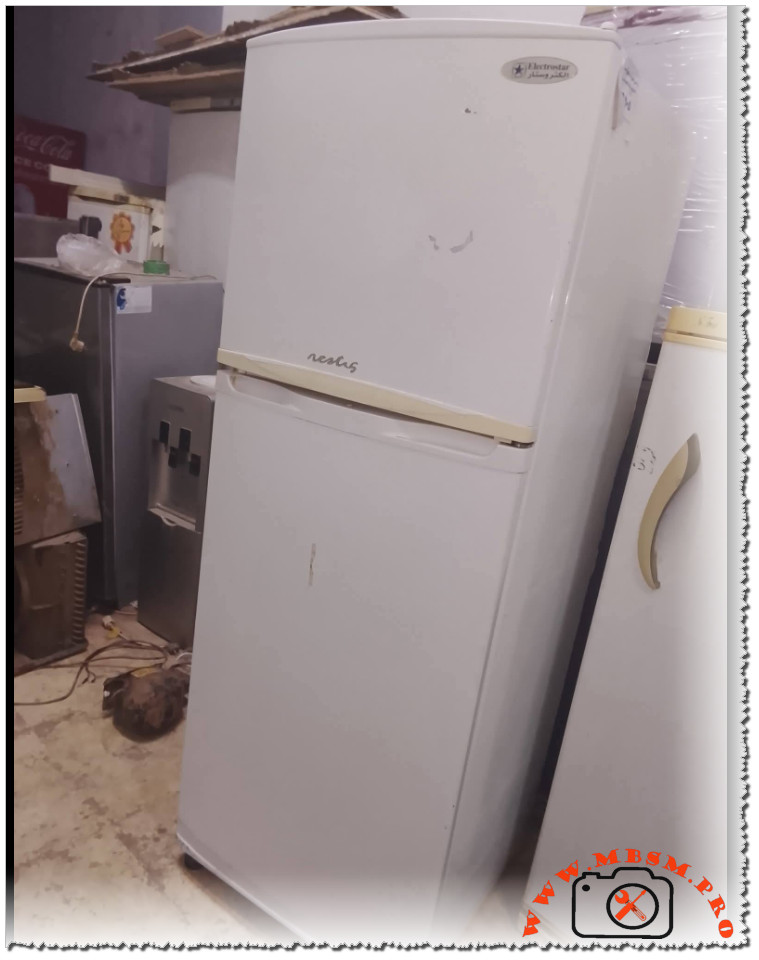
Electrostar 16‑Foot Refrigerator: Reliable Cooling With Efficient Compressor Power

The Electrostar 16‑foot refrigerator remains a practical choice for families who want robust cooling, straightforward controls and serviceable components rather than complex smart features. With a capacity around 315–330 liters and a compact footprint, it suits medium‑size kitchens while its small‑horsepower compressor keeps electricity consumption under control in hot climates.

Design, capacity and layout

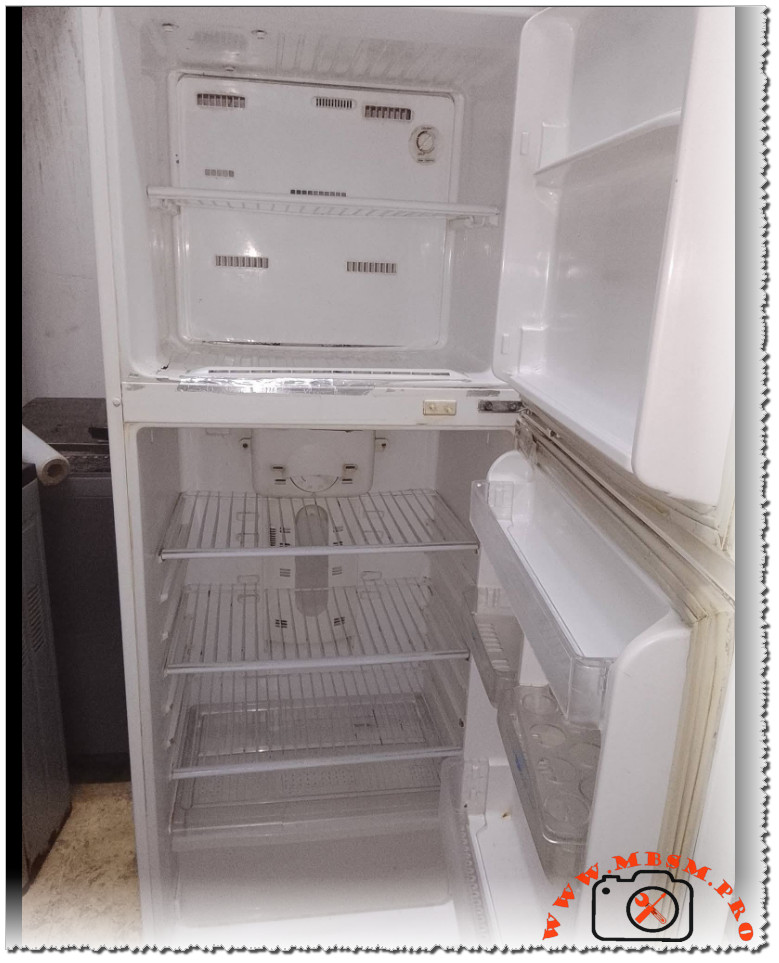
Electrostar positions this 16‑foot series in the standard top‑freezer category, giving households a familiar layout that is easy to organize and clean. The cabinet typically offers roughly 315–330 liters of gross capacity, split between a top freezer for frozen food and a larger refrigerator section for fresh produce, drinks and daily ingredients.

  • Adjustable wire or glass shelves let users reconfigure the interior for tall pots, trays or beverage bottles as needed.
  • A full‑width vegetable crisper maintains higher humidity for fruits and vegetables, limiting dehydration over long storage periods.
  • Door balconies provide space for sauces, jars and large bottles so that the main shelves stay free for bulkier items and prepared dishes.

Cooling system and compressor power (HP & W)

Most 16‑foot Electrostar models are offered in both defrost and No‑Frost versions, but in both cases the “heart” of the system is a low‑horsepower hermetic compressor sized for domestic use. Domestic compressor selection charts show that refrigerators in the 9–13 cubic‑foot (around 283–370 liter) range are normally matched with compressors in the 1/6 to 1/5 horsepower class, consuming about 120–150 watts at rated conditions.

  • A typical 1/6 HP refrigerator compressor corresponds to roughly 120–130 W electrical input, giving enough capacity for a 16‑foot top‑freezer cabinet when paired with an efficient evaporator and insulation package.
  • Independent wattage studies for 16–20 cubic‑foot top‑freezer fridges show average running power between 100 and 400 W depending on design and age, placing a modern Electrostar 16‑foot model toward the lower end of that span when the thermostat cycles the compressor on and off.
  • Some Electrostar variants use branded compressors such as Panasonic, chosen for quieter operation and better efficiency in high‑ambient environments.

Technical snapshot

Parameter Typical Electrostar 16‑ft value
Total capacity About 315–330 liters.
Configuration Top‑mount freezer, two doors.
Compressor nominal power Around 1/6 HP (≈125 W) for domestic use.
Average running wattage Roughly 100–300 W depending on load and ambient temperature.
Cooling system Static defrost or No‑Frost forced air, model‑dependent.
Energy class Designed for A or A+ energy labels in regional markets.

Everyday performance and reliability

Electrostar’s 16‑foot refrigerators are built for continuous operation in regions where high ambient temperatures put extra stress on compressors and condensers. The relatively small 1/6 HP‑class compressor may sound modest, but in a well‑insulated cabinet it provides ample cooling capacity while keeping noise and energy bills under control for most households.

  • Mechanical thermostat controls make it simple for users to adjust internal temperatures without dealing with complex digital menus, and they are easy for technicians to diagnose and replace.
  • Service networks in many Arab and North‑African markets stock compatible compressors, starting components and thermostats, which reduces downtime in case of failure and extends the working life of older units.
  • When paired with good ventilation around the condenser and regular cleaning, the compressor can run for many years with stable suction and discharge pressures, even under heavy daily usage.

Maintenance tips to protect the compressor

Proper maintenance does not just improve hygiene; it also directly protects the small‑horsepower compressor from unnecessary strain and overheating.

  • Keep at least several centimeters of clearance around the back and sides of the refrigerator so that condenser coils can reject heat effectively, preventing the compressor from running at high head pressure for long periods.
  • For defrost models, manually defrost the freezer whenever frost thickness exceeds about 3–5 mm, since thick ice forces the compressor to run longer cycles to pull down temperature.
  • Check door gaskets regularly for cracks or gaps; a poor seal allows warm air infiltration, leading to more frequent compressor starts and higher electricity use.

Helpful external resources

Technicians and advanced users who want deeper technical data can turn to independent references and brand‑agnostic manuals.

  • A general household refrigerator user manual in PDF format explains compressor operation, wattage ratings, thermostat settings and recommended clearances that apply to most top‑freezer models.
  • Mbsmgroup also publishes technical sheets and compressor data for various Electrostar units, including power ratings and application notes that help match HP and wattage when selecting replacements.

Example image and catalog links

  • Safe product galleries of Electrostar refrigerators, including 315‑liter and 328‑liter models, are available through regional appliance retailers and show external design, interior shelving and control layouts similar to the 16‑foot series.
  • Technical documentation and catalog PDFs for domestic refrigeration compressors outline HP classes, wattage and typical cabinet sizes, providing useful guidance when evaluating or replacing the compressor in a 16‑foot fridge.
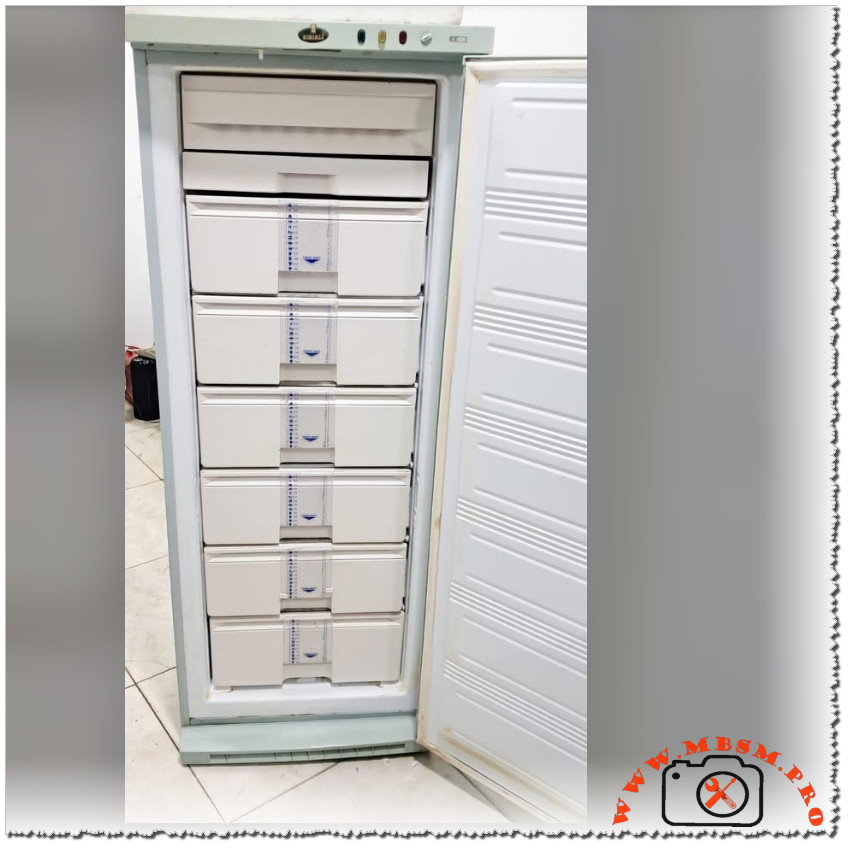
Kiriazi 6‑Drawer No‑Frost Upright Freezer: Complete Technical and Service‑Level Overview

Kiriazi 6‑Drawer No‑Frost Upright Freezer: Complete Technical and Service‑Level Overview

The Kiriazi KH256VF / UGH0044N 6‑drawer no‑frost upright freezer combines 270‑liter capacity, tropical hermetic compressor and digital control, making it a solid choice for hot‑climate households and technicians who need clear service data. Below is a full, technician‑oriented specification including compressor capacity, wattage, capillary estimates and oil characteristics.


Main cabinet specifications

Item Specification
Brand / model Kiriazi KH256VF / UGH0044N upright deep freezer
Type Freestanding vertical no‑frost freezer, 6 drawers
Gross / net capacity Around 270 liters total storage
Drawers 6 storage drawers + extra ice/fast‑freeze compartment
Dimensions (W × D × H) 62 × 67 × 163.6–164 cm
Cooling system Forced‑air evaporator, automatic no‑frost fan system
Features Fast‑freeze mode, digital display, open‑door alarm, info labels per drawer
Insulation High‑efficiency polyurethane, thickness about 8–10 cm
Cabinet material Anti‑rust steel outer body with plastic inner liner

Electrical and performance data

Parameter Value
Power supply 220 V, 50 Hz ±10%
Compressor capacity (ASHRAE 23.3 °C) 156 W tropical hermetic compressor
Approx. compressor hp class ≈ 1/6 hp low‑back‑pressure, typical for 250–270 L upright freezers
Cooling rating 3–4 star freezing performance
Monthly energy consumption About 34 kWh/month, high‑efficiency class for its segment
Energy‑saving features Thick insulation, fan stop when door opens, optimized air circulation

The 156 W ASHRAE rating places the compressor firmly in the 1/6 hp category, widely used for domestic vertical freezers because it balances pull‑down speed with low running consumption.


Refrigeration circuit: refrigerant, capillary and oil

Official retail pages specify cabinet and compressor wattage but not full circuit details; the following values combine what is published for KH256VF with standard practice for similar Kiriazi no‑frost systems.

Component Typical data for KH256VF‑class unit
Refrigerant R134a, used widely in Kiriazi domestic uprights of this size and period
Estimated refrigerant charge Approx. 120–150 g R134a (230 L Kiriazi uprights use ≈120 g; 270 L models usually fall slightly higher)
Expansion device Capillary tube feeding a forced‑air evaporator (no‑frost)
Practical capillary range (service reference) Internal diameter about 0.7–0.8 mm with 2.5–3.0 m length for 1/6 hp R134a low‑temperature application; exact factory size is not published and should be copied from the original tube when available.​​
Compressor type Tropical hermetic LBP compressor, designed for high ambient temperatures
Recommended oil type POE (polyolester) oil for R134a domestic compressors, viscosity ISO 22–32
Typical oil quantity Around 200–300 ml for 1/6 hp hermetic can, exact value depends on compressor model plate​​

Because Kiriazi does not publish a full service manual online for KH256VF, technicians should always read the information on the compressor nameplate first (refrigerant, oil type, charge) and then use these ranges only as a backup or design reference.


Practical service notes for technicians

  • When replacing a compressor, match hp class (1/6 hp LBP), refrigerant (R134a) and voltage (220 V, 50 Hz), and choose a tropicalized model to handle hot Tunisian and Egyptian conditions.
  • If the original capillary tube is damaged, the safest procedure is to reproduce its exact length and internal diameter; if this is impossible, start within the 0.7–0.8 mm × 2.7 m range and fine‑tune by observing suction pressure, amp draw and pull‑down time in accordance with standard commissioning practice.​
  • Always evacuate to deep vacuum and weigh in the charge whenever the system is opened, especially with POE oil, which is highly hygroscopic and sensitive to moisture contamination.

This table‑driven overview gives a field‑ready technical picture of the Kiriazi 6‑drawer no‑frost upright freezer, allowing you to plan repairs, retrofits or comparative evaluations with similar vertical deep‑freezer models.


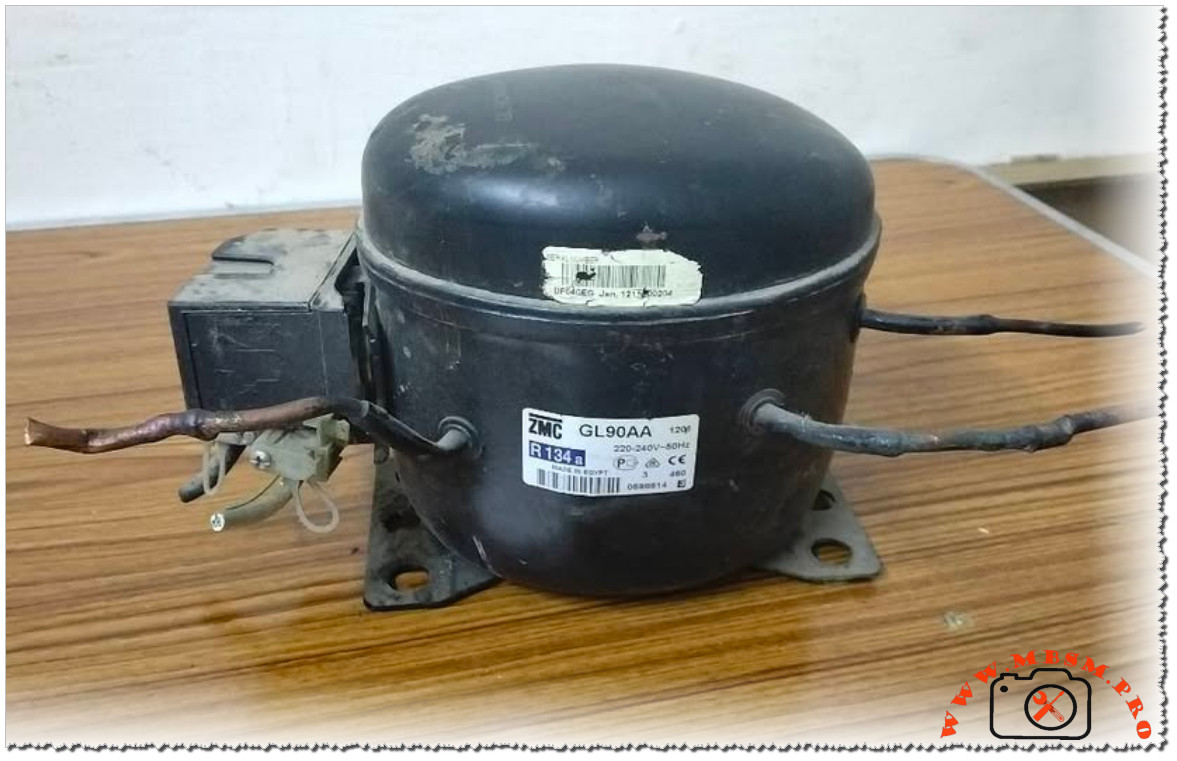
Zanussi 16 Cubic Feet Refrigerator Compressor GL90AA – 1/4 HP R134a

Zanussi 16 Cubic Feet Refrigerator Compressor GL90AA – 1/4 HP R134a

A 16 cubic feet Zanussi refrigerator typically relies on the GL90AA hermetic compressor, a compact piston unit designed for R134a and low back pressure applications in domestic cooling. This 1/4 HP motor delivers cooling capacities from roughly 165 W up to around 346 W depending on evaporating conditions, which is enough to keep a family‑size fridge and freezer stable even in hot kitchens.

Technical profile of the GL90AA

The GL90AA is manufactured under the ZMC/Cubigel/Electrolux ZEM family and built specifically for 220–240 V, 50 Hz single‑phase supply used in markets such as North Africa and Europe. It operates in a low back pressure range from about −35 °C to −10 °C evaporating temperature, making it suitable for the freezer section and the fresh‑food evaporator in combined refrigerators.

Inside its welded shell, a single‑cylinder piston with a displacement of about 9.08–9.09 cm³ compresses the R134a, driven by an RSIR motor controlled by a start relay and overload protector. Static shell cooling, ester oil lubrication (ISO VG 19 or ISO VG 32 depending on version) and a 43 °C maximum ambient rating help the compressor maintain performance and reliability in warm climates where kitchen temperatures can be high.

Main specifications table

Parameter Typical GL90AA value Practical meaning
Application Low Back Pressure, R134a. Designed for household fridges and freezers.
Nominal power 1/4 HP. Common rating for 14–16 ft³ refrigerators.
Cooling capacity ≈165–224 W at low evaporating temps; up to ≈330–346 W near −10 °C; some catalogs give 407 W at −10 °C in optimized conditions. Covers the needs of a 16 ft³ Zanussi fridge‑freezer.
Displacement 9.08–9.09 cm³. Defines the volume of gas compressed each stroke.
Voltage / frequency 220–240 V, 50 Hz; voltage range about 187–264 V. Compatible with residential grids in Tunisia, Egypt and Europe.
Motor type RSIR (some GLY90 variants CSIR). Uses start relay and overload protector.
Max ambient 43 °C. Important for hot‑climate kitchens and workshops.
Oil type / charge Ester oil, about 295–345 cm³. Requires clean, dry circuit without mineral oil.

Why Zanussi chooses the GL90AA for 16 ft³

A 16 ft³ Zanussi refrigerator, usually in the 370–425 liter range, combines a generous fresh‑food compartment with a freezer designed to reach well below −18 °C. To maintain those temperatures under frequent door openings, the system needs a compressor that can provide solid capacity at low evaporating temperatures without excessive energy consumption or noise, especially in small apartments and family homes.

With its 1/4 HP rating, 9 cm³ displacement, and low back pressure characteristics, the GL90AA matches the thermodynamic design of these cabinets, particularly when paired with a correctly sized capillary tube, condenser and evaporator set. Spare‑parts distributors across Europe and the MENA region list GL90AA explicitly as original or equivalent equipment for many Electrolux–Zanussi refrigerator models, confirming its position as a standard solution for this capacity segment.

Application matching table

Appliance feature Requirement for Zanussi 16 ft³ How GL90AA fits
Net volume Around 370–425 L (≈14–16 ft³). Cooling capacity up to ≈346–407 W covers this volume in R134a systems.
Refrigerant R134a sealed system. GL90AA is optimized and rated only for R134a.
Ambient class Up to about 43 °C. Compressor carries a 43 °C max ambient rating.
Energy and noise Domestic, continuous duty. RSIR design and static cooling balance efficiency and cost.

Installation and service considerations

Technicians replacing a Zanussi 16 ft³ compressor with a GL90AA must observe best practices to protect the new unit and the customer’s investment. The old R134a charge should be fully recovered, and the filter‑drier replaced with a compatible R134a/POE model to keep moisture and acids under control. Tubes should be cut and brazed under a small nitrogen flow to prevent oxide formation inside the lines, and suction/discharge diameters given in the technical sheet (about 6.5 mm suction, 4.9 mm discharge) should be respected to maintain design capacity and good oil return.

Because the GL90AA uses ester oil, any contamination with mineral oil from previous generations of compressors must be avoided; if the old system contained mineral oil, thorough flushing or component replacement is recommended. After brazing, the circuit needs a pressure test, deep evacuation to below roughly 500 microns, and precise charging with the mass of R134a specified by Zanussi to secure low noise, correct suction superheat and long compressor life.


Samsung front‑load tub front half assembly: dimensions, components and replacement guide

Samsung front‑load tub front half assembly: dimensions, components and replacement guide

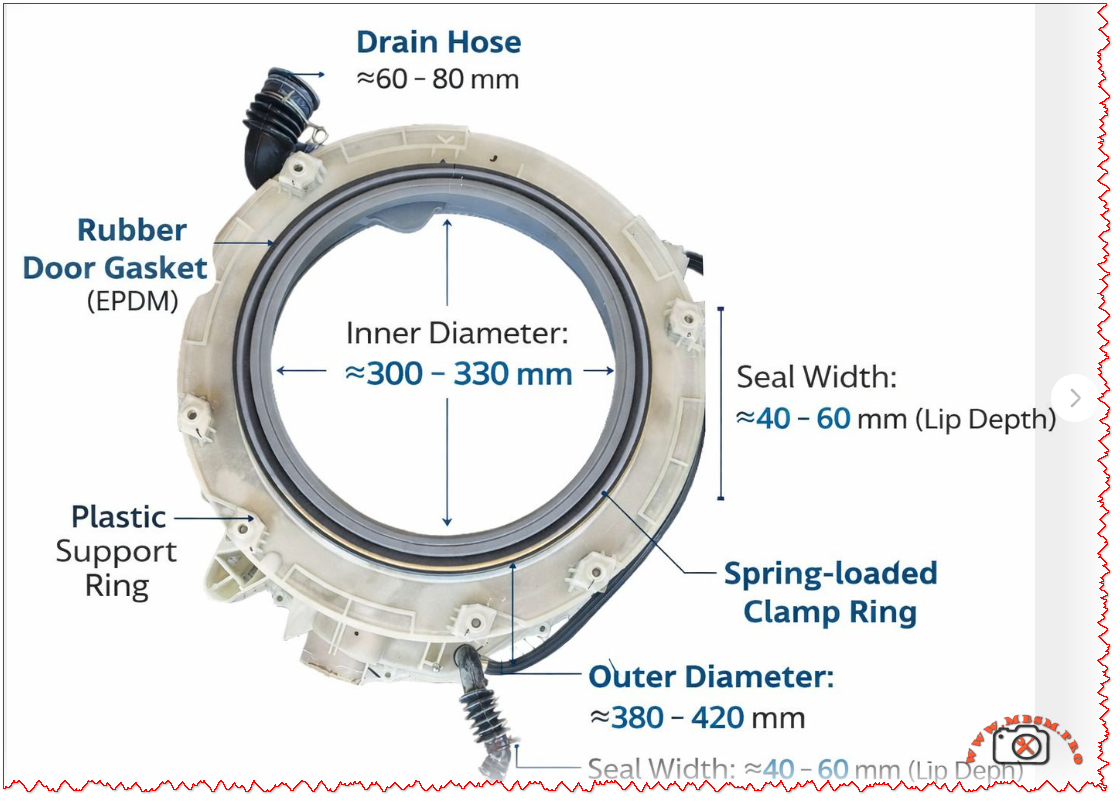
The tub front half assembly on Samsung front‑load washing machines combines the plastic support ring, EPDM rubber door gasket, drain hose and spring‑loaded clamp into one critical sealing unit between the drum and the cabinet front. It defines the loading opening (≈300–330 mm inner diameter) and overall front tub size (≈380–420 mm outer diameter), while controlling water drainage and leak‑free operation during high‑speed spin cycles.


Main components

  • Plastic support ring (semi tub front)
    The plastic semi tub front forms the rigid structure of the assembly and bolts to the rear half of the outer tub, typically listed in Samsung parts lists as “ASSY SEMI TUB FRONT”. It carries mounting points for the hinge area, latch, front panel screws and hose connections that surround the loading opening.
  • Rubber door gasket (EPDM)
    The grey EPDM door gasket works as a flexible diaphragm between the rotating stainless drum and the fixed plastic tub, absorbing vibration and preventing splashes through the door opening. Its lip depth or seal width is typically about 40–60 mm, providing a deep channel that guides water back into the tub instead of toward the door glass.​
  • Spring‑loaded clamp rings
    Two metal clamps are usually used: an inner clamp secures the gasket to the plastic tub, and an outer spring clamp band fixes it to the cabinet front panel. The outer band relies on a strong tension spring so that the elastomer lip remains compressed even under drum imbalance and door vibration at high spin speeds.
  • Drain hose connection
    A molded drain hose stub integrated into the front tub section channels residual water away from the gasket area and lower sump, typically matching Samsung’s EPDM drain hoses specified in spare‑parts diagrams. Hose internal diameters in this class of machines are commonly within 60–80 mm at the large bellows connection shown in the image, ensuring rapid evacuation and reducing standing water that could cause odors.​

Key dimensions from the assembly

The illustration corresponds to a common size range used on 7–9 kg Samsung front‑loaders, and the measurements help technicians and spare‑parts sellers match non‑OEM or compatible tubs and door boots.

Parameter Typical range (mm) Technical role
Inner opening diameter ≈300–330 Defines usable drum access and must match door glass and hinge geometry.
Outer tub front diameter ≈380–420 Matches cabinet cut‑out and rear tub half for correct bolt alignment.
Seal width / lip depth ≈40–60 Controls how deeply the gasket overlaps the drum rim and door glass to avoid leaks.​​
Drain‑hose connector length ≈60–80 Provides sufficient fall for water to clear the boot and flow to the pump housing.

Such dimensional ranges also influence replacement choices when original part numbers are no longer available, allowing cross‑referencing by diameter and seal width.


Typical failure modes and maintenance

  • Leakage and gasket damage
    Front leaks usually come from cuts, hardening or mold damage on the EPDM gasket lip, especially around the lower section where coins or sharp objects scrape during spin. Early signs include water tracks on the front panel, standing water in the door boot and musty odors after a cycle.​
  • Clamp loosening or mis‑seating
    If the spring clamp is not seated evenly in its groove after service, the boot can pull away from the cabinet, producing intermittent leaks only on high‑load or high‑speed programs. Corroded or stretched bands should always be replaced with genuine door‑seal clamp kits to maintain uniform radial pressure.​
  • Blocked drain hose connection
    Lint, detergent residue and small objects can partially block the drain hose stub shown at the bottom of the assembly, increasing water retention inside the boot and generating mold growth. Routine cleaning of the filter housing and periodic inspection of the lower hose path reduces these problems and extends component life.​

Replacement and selection tips

  • Identifying the correct part
    The fastest method is to read the full model code from the washer rating label and search for the matching “ASSY SEMI TUB FRONT” or “door boot / diaphragm” in Samsung’s illustrated parts lists or reputable spare‑parts catalogues. Where the exact code is unavailable, technicians can use the inner and outer diameters plus seal width shown in the image to select compatible universal boots within the 300–330 mm and 380–420 mm ranges.
  • Installation considerations
    When replacing the tub front half or door boot, manufacturers recommend removing the front panel, control panel and door lock assembly and carefully transferring hoses and wiring harness clips to the new ring. The gasket must be aligned to witness marks on the tub, with the drain holes positioned at the lowest point and both inner and outer clamps tightened uniformly to prevent wrinkles.​
  • Professional vs DIY service
    Although many guides and videos demonstrate door‑boot replacement as a do‑it‑yourself repair, full tub front‑half replacement involves heavy lifting and more extensive disassembly and is better performed by experienced technicians or advanced DIY users with proper support stands. For machines still under manufacturer warranty or covered by extended service contracts, any tub replacement should follow Samsung’s official service procedures and part numbers to maintain coverage.


Finder 66.82.8.230.0000 Power Relay: Reliable 30A Solution for HVAC and Industrial Control

Finder 66.82.8.230.0000 Power Relay: Reliable 30A Solution for HVAC and Industrial Control

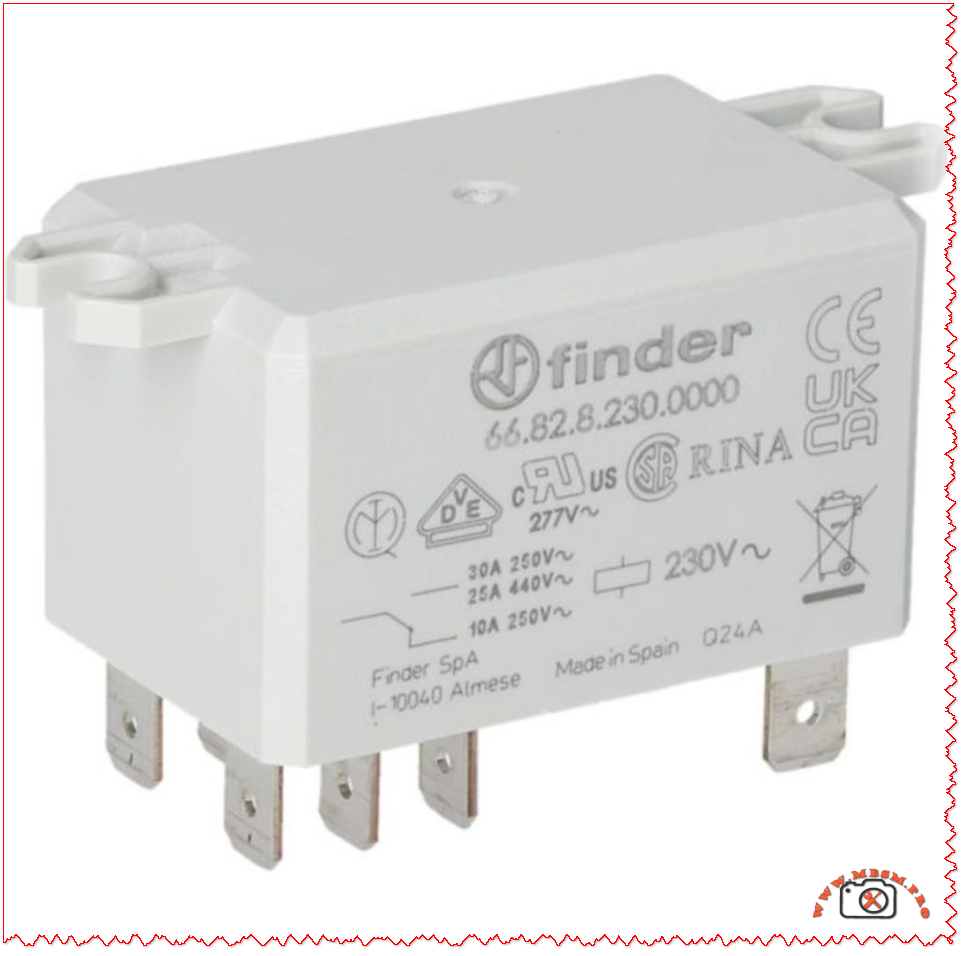
The Finder 66.82.8.230.0000 is a high‑power, flange‑mount relay designed for demanding switching tasks in HVAC, refrigeration and industrial control panels. With a 230 V AC coil and 30 A contact rating, it offers a compact but robust alternative to contactors in many applications.

Product overview

The Finder 66.82 series is a family of 30 A power relays with Faston terminals and reinforced insulation that comply with international safety standards for electrical equipment. The 66.82.8.230.0000 variant pictured is a DPDT (2 changeover contacts) relay with a 230 V AC coil, suitable for single‑phase loads up to 440 V AC.

Mounted on a panel via integrated flanges, this relay is widely used in OEM machines, control panels and HVAC units where reliable separation between the control circuit and the power circuit is essential. Its compact housing and Faston 6.3 × 0.8 mm connections make wiring quick and maintenance friendly for installers and service technicians.

Key electrical specifications

For designers and technicians, the most critical data are contact rating, coil voltage and insulation performance. The table below summarizes the main technical characteristics of the Finder 66.82.8.230.0000 as presented in distributors’ listings and the manufacturer’s catalog.

Specification Value Notes
Manufacturer / Series Finder 66.82 Power relays 30 A series.
Coil voltage 230 V AC Standard mains control voltage.
Contact configuration DPDT (2CO) Two changeover contacts.
Max. switching current 30 A Per contact set for AC loads.
Max. switching voltage 440 V AC For power applications.
Terminals Faston 6.3 × 0.8 mm For push‑on connectors.
Mounting Flange mount For panel or chassis mounting.
Insulation Reinforced between coil and contacts According to EN 60335‑1.

These values make the relay particularly suitable for switching compressors, fan motors, heating elements and resistive or slightly inductive loads in HVAC and refrigeration systems.

Typical applications in HVAC and industry

In real‑world installations, the Finder 66.82.8.230.0000 often replaces bulkier contactors in medium‑power circuits where panel space and cost must be optimized. Common uses include:

  • Switching single‑phase compressors in cold rooms, display cabinets and small chillers up to 30 A at 230–250 V AC.
  • Controlling electric heaters, defrost elements and fan banks in air‑handling units and rooftop HVAC packages.
  • Interfacing low‑power thermostats, PLC outputs or electronic boards with mains loads in industrial machinery and building automation.

Because it provides reinforced insulation between coil and contacts, the relay is suitable for applications governed by household and similar equipment standard EN 60335‑1, which is frequently referenced in HVAC and appliance design. This insulation level enhances safety where user‑accessible electronics coexist with high‑voltage power circuits.

Installation and safety guidelines

When integrating this relay into a control panel, technicians should follow the wiring diagrams supplied in the Finder datasheet and the equipment manufacturer’s instructions. Faston terminations must be fully mated with correctly sized push‑on connectors, and conductors should be chosen according to the 30 A rating and ambient temperature in the enclosure.

The relay must be mounted on a flat surface using the dedicated flanges, ensuring adequate clearance for cooling and respecting creepage distances to nearby live parts. As with all power components, switching capacity must be derated for highly inductive loads, frequent cycling or elevated temperatures, conditions that are common in heavy‑duty HVAC duty cycles.


Tecumseh CAJ9480T R22 Hermetic Compressor: Complete Technical Guide for Professionals

Tecumseh CAJ9480T R22 Hermetic Compressor: Complete Technical Guide for Professionals

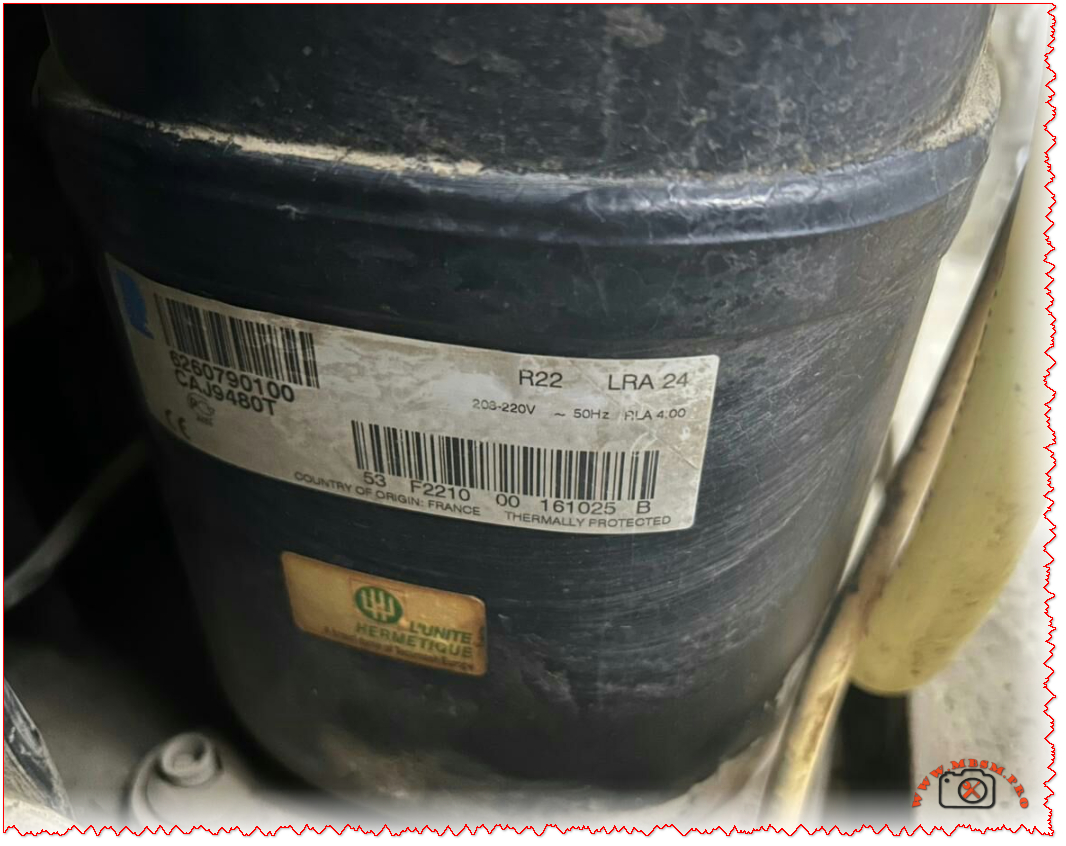
The Tecumseh / L’Unité Hermetique CAJ9480T is a fully hermetic reciprocating compressor designed for commercial refrigeration systems operating with R22 and compatible retrofit refrigerants. Widely used in small cold rooms, display cabinets and compact condensing units, it runs on 220–240 V single‑phase, 50 Hz power and delivers 5/8 HP with around 1.97 kW of cooling capacity at EN12900 conditions.

General description

This model belongs to the CAJ family, Tecumseh’s workhorse range for medium and high back‑pressure refrigeration applications such as positive‑temperature cold rooms and commercial coolers. It is a hermetic piston compressor using a CSR motor (capacitor start, capacitor run), giving high starting torque and stable operation on standard single‑phase networks.

Manufactured in France under the L’Unité Hermetique brand, the CAJ9480T combines compact size, good efficiency and a robust mechanical design, which explains its popularity among installers and service companies like Mbsmgroup, Mbsm.pro and mbsmpro.com.

Main technical specifications (with HP and W)

The table below consolidates key data from Tecumseh specification sheets and trusted distributors.

Specification CAJ9480T value (R22, 50 Hz)
Refrigerant R22 (and some approved retrofits such as R438A on specific codes)
Application range Medium / high back pressure (commercial refrigeration)
Nominal horsepower (HP) 5/8 HP (0.625 HP)
Nominal cooling capacity (W) ≈ 1 968 W at EN12900: 220 V, 50 Hz, +5 °C evap / +50 °C cond
Input electrical power (W) ≈ 780–800 W at the same EN12900 rating point
Displacement 15.2 cm³/rev
Supply voltage 220–240 V, 1‑phase, 50 Hz
Voltage range 187–242 V (50 Hz)
Rated load amps (RLA, 50 Hz) ≈ 4 A
Locked rotor amps (LRA) ≈ 24 A
Oil type / quantity Synthetic alkylate or mineral, approx. 475–887 cm³ depending on version
Net weight ≈ 19–22 kg

The nameplate visible in your photo shows “R22 – LRA 24 – 203–220 V – 50 Hz – RLA 4.00”, matching these published values and confirming a single‑phase CAJ9480T produced in France.

Typical applications and field use

Because of its capacity, voltage and starting characteristics, the CAJ9480T fits many everyday refrigeration jobs.

  • Small cold rooms for butchers, restaurants, bakeries and mini‑markets originally charged with R22.
  • Vertical display cabinets, reach‑in fridges and refrigerated counters using factory‑built condensing units.
  • Custom‑built condensing units and mini‑packs produced by specialists such as Mbsmgroup, Mbsm.pro and mbsmpro.com, especially where reliable 5/8 HP performance is required on 230 V single‑phase.

Its CSR motor and high starting torque help the compressor start under tougher conditions, such as long pipe runs or marginal supply voltage.

Installation and maintenance best practices

Correct installation and servicing are essential to protect this compressor and keep systems efficient.

  • Flush and evacuate the circuit carefully, and always install a new filter‑drier when replacing a failed R22 compressor.
  • Use the start and run capacitors and potential relay recommended by Tecumseh (for example, 88 µF start and 15 µF run on the CAJ9480T‑FZ code) and follow the official wiring diagram.
  • Verify charge, suction superheat and condensing temperature so operation stays within Tecumseh’s performance envelope.
  • For R22 retrofit projects, respect manufacturer guidance on compatible replacement refrigerants and oil changes to avoid lubrication and overheating issues.

Working with trusted suppliers such as Mbsmgroup and its online platforms helps ensure genuine Tecumseh parts, correct electrical components and updated technical information.